Situation Summary
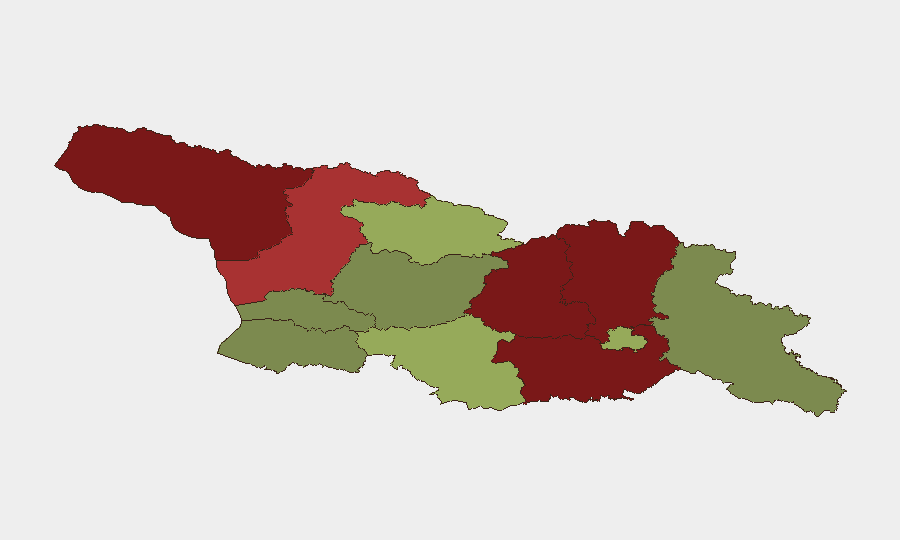
Georgia remains at global threat rank #97 with a composite threat score of 18 and no tracked discrete security events in the current measurement window. Political instability and sustained protest activity dominate the security picture in Tbilisi, now in its 666th consecutive day, driven by demands for political change, release of detained activists, and alignment with Euro-Atlantic policy. The broader risk landscape remains heavily concentrated in the four northern and western regions—Abkhazia, Shida Kartli, Lower Kartli, and Mtskheta-Mtianeti—where geopolitical tensions and territorial disputes sustain elevated threat scores. Corporate and duty-of-care teams operating in Georgia should maintain heightened situational awareness in the capital and northern regions while monitoring security sector instability.
Key Developments
- Tbilisi, 21 September: Pro-European demonstrators gathered at Parliament; coordinated parallel protests were reported in Kutaisi and Batumi, signaling geographic spread of political activism.
- Tbilisi, 22–24 September: Sustained protest activity continued for the 664th–666th consecutive day near Parliament and Tbilisi City Hall, with consistent demands for political prisoner release, repeal of restrictive legislation, and foreign-policy reorientation.
- Tbilisi, 23 September: A senior counterintelligence official departed; this represents the fourth departure of a senior security/intelligence leader in 18 months, indicating continued organizational instability within Georgia's security apparatus.
- Tbilisi, 24 September: Ongoing parent, teacher, and student protests continued over the closure of Public School No. 21 due to structural safety concerns; the Education Ministry indicated imminent reopening.
- Tbilisi, 26 September: A pro-European "Saturday march" was held in the capital, featuring messaging on disputed territories ("Abkhazia is Georgia") and expressions of solidarity with Ukraine, reinforcing the geopolitical dimension of domestic political mobilization.
Highest-Risk Areas
Abkhazia (risk 95) and three contiguous northern/central regions—Shida Kartli (88), Lower Kartli (85), and Mtskheta-Mtianeti (82)—drive Georgia's sub-national risk profile. These areas remain subject to de facto territorial control, frozen-conflict dynamics, and historical tensions. Samegrelo-Upper Svaneti (78) and Samtskhe-Javakheti (48) represent secondary concern zones. Tbilisi itself ranks seventh at risk 45, reflecting localized political unrest and security-sector instability rather than armed conflict or mass violence. Organizations with personnel or supply chains in the north and west should prioritize contingency planning; those operating in Tbilisi should treat sustained protest activity and intelligence-community transitions as operational friction factors.
How GeoBit Would Assist
Security teams in Georgia benefit from AOI Monitoring & Early Warning capabilities to track protest dynamics, security-sector movements, and developments in high-risk northern regions with persistent alerting and temporal analysis. Election Monitoring and Regime-Stability Search capabilities provide early signals of political fragmentation and institutional stress within the security services. Conflict & Military tracking and Routing & Network Analysis support contingency planning for personnel in disputed and high-risk regions, enabling alternative route planning and border-security assessment if conditions deteriorate.
7-Day Outlook
Political protest activity is expected to remain elevated in Tbilisi and secondary cities through early October. Security-sector personnel transitions and the absence of discrete armed-conflict or crime events suggest the threat remains concentrated in political friction rather than kinetic escalation. North-south regional risk disparity will persist; teams operating north of Tbilisi should maintain defensive posture and continue contingency review.
Highest-Risk Areas — Ranked
| # | State / Region | Risk |
|---|---|---|
| 1 | Autonomous Republic of Abkhazia | 95 |
| 2 | Shida Kartli | 88 |
| 3 | Lower Kartli | 85 |
| 4 | Mtskheta-Mtianeti | 82 |
| 5 | Samegrelo-Upper Svaneti | 78 |
| 6 | Samtskhe-Javakheti | 48 |
| 7 | Tbilisi | 45 |
| 8 | Racha-Lechkhumi and Kvemo Svaneti | 42 |
| 9 | Kakheti | 38 |
| 10 | Autonomous Republic of Adjara | 35 |
| 11 | Imereti | 32 |
| 12 | Guria | 28 |
Sources
Previous Weekly Briefs
A new Georgia brief is written every Monday, covering the week — each with its own risk map and downloadable CSV. Use the calendar to go further back.
- September 21, 2026
- September 14, 2026
- September 7, 2026
- September 3, 2026
- September 2, 2026
- September 1, 2026
- August 31, 2026
📅 Browse past briefs by calendar →
Highlighted days have a brief. Tap a day for that day's map & analysis, or “csv” for that day's dataset ($5).
Atlas — our AI intelligence desk — emails them this snapshot personally. Nothing else, no list.