Situation Summary
Iran is experiencing a critical succession period following the death of Ayatollah Ali Khamenei, with funeral processions underway in Tehran and major cities under heightened IRGC security. The transition to a new Supreme Leader—reported to be Mojtaba Khamenei—is occurring amid regional tensions with Israel, the UAE, and Yemen, alongside domestic political instability. Tehran airspace has been restricted for the funeral window, and the IRGC has issued explicit public warnings against any external military action, signaling elevated threat perception and operational readiness.
Key Developments
- 2026-07-05 · Tehran · Funeral Processions & Airspace Closure: Large-scale funeral processions for Ayatollah Khamenei are underway across Tehran and other major cities; civil airspace over Tehran has been sealed for the duration, with direct implications for commercial aviation scheduling and travel routing.
- 2026-07-05 · Tehran · IRGC Strategic Warning: The Islamic Revolutionary Guard Corps issued one of its most explicit public warnings regarding potential external strikes during the succession window, indicating elevated military posture and threat-response readiness across air defense and coastal systems.
- 2026-07-05 · Nationwide · Leadership Succession Uncertainty: Mojtaba Khamenei has not appeared publicly since the strike that killed his father; multiple unconfirmed reports suggest possible wounding, creating a governance vacuum during a period of active regional conflict and domestic demonstrations.
- 2026-07-04 · Iran–Israel Nexus · Threat Escalation: Iran issued formal threats toward Israel; Israel simultaneously conducted aerial weapons activity against Tehran, indicating active military exchange and no de-escalation pathway in the near term.
- 2026-07-04 · Regional Diplomatic Fracture: The UAE formally rejected Iranian positions, and Yemen's Houthi-aligned forces issued disapproval of Iran, suggesting erosion of Iran's regional alliance structure at a moment of internal vulnerability.
- 2026-07-06 · Nationwide · Security Sweep & Arrests: Arrest and detention activity was recorded; concurrent investigation orders suggest internal security operations, possibly related to succession security or suppression of anti-government sentiment.
Highest-Risk Areas
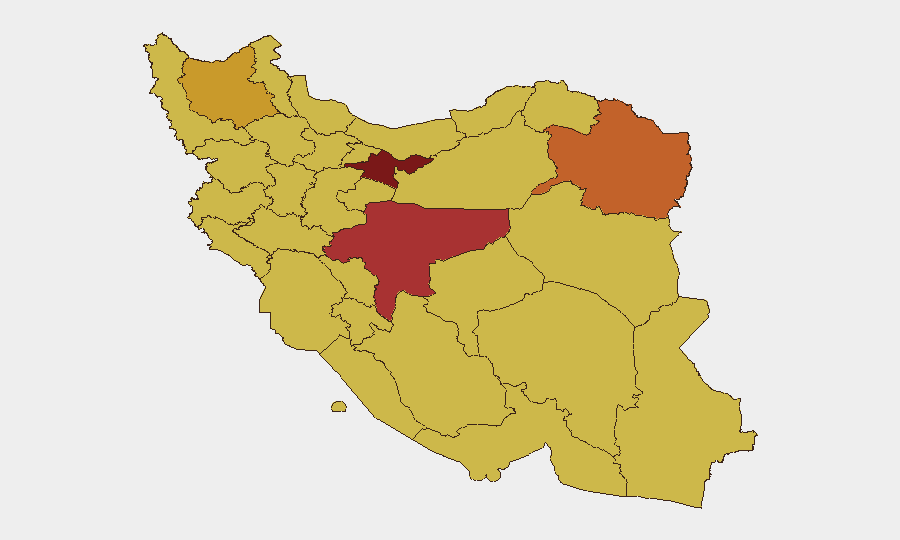
Tehran Province (98.7) dominates the risk landscape due to the ongoing succession, funeral operations, airspace restrictions, and concentration of government, military, and diplomatic infrastructure. Isfahan (79), Razavi Khorasan (73.7), and East Azerbaijan (72.9) carry elevated risk from military presence, border proximity, and regional volatility. The southern corridor—Hormozgan, Fars, and Kerman provinces—faces compounded risk from maritime chokepoint exposure (Strait of Hormuz) and Israeli strike capability. Collectively, these provinces account for critical infrastructure, population density, and military concentration, making them priority monitoring zones for corporate teams.
How GeoBit Would Assist
Security teams operating in Iran should deploy AOI Monitoring & Early Warning for critical facilities in high-risk provinces, coupled with Intel Sweep and X/Twitter & Telegram OSINT to track official statements, military signaling, and succession developments in real time. Aviation tracking and routing & network analysis capabilities are essential for travel teams navigating airspace restrictions and alternative ground routes. Regime-stability search and network & actor analysis will help assess the durability of the succession transition and identify secondary leadership figures and factional alignments that may affect operational security.
7-Day Outlook
The funeral period (estimated 3–5 days) will maintain elevated military readiness and restricted airspace. Leadership consolidation around Mojtaba Khamenei is unlikely to be publicly confirmed within 7 days; governance uncertainty will persist. Regional military activity with Israel is expected to continue or escalate, with no clear off-ramp; corporate teams should assume sustained operational disruption and elevated personal security risk across all provinces.
Highest-Risk Areas — Ranked
| # | State / Region | Risk |
|---|---|---|
| 1 | Tehran Province | 98.7 |
| 2 | Isfahan Province | 79 |
| 3 | Razavi Khorasan | 73.7 |
| 4 | East Azerbaijan Province | 72.9 |
| 5 | Kohgiluye and Buyer Ahmad Province | 69.6 |
| 6 | South Khorasan Province | 69.6 |
| 7 | Hormozgan Province | 69.1 |
| 8 | Fars Province | 68.9 |
| 9 | Kerman Province | 68.8 |
| 10 | North Khorasan Province | 68.7 |
| 11 | Ilam Province | 68.7 |
| 12 | Chaharmahal and Bakhtiyari Province | 68.7 |
Sources
Previous Daily Briefs
A new Iran brief is written every day — each with its own risk map and downloadable CSV. Here's the last week; use the calendar to go further back.
📅 Browse every day by calendar →
Highlighted days have a brief. Tap a day for that day's map & analysis, or “csv” for that day's dataset ($5).
Atlas — our AI intelligence desk — emails them this snapshot personally. Nothing else, no list.