Situation Summary
Libya is experiencing a sharp escalation of civil unrest driven by severe, prolonged electricity shortages—reaching 12–14 hours daily during an active heatwave—compounded by fuel scarcity and inflation. Protests have evolved from service-delivery complaints into politically destabilizing demands for removal of the Government of National Unity, with roadblocks and infrastructure occupation spreading across the western coastal belt. A newly announced Interior Ministry security accord attempts to stabilize critical sites (airports, borders, Central Bank) through armed-group cooperation, but implementation uncertainty and institutional fragility create elevated risk of inter-factional clashes and potential institutional breakdown.
Key Developments
- Tripoli, 1 August: Youth-led roadblocks and tyre fires across central Tripoli (Corniche, Second Ring Road, Janzour) caused severe traffic congestion and partial closure of major arteries in protest at electricity cuts exceeding 12 hours in some districts. Social-media verification confirms multiple fire sites and blocked junctions.
- Western coastal belt (Zawiya, Zanzour, Bani Walid), 1 August: Simultaneous demonstrations and roadblocks spread beyond Tripoli, with activists blocking roads and burning tyres to protest power cuts, gas shortages for power stations, and 67% black-market diesel price increases (3 to 5 Libyan dinars/liter). Activist calls to halt gas pipeline exports to Italy until domestic supply improves gained traction.
- Mellitah Oil & Gas complex (west of Tripoli), 1 August: Protest pressure and prior occupation of the complex triggered intermittent shutdowns of gas lines feeding power generation; cascading disruptions at El Feel and Wafa oilfields have amplified nationwide electricity shortages and further local unrest.
- Tripoli, 1–2 August: Interior Ministry announced a new security accord with armed groups and security services to jointly secure airports, land borders, government headquarters, and the Central Bank of Libya, with implementation scheduled within 24 hours. UN raised institutional-violence concerns prior to the announcement.
- Tripoli & western municipalities, 1–2 August: Security-force deployments intensified around West Tripoli power station, municipal council buildings, and central intersections; armed units positioned to prevent occupation or storming of key sites.
- Tripoli & regional cities, 31 July–1 August: Protests escalated into overtly political demands, with crowds chanting for removal of PM Abdulhamid Dbeibah's Government of National Unity and calling for removal of authorities in both eastern and western Libya, signaling transition from service grievance to regime-stability risk.
- Tripoli, 1 August: Associated water-supply shortages and price spikes further compounded public anger; residents cited cascading effects of heat, outages, and fuel-cost inflation as drivers of mass protest participation.
Highest-Risk Areas
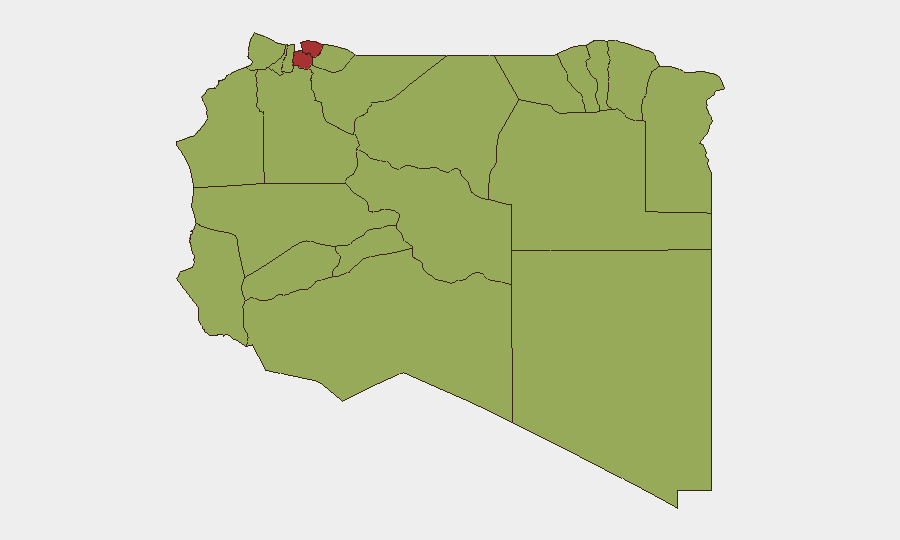
Tripoli and Jafara (risk scores 76.3) are the primary drivers of current instability, hosting the capital's power infrastructure, government institutions, and the densest concentration of armed factions. The western coastal belt—including Zawiya, Zanzour, Bani Walid, and the Mellitah complex—is experiencing simultaneous protest spread and infrastructure disruptions that threaten both service delivery and institutional security. Secondary areas (Nalut, Ghat, Az Zawiya, Murzuq, Kufra) show elevated risk (46.3) likely reflecting regional armed-group activity, border tensions, and supply-chain strain, though current event density remains concentrated in the west.
How GeoBit Would Assist
Security teams should deploy Area-of-Interest Monitoring & Early Warning on Tripoli power stations, airports, the Central Bank, and Mellitah complex to detect escalation in roadblocks, security deployments, or infrastructure occupation in real time. Conflict & Military force-structure tracking and Network & Actor Analysis would clarify armed-group participation in the Interior Ministry accord and assess compliance risk. Sentiment & temporal OSINT analysis (X/Twitter, local media, activist channels) would provide leading indicators of protest radicalization and institutional-violence probability before physical clashes materialize.
7-Day Outlook
The Interior Ministry accord may temporarily stabilize critical infrastructure access through 2–3 August, but non-compliance or factional defection could trigger armed clashes near airports or the Central Bank by mid-week. Power-sector recovery remains uncertain; prolonged outages will sustain protest momentum and political radicalization, increasing risk of uncontrolled demonstrations or institutional seizures by 5–7 August. Duty-of-care teams should assume heightened civil-unrest risk and route/access constraints across Tripoli and coastal cities through at least 10 August.
Highest-Risk Areas — Ranked
| # | State / Region | Risk |
|---|---|---|
| 1 | Tripoli | 76.3 |
| 2 | Jafara | 76.3 |
| 3 | Nalut | 46.3 |
| 4 | Ghat | 46.3 |
| 5 | Baladiyah Surman | 46.3 |
| 6 | Az Zawiya District | 46.3 |
| 7 | Wadi al Shatii | 46.3 |
| 8 | Wadi al Hayaa | 46.3 |
| 9 | Murzuq | 46.3 |
| 10 | Kufra | 46.3 |
| 11 | Nuqat al Khams | 46.3 |
| 12 | Murqub | 46.3 |
Sources
Previous Daily Briefs
A new Libya brief is written every day — each with its own risk map and downloadable CSV. Here's the last week; use the calendar to go further back.
📅 Browse every day by calendar →
Highlighted days have a brief. Tap a day for that day's map & analysis, or “csv” for that day's dataset ($5).
Atlas — our AI intelligence desk — emails them this snapshot personally. Nothing else, no list.