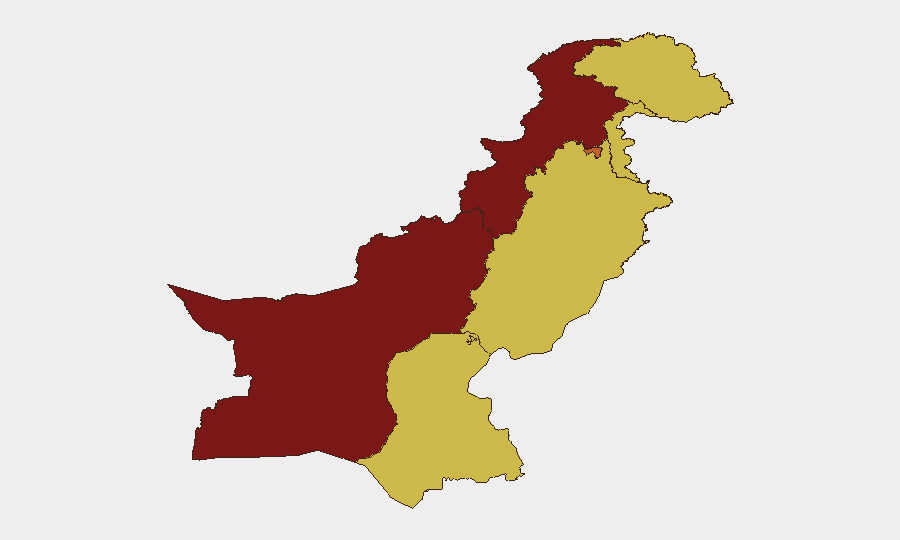
Situation Summary
Pakistan remains at elevated security risk (rank #14 globally, composite score 89), with insurgency as the primary driver across 306 tracked events. The past 48 hours have recorded multiple militant engagements, counter-terrorism operations, and urban unrest incidents concentrated in Khyber Pakhtunkhwa and Balochistan, reflecting an intensifying operational tempo by both security forces and non-state actors. Current trajectory indicates sustained volatility in the near term, particularly in southwestern and northwestern provinces.
Key Developments
- Karak District, Khyber Pakhtunkhwa (13 July 2026): Four militants from the "Commander Zahid" group were killed in an intelligence-based police operation near Khattak Dam following a firefight; subsequent cordon-and-search operations were launched in the district.
- Balochistan Province—Multi-District Operations (10–11 July 2026): Pakistani security forces, supported by military helicopter assets, conducted sustained counter-insurgency operations against an outlawed separatist group, reporting approximately 75 insurgent fatalities following a wave of attacks on troops, police, and civilian targets across the province.
- Islamabad Capital Territory (11 July 2026): Federal authorities initiated a counter-intelligence investigation led by a senior Director General against a Rawalpindi-based entity, signaling heightened internal-security scrutiny in the capital region.
- Quetta and Wider Balochistan (10–11 July 2026): Expanded clearance and search operations continued following earlier multi-day militant attacks that killed dozens of security personnel; these operations form part of a provincial-scale counter-terrorism campaign elevating infrastructure and travel risk across Balochistan.
- Karachi, Sindh (12 July 2026): A violent protest/riot incident linked to a robbery was reported; incomplete casualty data requires verification, though the event reflects ongoing urban crime-related unrest risk in the city.
- National Security Posture (10–15 July 2026): Concurrent with regional operations, authorities issued public statements on security measures and Amnesty International documented concerns over detention and administrative sanctions, indicating elevated scrutiny of both militant activity and internal governance.
Highest-Risk Areas
Khyber Pakhtunkhwa (92.3) and Balochistan (86.3) dominate the sub-national risk profile and are the primary drivers of Pakistan's global rank. Both provinces are experiencing active militant insurgency, with the past 48 hours documenting large-scale counter-terrorism sweeps, reported casualties exceeding 75, and ongoing territorial clearance operations. Islamabad Capital Territory (73.8), despite lower absolute rank, has registered counter-intelligence activity, suggesting heightened alertness to espionage or internal security threats near government and diplomatic facilities. Punjab and Sindh remain elevated (70.5 and 69.5, respectively), reflecting persistent urban crime and protest dynamics, particularly in Karachi and Lahore corridors.
How GeoBit Would Assist
Security teams would deploy AOI Monitoring & Early Warning tools to track militant activity and security-force operations in Balochistan and Khyber Pakhtunkhwa, with persistent alerting on attack patterns and casualty trends. Intel Sweep and OSINT fusion capabilities—leveraging Twitter/Telegram feeds, multi-language sources, and radio SIGINT—would corroborate official reports and detect emerging threats or protest mobilization in urban centers. Routing & Network Analysis would support alternative journey planning and risk-aware logistics for personnel and assets in high-volatility provinces, while Conflict & Military mapping would track force-structure deployments and territorial changes in real time.
7-Day Outlook
Current operational intensity in Balochistan and Khyber Pakhtunkhwa is expected to persist through mid-to-late July as security forces consolidate gains from recent sweeps and militant groups potentially regroup or relocate. Urban unrest in Sindh and Punjab may spike if protest movements escalate or if crime-related incidents intersect with political activity; monitoring social-media sentiment and police deployments will be critical for early warning.
Highest-Risk Areas — Ranked
| # | State / Region | Risk |
|---|---|---|
| 1 | Khyber Pakhtunkhwa | 92.3 |
| 2 | Balochistan | 86.3 |
| 3 | Islamabad Capital Territory | 73.8 |
| 4 | Punjab | 70.5 |
| 5 | Sindh | 69.5 |
| 6 | Azad Kashmir | 63.4 |
| 7 | Gilgit-Baltistan | 62.3 |
Sources
Previous Daily Briefs
A new Pakistan brief is written every day — each with its own risk map and downloadable CSV. Here's the last week; use the calendar to go further back.
📅 Browse every day by calendar →
Highlighted days have a brief. Tap a day for that day's map & analysis, or “csv” for that day's dataset ($5).
Atlas — our AI intelligence desk — emails them this snapshot personally. Nothing else, no list.