Situation Summary
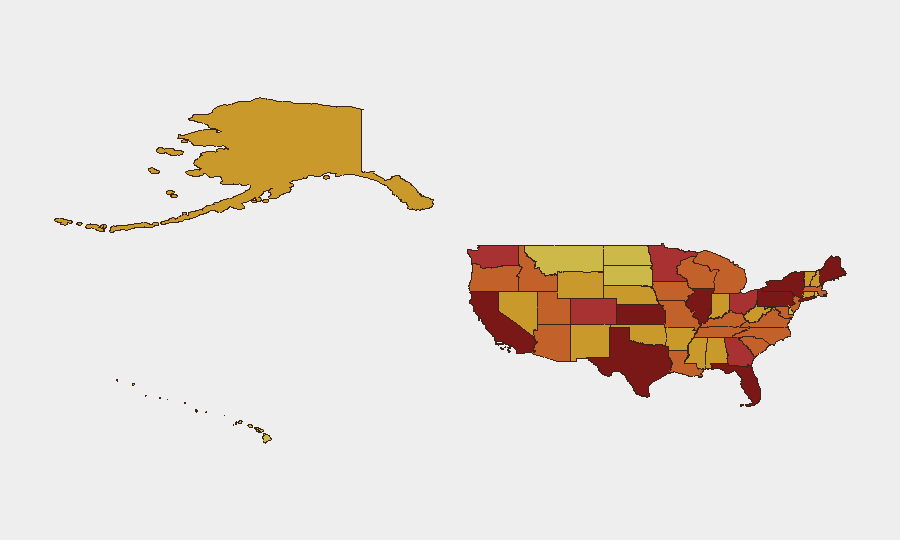
The United States faces a composite threat score of 100 (ranking #2 globally) with 10,206 tracked events, reflecting sustained pressure across conventional and unconventional security domains. Recent 48-hour signals include judicial-system incidents, law enforcement activity, and reported hostage-related events at the federal level, indicating elevated institutional stress. Texas and California dominate the sub-national risk picture, together accounting for a significant portion of tracked threat activity. Trajectory remains elevated with no immediate de-escalation indicators.
Key Developments
- 2026-07-18 · Federal-Level Hostage Event — An incident involving the office of the President was reported; scope and resolution status require urgent clarification through official channels.
- 2026-07-18 · Judicial System Distress — A federal judge became the subject of a "Conventional Military Force" flagged event; simultaneous "Unconventional Violence" event involving an Appeals Court and New Jersey indicates fracture in rule-of-law institutions.
- 2026-07-18 · Florida Judicial Conflict — State vs. judicial actor ("Florida vs JUDGE") marked "Disapprove"; reflects state-level governance friction with potential operational security implications for personnel in the jurisdiction.
- 2026-07-18 · Law Enforcement Action — Police arrest/detain event recorded; insufficient detail to confirm scale or jurisdiction.
- 2026-07-17 · Legislative & Health Oversight — Senate investigation and health official investigation both flagged; suggests federal-level scrutiny of agency or public-health matter.
- 2026-07-16 · Cross-Border or International Incident — British national involvement in an abduct/hijack/hostage event; indicates potential extraterritorial dimension or international person-of-interest in U.S. territory.
- 2026-07-16 · Transportation & Employer Statements — Airline, employer, and New York state (involving a captain) all issued public statements, suggesting reputational or operational disruption across commercial sectors.
Note: The foregoing reflects GeoBit's tracked event signals only. Detailed incident reporting, casualty counts, and jurisdictional specifics are not available from current sources and should be cross-checked against official law enforcement and government statements.
Highest-Risk Areas
Texas (100) and California (99.4) carry nearly equivalent risk profiles and dominate the national threat landscape; both states host large populations, complex border/maritime vectors, and persistent governance friction. Kansas (87.5) and New York (85.7) follow closely, with New York showing particular vulnerability at the municipal and state-official level based on recent signals. The top four states account for a disproportionate share of recent event volume, suggesting either genuine concentration of incidents or intensified monitoring in major metropolitan and border corridors. Secondary-tier states (Maine, Florida, Pennsylvania, Illinois) remain elevated and warrant routine monitoring for secondary-order risks.
How GeoBit Would Assist
Intel Sweep and OSINT fusion across X, Telegram, law enforcement feeds, and open sources would establish real-time incident corroboration and timeline confirmation for the federal-level events flagged. AOI Monitoring & Early Warning with persistent alerts on Texas, California, and New York would provide duty-of-care teams with next-incident detection and geofenced notifications relevant to personnel movement. Network & Actor Analysis would map institutional players (judiciary, law enforcement, federal agencies) and their emerging friction points, enabling proactive security posture adjustment for corporate assets and staff located near flashpoints.
7-Day Outlook
Institutional stress indicators (judicial, legislative, executive) suggest sustained friction rather than immediate crisis, but the velocity of flag events (three in 24 hours involving federal actors) warrants heightened vigilance. No clear de-escalation vector is visible; monitoring should assume elevated baseline through end of week. Organizations with operations in Texas, California, or New York should consider contingency review for personnel safety and asset continuity.
Highest-Risk Areas — Ranked
| # | State / Region | Risk |
|---|---|---|
| 1 | Texas | 100 |
| 2 | California | 99.4 |
| 3 | Kansas | 87.5 |
| 4 | New York | 85.7 |
| 5 | Maine | 85.4 |
| 6 | Florida | 84.5 |
| 7 | Pennsylvania | 81.9 |
| 8 | Illinois | 80.2 |
| 9 | Ohio | 79.5 |
| 10 | Georgia | 77.2 |
| 11 | Minnesota | 76.7 |
| 12 | Colorado | 76.1 |
Sources
Previous Daily Briefs
A new United States brief is written every day — each with its own risk map and downloadable CSV. Here's the last week; use the calendar to go further back.
📅 Browse every day by calendar →
Highlighted days have a brief. Tap a day for that day's map & analysis, or “csv” for that day's dataset ($5).
Atlas — our AI intelligence desk — emails them this snapshot personally. Nothing else, no list.