Situation Summary
Uruguay remains a stable, low-threat environment with no verified acute security incidents in the past 24–48 hours. However, homicide rates rose 6.6% in H1 2026 (195 victims), prompting sustained government focus on organized crime and gang violence concentrated in Montevideo's highest-risk neighborhoods. The Interior Ministry has escalated operational posture through armored vehicle patrols and expanded command coordination, reflecting institutional response to structural crime rather than emergency-level escalation.
Key Developments
- Montevideo (Barrio Marconi & west-side zones) – 27 Jul 2026: National Police resumed active patrols with armored "Cóndor" vehicle in high-crime sectors after technical repairs; authorities confirm full operational status and assignment to areas of "greater complexity."
- Montevideo (metropolitan high-risk neighborhoods) – 27 Jul 2026: Interior Ministry deployed National Army armored vehicles (Mamba MK-7 / Cóndor-type) to patrol neighborhoods with highest crime concentration as reinforced anti-organized-crime measure; move has triggered political debate regarding perceived security militarization.
- Montevideo metropolitan area – 27 Jul 2026: Interior Ministry convened expanded command meeting ("comando ampliado") to strengthen metropolitan security strategy; new actions include personnel redistribution, equipment reallocation, inter-unit coordination, and closer Prosecutor's Office joint operations.
- Uruguay nationwide – 27 Jul 2026: No independently corroborated terrorism, civil unrest, major crime spikes, or infrastructure disruptions reported in past 24–48 hours; environment classified as stable and low-threat despite ongoing crime management.
- Montevideo / national level – 27 Jul 2026: First-half 2026 homicide data (6.6% increase) publicly cited as justification for current armored-patrol policy; opposition parties continue criticism of initiative following vehicle technical failure.
Highest-Risk Areas
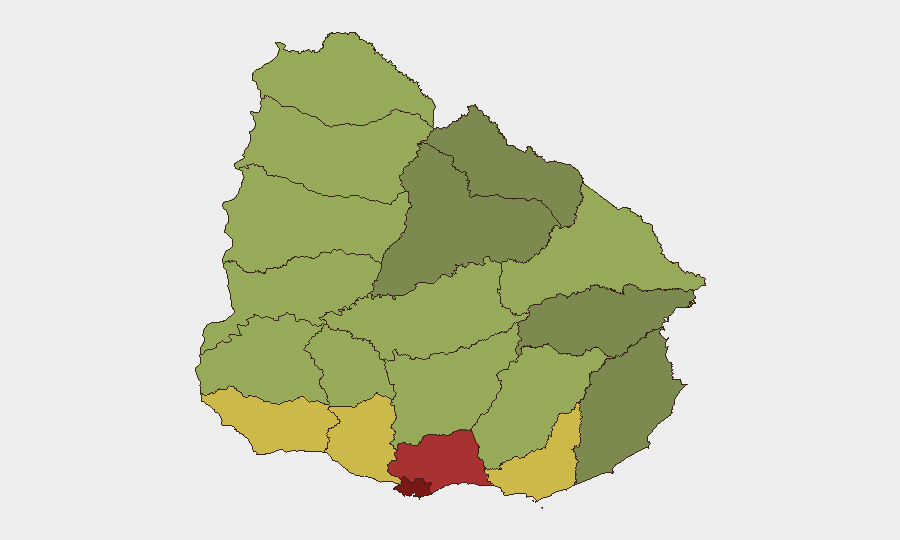
Montevideo dominates the threat landscape (risk score 92), driven by organized-crime activity, gang violence, and homicide concentration in western and southern neighborhoods including Barrio Marconi. Canelones (risk 78) and Maldonado (risk 68) follow as secondary concern zones; all three form the metropolitan and coastal corridor where crime-related risk is substantively higher than interior regions. San José, Colonia, and Soriano maintain moderate elevation above the national baseline, while northern and eastern departments (Salto, Artigas, Paysandú, Florida, Flores) remain significantly lower-risk. Corporate and duty-of-care focus should prioritize Montevideo zone management and situational awareness in Canelones for any personnel movement.
How GeoBit Would Assist
Security teams should employ AOI Monitoring & Early Warning to track persistent activity in Montevideo's high-crime neighborhoods and receive alert notifications on police operations, crime incidents, or civil unrest. OSINT fusion (X/Twitter, local media, government announcements, multi-language search) enables real-time corroboration of Interior Ministry initiatives and homicide data without travel risk overhead. Network & Actor Analysis combined with conflict mapping supports identification of organized-crime group movements, territorial shifts, and evolving gang dynamics affecting asset and personnel safety in the metropolitan zone.
7-Day Outlook
Armored patrol operations and command-level coordination are expected to continue in Montevideo through early August with no indication of de-escalation. Crime-driven risk in the capital will remain elevated relative to national baseline; no acute incidents or major policy changes are forecast in the near term. Travel and movement within Montevideo should remain subject to standard corporate risk protocols, with heightened situational awareness in Barrio Marconi and west-side zones.
Highest-Risk Areas — Ranked
| # | State / Region | Risk |
|---|---|---|
| 1 | Montevideo | 92 |
| 2 | Canelones | 78 |
| 3 | Maldonado | 68 |
| 4 | San José | 64 |
| 5 | Colonia | 62 |
| 6 | Soriano | 58 |
| 7 | Río Negro | 56 |
| 8 | Salto | 54 |
| 9 | Artigas | 52 |
| 10 | Paysandú | 50 |
| 11 | Florida | 48 |
| 12 | Flores | 46 |
Sources
Previous Daily Briefs
A new Uruguay brief is written every day — each with its own risk map and downloadable CSV. Here's the last week; use the calendar to go further back.
📅 Browse every day by calendar →
Highlighted days have a brief. Tap a day for that day's map & analysis, or “csv” for that day's dataset ($5).
Atlas — our AI intelligence desk — emails them this snapshot personally. Nothing else, no list.