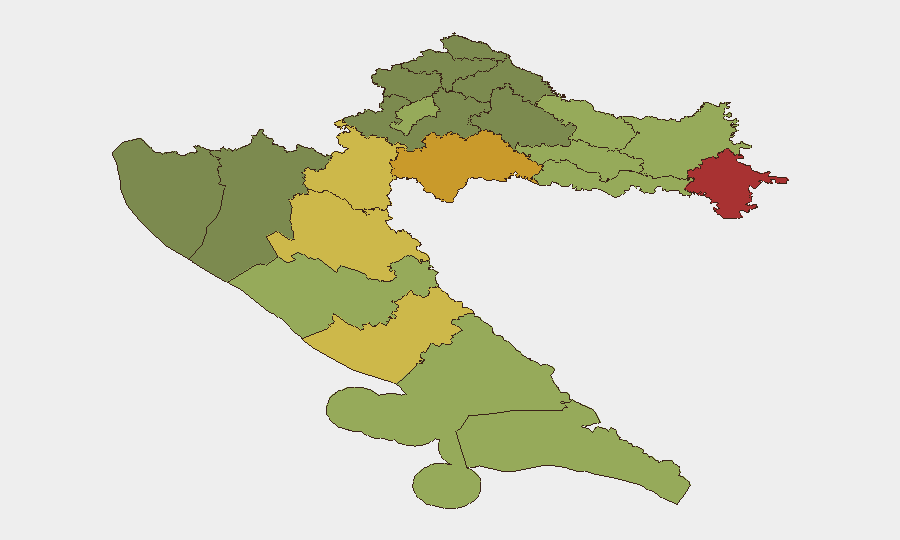
Situation Summary
Croatia remains a low-threat environment globally (rank #148, composite score 7), but faces elevated localized risks in its eastern and northern regions owing to legacy post-conflict instability, environmental grievances, and emerging criminal activity. Two significant incidents within the past 48 hours—a coordinated arson cell operating in Zadar County and the arrest of a Nord Stream bombing suspect in Pula—underscore the need for heightened situational awareness in specific coastal and backcountry corridors. The arson cases in particular carry indicators of potential terrorism, and investigations remain active. Overall trajectory suggests contained but monitored risk, with no indication of nationwide destabilization.
Key Developments
- Pula, Istria County (19 August 2026): Ukrainian national "Vladimir Z." arrested on European warrant in connection with 2022 Nord Stream pipeline explosions. Trained scuba diver allegedly part of explosives-placement group; extradition to Germany pending. Demonstrates use of Croatian territory in transnational critical-infrastructure sabotage.
- Zadar County—Multiple locations (14–15 August; arrests/charges filed 18–20 August): Four suspects (three Croatian, one Polish national, age 33) confessed to deliberately igniting fires at 10 locations using lighters and flammable materials. Criminal charges filed with State Attorney's Office; prosecutors investigating whether acts meet terrorism threshold. Specific confirmed fire sites include Bili Brig and Zemunik Donji area.
- Zadar County (ongoing as of 20 August): Authorities continuing investigation into motives for arson series; not ruling out sabotage or politically motivated/terrorist dimension. Active police and firefighting presence in northern Dalmatia may cause road closures and travel disruption.
- Gospić, Lika-Senj County (video coverage updated 19–20 August): Ongoing civil unrest over illegal hazardous-waste dump (~37,000 tons) and groundwater contamination risk. While main protest gathering occurred earlier in week, demonstrations and road disruption remain possible if action by central government is not forthcoming.
Highest-Risk Areas
Vukovar-Srijem, Sisak-Moslavina, and Karlovac counties dominate the risk ranking (scores 78, 72, 68 respectively), driven by legacy post-conflict tensions, weak institutional capacity, and historical weapons proliferation in eastern border zones. Zadar County (rank 5, score 62) has risen in operational salience due to the active arson investigation and coastal/backcountry wildfire exposure. Lika-Senj County (rank 4, score 65) carries environmental-protest and infrastructure-sabotage risk. Together, these six counties form a contiguous eastern and northern Dalmatian corridor where duty-of-care exposure is highest for corporate operations, supply chains, and personnel.
How GeoBit Would Assist
Corporate security teams with personnel or assets in Zadar, Lika-Senj, and eastern counties should activate AOI Monitoring & Early Warning on Zadar and Gospić districts to detect resumed arson or protest activity in real time. OSINT Fusion (X/Twitter, Telegram, YouTube, multi-language search) and Sentiment & Temporal Analysis of local and regional feeds will track investigator statements, court filings, and civil-unrest escalation. Routing & Network Analysis capabilities enable rapid identification of alternative routes if main corridors (e.g., coastal highway through Zadar) face temporary closure due to fire or protest activity.
7-Day Outlook
The arson investigation will likely dominate media and police attention in Zadar over the next 7 days; court proceedings and motive clarification are expected. Environmental protests in Gospić may resume if no government response materializes. No indication of broader criminal or insurgent activity, but regional border-zone instability and the Nord Stream arrest reminder to maintain heightened alertness on international sabotage and transnational criminal networks operating through Croatian territory.
Highest-Risk Areas — Ranked
| # | State / Region | Risk |
|---|---|---|
| 1 | Vukovar-Srijem County | 78 |
| 2 | Sisak-Moslavina County | 72 |
| 3 | Karlovac County | 68 |
| 4 | Lika-Senj County | 65 |
| 5 | Šibenik-Knin County | 62 |
| 6 | Brod-Posavina County | 58 |
| 7 | Zadar County | 55 |
| 8 | Osijek-Baranja County | 52 |
| 9 | City of Zagreb | 50 |
| 10 | Split-Dalmatia County | 48 |
| 11 | Požega-Slavonia County | 45 |
| 12 | Virovitica-Podravina County | 42 |
Sources
Previous Daily Briefs
A new Croatia brief is written every day — each with its own risk map and downloadable CSV. Here's the last week; use the calendar to go further back.
- August 18, 2026
- August 16, 2026
- August 14, 2026
- August 12, 2026
- August 10, 2026
- August 8, 2026
- August 6, 2026
📅 Browse every day by calendar →
Highlighted days have a brief. Tap a day for that day's map & analysis, or “csv” for that day's dataset ($5).
Atlas — our AI intelligence desk — emails them this snapshot personally. Nothing else, no list.