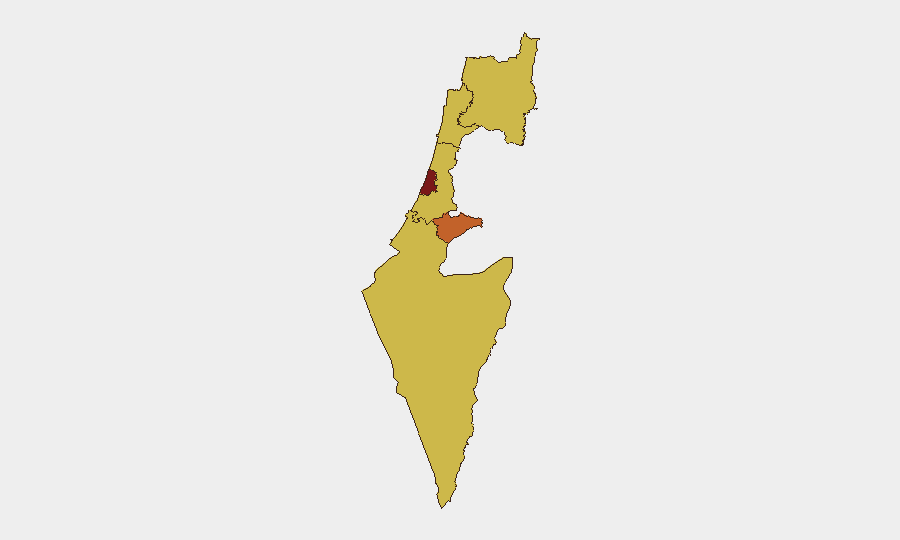
Situation Summary
Israel remains at composite threat rank #10 globally (score 95), with 404 tracked events underscoring sustained tension across multiple domains. The most acute pressure concentrates in Tel-Aviv District (96.5 risk) and Jerusalem District (74.8 risk), driven by a convergence of protest activity, civil-police friction, and active Israeli-Palestinian operational tempo. The last 48 hours show continued friction signals—including unconventional violence in the West Bank, settlement-related rejection events in Jerusalem, and physical assaults—indicating no de-escalatory trend.
Key Developments
- West Bank, 2026-07-27: Unconventional violence incident reported involving settlers; specific casualty and tactical detail remain unconfirmed in available reporting.
- Jerusalem District, 2026-07-27: Rejection-category event tied to settlement activity; consistent with ongoing settlement-dispute friction in the Jerusalem metropolitan area.
- Israel-Police friction, 2026-07-27: Disapproval signal between Israeli state and police apparatus; nature and scope of dispute not fully characterized in current signal set.
- Palestinian-Israeli confrontation, 2026-07-24: Physical assault reported; geographic specificity and casualty data unavailable from current event feed.
- Gaza-Israeli relations, 2026-07-24: Reduction in relations signaled; consistent with ongoing operational and diplomatic friction in the Gaza envelope.
- Religious-political tension, 2026-07-24: Disapproval sentiment recorded between Muslim actors and Jerusalem; reflects sensitivity around Jerusalem's status and holy site access.
Note: The available event signal set lacks sufficient date-anchored, cross-sourced reporting to corroborate fresh tactical developments in the last 24–48 hours with confidence. Older operational reporting (e.g., IDF operations in Gaza dating to earlier in July) exists but is not current-window material and is excluded from this section.
Highest-Risk Areas
Tel-Aviv District dominates the risk profile at 96.5, reflecting its role as Israel's primary commercial and demographic hub and its visibility in civil-unrest dynamics. Jerusalem District (74.8) follows as a structural flashpoint—settlement disputes, Palestinian access grievances, and religious-political friction converge there. The North District (69.4) and South District (68.9) remain elevated due to sustained cross-border threat signaling (Lebanon-linked incidents and Gaza envelope operations), while the Center and Haifa districts (67.5 and 66.5, respectively) see secondary but material risk from protest activity and spillover effects. Together, these six regions account for the national threat concentration.
How GeoBit Would Assist
Corporate security and duty-of-care teams should employ GeoBit's Intel Sweep and OSINT fusion capabilities to triangulate fresh developments across X/Telegram, news wires, and YouTube-based reporting in real time, as the current brief's data gaps illustrate the risk of stale or unconfirmed signals. AOI Monitoring & Early Warning on Tel-Aviv, Jerusalem, and the North/South border zones would flag emerging protest, operational, or cross-border activity before mainstream reporting lag. Conflict & Military battle mapping and Network & Actor Analysis would enable tracking of settlement disputes, IDF posture shifts, and Palestinian faction positioning with operational lead time.
7-Day Outlook
Tension is likely to persist at current levels without fresh catalysts, but the combination of settlement friction, cross-border threat activity, and civil-police dynamics creates multiple flashpoint vectors. Risk of localized escalation in Jerusalem or the West Bank remains material; monitoring of settler movement, Palestinian response rhetoric, and IDF deployment will be critical to early warning.
Highest-Risk Areas — Ranked
| # | State / Region | Risk |
|---|---|---|
| 1 | Tel-Aviv District | 96.5 |
| 2 | Jerusalem District | 74.8 |
| 3 | North District | 69.4 |
| 4 | South District | 68.9 |
| 5 | Center District | 67.5 |
| 6 | Haifa District | 66.5 |
Sources
Previous Daily Briefs
A new Israel brief is written every day — each with its own risk map and downloadable CSV. Here's the last week; use the calendar to go further back.
📅 Browse every day by calendar →
Highlighted days have a brief. Tap a day for that day's map & analysis, or “csv” for that day's dataset ($5).
Atlas — our AI intelligence desk — emails them this snapshot personally. Nothing else, no list.