Situation Summary
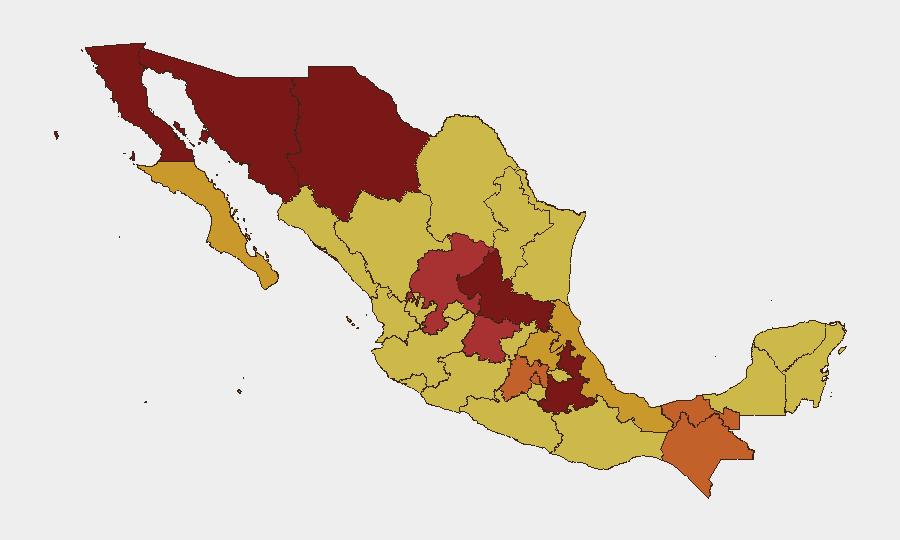
Mexico remains the eighth-highest global security risk (composite score 96), driven overwhelmingly by organized-crime violence and drug-trafficking competition. The 1,140 tracked events reflect sustained cartel activity, military/police operations against narco infrastructure, and spillover community violence across multiple states. Puebla, Chihuahua, and San Luis Potosí dominate the sub-national ranking, but risk is geographically dispersed, with criminogenic pressure evident in secondary cities and towns across twelve high-threat states. Current trajectory shows no reduction in operational tempo or violence intensity.
Key Developments
- Arteaga, Michoacán (21 July): Mexican Navy and federal forces dismantled a clandestine drug laboratory in El Ahijadero, securing chemical precursors as part of "Plan Michoacán por la Paz." Operation indicates continued state intervention in narco-production infrastructure.
- Fresnillo, Zacatecas (21 July): Armed assailants fired on security forces during a multihomicide investigation operation; authorities identified a third suspect vehicle allegedly used to transport victims. Reflects direct confrontation between criminal actors and law enforcement in one of Mexico's highest-violence municipalities.
- Ciudad Madero, Tamaulipas (21 July): Authorities launched a feminicide investigation into the death of a minor at a militarized summer academy, with initial findings indicating asphyxiation. Raises governance and oversight concerns at state-run security institutions.
- San Pedro Muñoztla, Tlaxcala (21 July): Local residents detained and assaulted a disabled woman on unsubstantiated theft allegations; attempted lynching occurred before municipal police intervention. Signals breakdown in rule-of-law enforcement and heightened mob-justice risk in smaller settlements.
- Tlaquepaque, Jalisco (21 July): Man shot dead following alleged animal abuse; killing characterized as retaliatory armed attack. Indicates volatile social tensions and potential for vigilante violence in mixed urban/criminal environments.
- Chiapas offshore (22 July): Magnitude 4.5 earthquake recorded off coast; no damage reported, but port-area precautions advised. Secondary concern relative to security operations but relevant to logistics and supply-chain continuity.
- Recent cross-border signal (20 July): Small-arms combat event flagged between Colombia and Mexico, indicating either spillover cartel violence or transnational criminal coordination requiring monitoring.
Highest-Risk Areas
Puebla (97.1) and Chihuahua (94.5) dominate the threat ranking, followed by San Luis Potosí (82.9), Baja California (80.4), and Sonora (80.1)—all strongholds of competing drug-trafficking organizations and sites of intense cartel-on-cartel warfare. Puebla's supremacy reflects both historical cartel presence and recent operational escalation. Northern border states (Chihuahua, Baja California, Sonora) remain flashpoints for transnational trafficking and U.S.-cartel coordination. Central industrial zones (Guanajuato, State of Mexico, Hidalgo) face organized crime's expansion into extortion, kidnapping, and retail drug markets. Notably, Mexico City (73.2) and Chiapas (74.7) rank among the top twelve despite lower absolute scores, indicating metropolitan and southern-corridor vulnerability.
How GeoBit Would Assist
Security teams monitoring Mexico should employ AOI (Area-of-Interest) Monitoring & Early Warning on high-risk zones to detect emerging violence clusters before they mature into incidents affecting personnel or assets. OSINT Fusion & Corroboration (X, Telegram, local media, radio SIGINT) provides real-time event confirmation and actor-intent signals ahead of official statements. Routing & Network Analysis enables identification of safe transit corridors and alternative supply-chain pathways around active conflict zones, while Satellite & Imagery Analysis supplies ground-truth confirmation of military/police operations and infrastructure damage.
7-Day Outlook
Expect sustained security-force operations against narco infrastructure (labs, trafficking corridors) in Michoacán and Zacatecas, likely prompting armed cartel response. Regional violence in Chiapas, Tamaulipas, and Jalisco will remain elevated due to cartel territorial disputes and weak institutional oversight. No reduction in organized-crime operational tempo is forecast over the near term.
Highest-Risk Areas — Ranked
| # | State / Region | Risk |
|---|---|---|
| 1 | Puebla | 97.1 |
| 2 | Chihuahua | 94.5 |
| 3 | San Luis Potosí | 82.9 |
| 4 | Baja California | 80.4 |
| 5 | Sonora | 80.1 |
| 6 | Zacatecas | 79.7 |
| 7 | Guanajuato | 78.1 |
| 8 | State of Mexico | 75.9 |
| 9 | Chiapas | 74.7 |
| 10 | Tabasco | 73.3 |
| 11 | Mexico City | 73.2 |
| 12 | Hidalgo | 72.2 |
Sources
Previous Daily Briefs
A new Mexico brief is written every day — each with its own risk map and downloadable CSV. Here's the last week; use the calendar to go further back.
📅 Browse every day by calendar →
Highlighted days have a brief. Tap a day for that day's map & analysis, or “csv” for that day's dataset ($5).
Atlas — our AI intelligence desk — emails them this snapshot personally. Nothing else, no list.