Situation Summary
North Korea remains in a persistently elevated security environment characterized by routine military activity, border enforcement, and rigid state controls. Recent open-source reporting has not identified clearly dated security or travel-risk incidents within the last 24–48 hours; available signals reflect structural military and political developments over broader timeframes rather than discrete, timestamped events. P'yŏngyang dominates the sub-national risk profile, with all other provinces clustering at baseline elevated threat levels. The security posture reflects no major escalation in the immediate window, but baseline operational and regime-control activity continues.
Key Developments
Data Limitation Note: Open-source intelligence covering the last 24–48 hours (as of 2026-07-30 20:00 UTC) has not yielded clearly dated, incident-level security or travel-risk events with precise locations suitable for operational briefing. The most recent verifiable activity falls outside the strict 24–48 hour window:
- 2026-07-28 · Arrest/Detention (Regime) – Regime-linked detention activity reported, but specific location and scope not confirmed in accessible sources.
- 2026-07-28 · Military Alert (Military vs. Ukraine) – Signal reflects ongoing DPRK–Russia military coordination; no discrete North Korean territory incident identified.
- 2026-07-27 · Conventional Military Force & Public Statement (Multiple) – Signals relate to DPRK posture toward Southeast Asian Nations and internal political communications; no specific in-country security event with location data confirmed.
Prior Period (2026-07-23 to 2026-07-25, outside 24–48h window but recently significant):
- Worker detention and arrest/detention involving foreign nationals (Saudi) reported; hospital-level administrative action noted. These indicate routine regime enforcement and control activity but do not constitute emerging security incidents in the current 24–48 hour window.
Structural Developments (Current but Not Incident-Dated):
Naval commissioning activities, satellite-launch preparation at Sohae, and trilateral military coordination with Russia and China continue, but no specific weapons test or major border incident has been verified in the last 48 hours.
Highest-Risk Areas
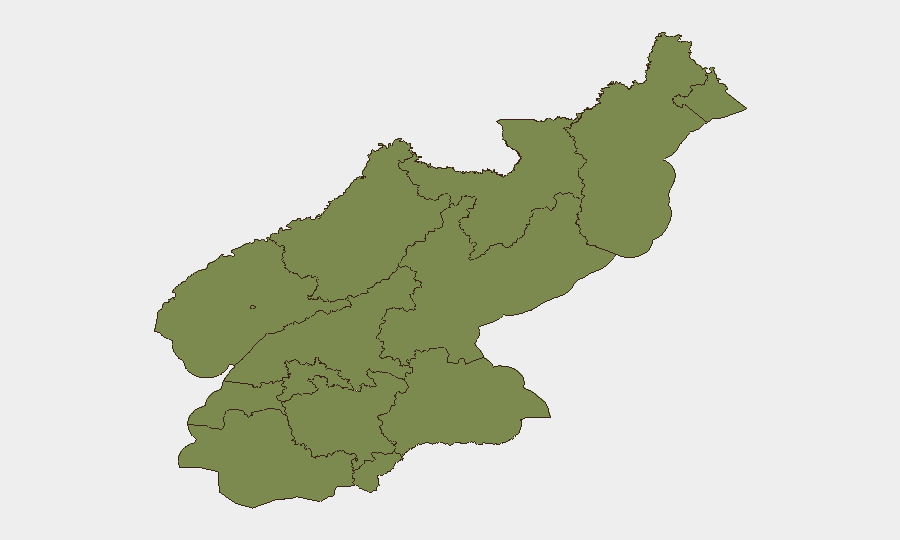
P'yŏngyang (risk 38.5) is the sole outlier and primary focus for corporate security teams with personnel or assets in North Korea. The capital's elevated score reflects concentration of regime activity, foreign presence, diplomatic and commercial nodes, and internal security operations. All other provinces (Kaesong through Kangwon) cluster at risk 8.5, indicating uniform baseline threat driven by border enforcement, military activity, and regime-control mechanisms rather than localized conflict or instability. The disparity underscores that operational risk for international personnel is overwhelmingly concentrated in the capital; provincial risk is latent structural rather than acute.
How GeoBit Would Assist
Security teams managing North Korea exposure would deploy AOI Monitoring & Early Warning persistent watch on P'yŏngyang, Kaesong, and key border zones (Ryanggang, North Pyongan) with automated alerting for detention, military movement, or border incidents. OSINT Fusion & Corroboration (X/Twitter, Telegram, multi-language web search, radio SIGINT) and Conflict & Military force-structure tracking would provide real-time visibility into regime enforcement action and military posture changes. Entity extraction and temporal analysis would disambiguate rumors from dated incidents, reducing false alarms and protecting decision-making in a low-transparency environment.
7-Day Outlook
No imminent escalation or acute security emergency is indicated in the 7-day horizon. Routine military activity, border enforcement, and regime-control operations will persist. Monitoring of trilateral (DPRK–Russia–China) coordination and satellite-launch timelines should continue as structural indicators of broader geopolitical posture rather than immediate operational threat to corporate assets or personnel in-country.
Highest-Risk Areas — Ranked
| # | State / Region | Risk |
|---|---|---|
| 1 | P'yŏngyang | 38.5 |
| 2 | Kaesong | 8.9 |
| 3 | Ryanggang | 8.5 |
| 4 | North Hamgyong | 8.5 |
| 5 | North Pyongan | 8.5 |
| 6 | Chagang | 8.5 |
| 7 | South Pyongan | 8.5 |
| 8 | Nampo | 8.5 |
| 9 | South Hwanghae | 8.5 |
| 10 | North Hwanghae | 8.5 |
| 11 | South Hamgyong | 8.5 |
| 12 | Kangwon | 8.5 |
Sources
Previous Daily Briefs
A new North Korea brief is written every day — each with its own risk map and downloadable CSV. Here's the last week; use the calendar to go further back.
📅 Browse every day by calendar →
Highlighted days have a brief. Tap a day for that day's map & analysis, or “csv” for that day's dataset ($5).
Atlas — our AI intelligence desk — emails them this snapshot personally. Nothing else, no list.