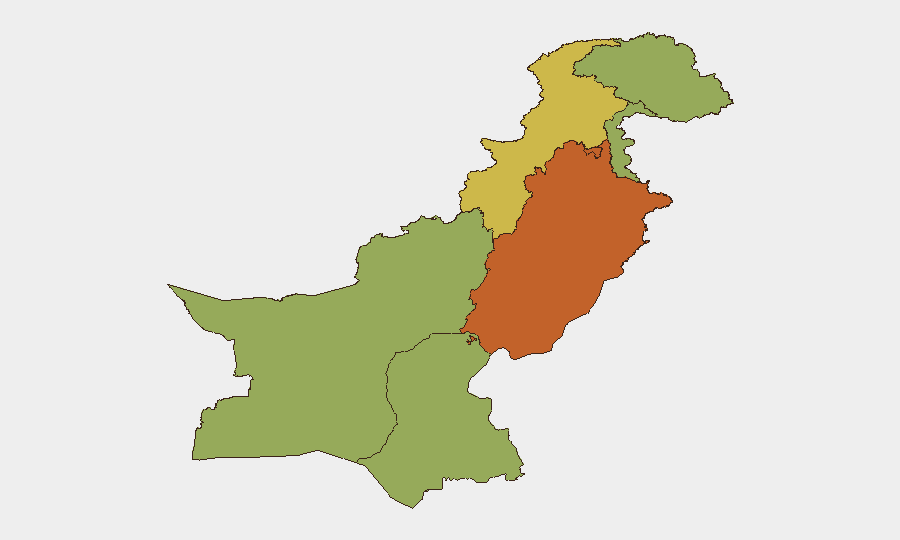
Situation Summary
Pakistan remains a persistently elevated threat environment (composite score 64, rank #27 globally), with 117 tracked events reflecting ongoing border tensions, militant activity in the northwest, and separatist operations in Balochistan. The most recent confirmed incidents—a coordinated militant ambush and suicide bombing in Khyber Pakhtunkhwa on July 15–16, followed by security force counter-operations—indicate continued TTP and Baloch militant capability and willingness to strike security targets. No major incidents have been reliably documented for July 20–21; the threat landscape remains active but without sharp escalation signals in the immediate 48-hour window.
Key Developments
- Upper Dir, Khyber Pakhtunkhwa (July 15): Militants ambushed a security convoy, killing three police officers and wounding 15 others in an extended firefight.
- Bannu, Khyber Pakhtunkhwa (July 15–16): Two suicide vehicle-borne IED attacks struck police stations and positions; combined toll reached at least 10 injured and two officers killed across engagements.
- Mastung, Balochistan (July 16): Coordinated militant attack on a Frontier Corps convoy on the N-25 highway destroyed one vehicle, killed three FC personnel, and injured 29 others.
- Security Force Counter-Operations (July 17): Pakistani military conducted intelligence-based raids in Bannu district and adjoining areas, killing 24 militants linked to TTP and Baloch groups and recovering weapons caches.
- Airspace Closure (ongoing): India-bound civil aviation remains restricted; Pakistan's ban on Indian-registered and Indian-leased aircraft has been extended through mid-July 2026, affecting regional travel and logistics.
Highest-Risk Areas
Islamabad Capital Territory (74.2) and Punjab (73.6) rank highest, driven primarily by border-security concerns and spillover risk from northwest conflict activity rather than direct militant strongholds. Khyber Pakhtunkhwa (67.3) remains the primary operational theatre, where TTP cells and affiliated groups continue to execute ambushes and bombings against security forces; the July 15–16 incidents underscore persistent militant capability despite ongoing counter-terrorism operations. Balochistan (49.1) registers moderate-to-elevated risk, reflecting separatist group activity along transportation corridors (notably the N-25 highway) and sporadic coordinated strikes on security convoys. Sindh (56.3) occupies a middle position, reflecting lower militant density but significant urban crime, port-security concerns, and organized crime networks.
How GeoBit Would Assist
Security teams operating in or transiting through Pakistan would use AOI Monitoring & Early Warning to receive real-time alerts on militant activity, security incidents, and checkpoint operations in high-risk districts (particularly Bannu, Upper Dir, and Mastung). Routing & Network Analysis capabilities enable identification of alternative transportation corridors and safer transit windows, critical given the N-25 highway vulnerability demonstrated on July 16. Multi-language OSINT, event-feed fusion, and sentiment analysis on Telegram, social media, and local news wires provide 24–48-hour lead time on militant statements, claimed operations, and security-force responses—allowing duty-of-care teams to adjust staffing, movement, and asset positioning ahead of escalation.
7-Day Outlook
No imminent major escalation is signaled, but the pattern of coordinated TTP and Baloch attacks followed by security counter-operations is expected to persist through late July. Travel restrictions, airspace closures, and localized checkpoints in Khyber Pakhtunkhwa and Balochistan will remain in effect; corporate teams should plan for extended transit times and possible convoy requirements in northwest regions.
Highest-Risk Areas — Ranked
| # | State / Region | Risk |
|---|---|---|
| 1 | Islamabad Capital Territory | 74.2 |
| 2 | Punjab | 73.6 |
| 3 | Khyber Pakhtunkhwa | 67.3 |
| 4 | Sindh | 56.3 |
| 5 | Balochistan | 49.1 |
| 6 | Gilgit-Baltistan | 44.2 |
| 7 | Azad Kashmir | 44.2 |
Sources
Previous Daily Briefs
A new Pakistan brief is written every day — each with its own risk map and downloadable CSV. Here's the last week; use the calendar to go further back.
📅 Browse every day by calendar →
Highlighted days have a brief. Tap a day for that day's map & analysis, or “csv” for that day's dataset ($5).
Atlas — our AI intelligence desk — emails them this snapshot personally. Nothing else, no list.