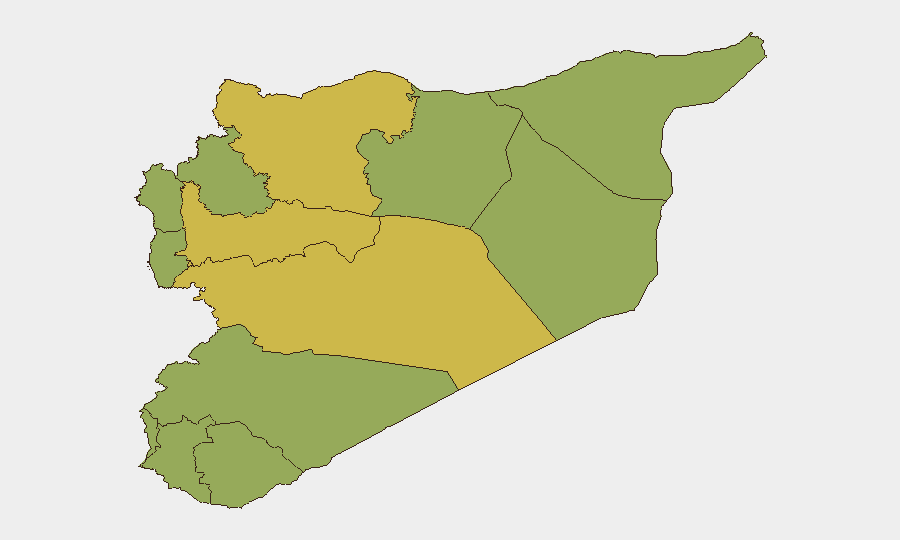
Situation Summary
Syria remains classified as a #15 global threat (composite score 84) driven primarily by ongoing civil war dynamics and fragmented governance. Open-source reporting from the first week of July 2026 documents multiple incidents—including dual IED attacks in Damascus during a high-profile state visit, a café bombing in the capital, and insurgent cell arrests in central regions—indicating that urban security vulnerabilities and residual armed opposition activity persist despite years of conflict de-escalation. No clearly verifiable, multi-sourced security incidents can be confidently dated to July 11–13, 2026 based on available open reporting; the most recent cross-confirmed events are from July 2–7. The overall trajectory remains fragile: Damascus remains the highest-risk governorate (88.5), while peripheral regions including Hama, Aleppo, and Homs continue to harbor operational insurgent cells and explosive remnants of war.
Key Developments
Note: The following developments are from July 2–7, 2026 and represent the most recent verifiable incidents available in open sources. No clearly dated security events have been confirmed for July 11–13, 2026.
- Damascus, July 7 – Two consecutive IEDs detonated near the Ministry of Tourism, injuring the Deputy Minister of Tourism, four police officers, and thirteen civilians. The attacks coincided with French President Emmanuel Macron's visit, indicating deliberate targeting of high-profile diplomatic events and security gaps in central Damascus despite elevated protection measures.
- Damascus, July 2 – An IED exploded inside a café in the Hijaz district near the Justice Palace, killing ten civilians and injuring twenty-one others according to interior authorities and local media. The incident exemplifies persistent urban bombing campaigns targeting civilian-populated areas.
- Sahl al-Ghab region (Hama/Idlib), July 5 – Ministry of Interior personnel detained seven alleged anti-government insurgents in a targeted raid; detainees were reportedly part of an assassination cell planning attacks against state figures, reflecting ongoing armed opposition presence in semi-rural areas.
- Near Uqayribat, Hama Governorate, July 6 – A Ministry of Defense engineer was injured while attempting to render safe an unexploded landmine, underscoring the significant explosive remnants of war (ERW) hazard in previously contested terrain where demining operations continue to face acute risk.
Highest-Risk Areas
Damascus Governorate dominates the risk ranking (88.5) due to its concentration of state institutions, diplomatic presence, and documented insurgent targeting capability—as evidenced by the July 2–7 bombing sequence. Hama Governorate (68.2) emerges as the second-highest risk driver, reflecting both residual armed opposition cells in the Sahl al-Ghab region and significant ERW contamination from years of conventional warfare. Aleppo (61) and Homs (60.8) remain elevated-risk zones where small-arms combat and militant property seizure have been recorded. Peripheral governorates including Idleb, Ar-Raqqa, and the UNDOF zone (Golan) are maintained at parity (58.5), indicating a broad baseline of fragmentation and continued armed-group presence across non-state-controlled or loosely governed territory.
How GeoBit Would Assist
Security and duty-of-care teams should employ AOI Monitoring & Early Warning to establish persistent watch over Damascus and Hama with real-time alerting on attack signatures and armed-group movement. Intel Sweep and multi-language OSINT fusion (X/Telegram, local media, radio SIGINT) will enable rapid corroboration and dating of emerging incidents, reducing reliance on delayed or undated open reporting. Network & Actor Analysis combined with Conflict & Military force-structure tracking will identify residual insurgent cells and their operational patterns, supporting risk stratification for specific facilities and travel corridors.
7-Day Outlook
No major escalation is indicated in available reporting, but the frequency of urban bombings in Damascus during early July suggests continued insurgent operational capability despite MOI counter-terrorism arrests. Demining and ERW clearance in Hama, Aleppo, and Homs will remain a significant civilian and military hazard. Diplomatic visits and large public gatherings remain elevated-risk targets.
Highest-Risk Areas — Ranked
| # | State / Region | Risk |
|---|---|---|
| 1 | Damascus Governorate | 88.5 |
| 2 | Hama Governorate | 68.2 |
| 3 | Aleppo Governorate | 61 |
| 4 | Homs Governorate | 60.8 |
| 5 | Lattakia Governorate | 58.5 |
| 6 | Tartus Governorate | 58.5 |
| 7 | UNDOF | 58.5 |
| 8 | Al-Quneitra Governorate | 58.5 |
| 9 | Dar'a Governorate | 58.5 |
| 10 | Idleb Governorate | 58.5 |
| 11 | Ar-Raqqa Governorate | 58.5 |
| 12 | Rif Dimashq Governorate | 58.5 |
Sources
Previous Daily Briefs
A new Syria brief is written every day — each with its own risk map and downloadable CSV. Here's the last week; use the calendar to go further back.
📅 Browse every day by calendar →
Highlighted days have a brief. Tap a day for that day's map & analysis, or “csv” for that day's dataset ($5).
Atlas — our AI intelligence desk — emails them this snapshot personally. Nothing else, no list.