Situation Summary
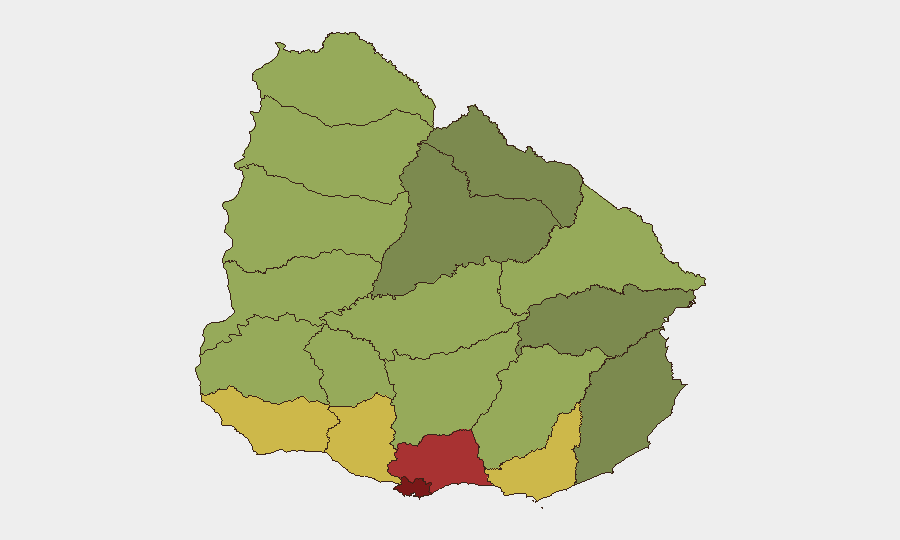
Uruguay maintains a stable, low-threat security environment with no verified acute incidents, civil unrest, or infrastructure disruptions reported in the last 24–48 hours. Routine law-enforcement operations and institutional crime-fighting measures continue nationally, but no emergency or crisis responses are underway. The country's composite threat score remains minimal (5/100), reflecting its regional standing as one of South America's more secure jurisdictions.
Key Developments
No discrete security incidents meeting verification thresholds have been reported in Uruguay during the 24–48 hour window. Open-source monitoring and regional briefings confirm an absence of terrorism activity, major crime spikes, organized-violence surges, or politically driven crises in that timeframe.
*Note: Longer-standing operational concerns—including gang-driven violence in peripheral departments (Salto, Artigas, Río Negro border zones) and drug-trafficking homicides in Rivera and Chuy—remain chronic but do not constitute new developments as of 31 July 2026.*
Highest-Risk Areas
Montevideo (risk 92) and Canelones (risk 78) drive national risk primarily through concentrated urban crime, including robbery, narcotics trafficking, and gang activity within metropolitan precincts. Maldonado (68) and San José (64) follow, reflecting localized property crime and transient criminal networks. Border departments—Artigas (52), Salto (54), and Río Negro (56)—carry elevated risk due to cross-frontier drug-trafficking routes and limited law-enforcement density; however, these areas do not currently experience active conflict or state-collapse conditions.
How GeoBit Would Assist
Corporate security teams monitoring Uruguay should deploy AOI Monitoring & Early Warning on high-risk departments (Montevideo, Canelones, border zones) to detect emerging crime clusters or unrest patterns in real time. OSINT fusion (X/Twitter, Telegram, local radio SIGINT) provides 24-hour situational awareness of criminal-network activity and law-enforcement operations. GIS & Spatial Analysis supports route-planning and alternative-journey assessment for personnel transiting high-risk urban or border zones, directly informing duty-of-care protocols for asset protection and staff safety.
7-Day Outlook
No acute security escalation is forecast over the next seven days. Routine departmental crime and cross-border trafficking activity will likely persist at baseline levels, with no indication of organized-violence surges, political instability, or infrastructure vulnerability. Standard security-hygiene measures remain appropriate for all personnel and assets in Montevideo and border regions.
GEOBIT CLASSIFICATION: Routine
CONFIDENCE: High (verified open-source corroboration)
NEXT REVIEW: 2026-08-01
Highest-Risk Areas — Ranked
| # | State / Region | Risk |
|---|---|---|
| 1 | Montevideo | 92 |
| 2 | Canelones | 78 |
| 3 | Maldonado | 68 |
| 4 | San José | 64 |
| 5 | Colonia | 62 |
| 6 | Soriano | 58 |
| 7 | Río Negro | 56 |
| 8 | Salto | 54 |
| 9 | Artigas | 52 |
| 10 | Paysandú | 50 |
| 11 | Florida | 48 |
| 12 | Flores | 46 |
Sources
Previous Daily Briefs
A new Uruguay brief is written every day — each with its own risk map and downloadable CSV. Here's the last week; use the calendar to go further back.
📅 Browse every day by calendar →
Highlighted days have a brief. Tap a day for that day's map & analysis, or “csv” for that day's dataset ($5).
Atlas — our AI intelligence desk — emails them this snapshot personally. Nothing else, no list.