Situation Summary
Afghanistan remains in a volatile state of ongoing conflict, with a composite threat score of 76 placing it at #23 globally. The primary driver is sustained insurgent activity and cross-border military tension, particularly along the Pakistan–Afghanistan border where clashes have intensified in recent weeks. Taliban consolidation efforts continue in urban centers, including enforcement actions targeting civilian populations. The security environment shows no signs of material improvement and carries elevated baseline risk across multiple threat vectors.
Key Developments
No major security incidents with confirmed dates in the last 24–48 hours (12–13 July 2026) have been independently verified and sourced from open reporting. Current Afghanistan-focused news outlets, travel advisories, and conflict-monitoring platforms (ACAPS, Afghanistan International, government foreign offices) do not document discrete, time-stamped attacks, clashes, or emergencies within this window.
The most recent verifiable incident reporting dates to 9–11 July 2026, including:
- Ragh district, Badakhshan province (9–10 July): National Resistance Front reported overnight attack on Taliban position, claiming two Taliban killed and three wounded.
- Zakha Khel Bazaar, Pakistan–Afghanistan border (9 July): Cross-border clashes between Taliban and Pakistani forces along the Durand Line with reported small-arms and artillery fire.
- Herat city, Herat province (10 July): Taliban morality police detained multiple women for dress-code violations; at least two patrol vehicles involved in detentions to undisclosed locations.
Broader patterns since late June include sustained border clashes in Kunar, Paktia, and Paktika provinces and documented Pakistani airstrikes on Kabul and Kandahar in March 2026.
Highest-Risk Areas
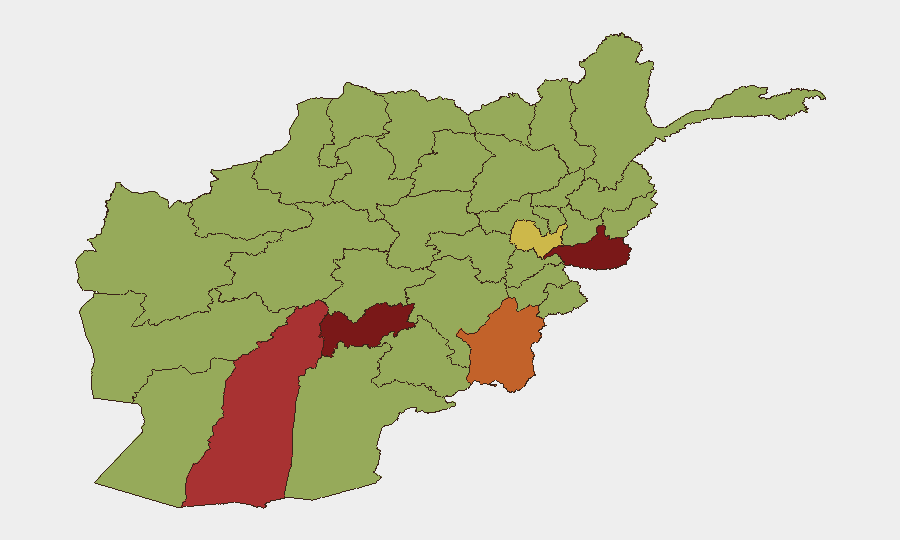
Uruzgan, Nangarhar, and Helmand provinces dominate the risk ranking (scores 83.2–77.6), driven by active insurgent and criminal networks, limited government control, and proximity to transit corridors. Paktika and Kabul follow (75.7 and 66.3, respectively), with Kabul's elevated score reflecting concentration of high-value targets and past terrorist attack history. The eastern and southern border belt—Nangarhar, Paktika, Paktia, Kunar—remains the most volatile zone due to cross-border Pakistan–Afghanistan military friction and NRF resistance activity. Mid-tier provinces (Zabul, Kandahar, Ghazni, Farah, Nimruz, Jowzjan, Balkh) all register 53.2, indicating widespread baseline instability.
How GeoBit Would Assist
Security teams operating in or monitoring Afghanistan should employ AOI Monitoring & Early Warning on high-risk provinces (Uruzgan, Nangarhar, Helmand) with persistent satellite and social-media alerting to capture emerging clashes, IED activity, and Taliban enforcement actions before they affect travel or operations. Multi-language OSINT fusion (X/Telegram monitoring, local news aggregation, conflict-event feeds) provides real-time corroboration of unconfirmed reports and distinguishes verifiable incidents from rumors—critical for duty-of-care decisions. Conflict & Military battle mapping and network analysis of Taliban, NRF, and Pakistani military force positions enable threat-informed routing and site-security posture adjustments, particularly for border-zone assets.
7-Day Outlook
No major escalation is forecast in the immediate term, but the baseline of border clashes, Taliban internal enforcement, and low-level insurgent activity will persist. Personnel and asset movements in Uruzgan, Nangarhar, and Helmand should assume elevated IED and ambush risk. Monitoring for spillover effects from Pakistan–Afghanistan military tensions into urban centers (Kabul, Kandahar) remains prudent.
Highest-Risk Areas — Ranked
| # | State / Region | Risk |
|---|---|---|
| 1 | Uruzgan Province | 83.2 |
| 2 | Nangarhar Province | 81.3 |
| 3 | Helmand Province | 77.6 |
| 4 | Paktika Province | 75.7 |
| 5 | Kabul Province | 66.3 |
| 6 | Zabul Province | 53.2 |
| 7 | Kandahar Province | 53.2 |
| 8 | Ghazni Province | 53.2 |
| 9 | Farah Province | 53.2 |
| 10 | Nimruz Province | 53.2 |
| 11 | Jowzjan Province | 53.2 |
| 12 | Balkh Province | 53.2 |
Sources
Previous Daily Briefs
A new Afghanistan brief is written every day — each with its own risk map and downloadable CSV. Here's the last week; use the calendar to go further back.
📅 Browse every day by calendar →
Highlighted days have a brief. Tap a day for that day's map & analysis, or “csv” for that day's dataset ($5).
Atlas — our AI intelligence desk — emails them this snapshot personally. Nothing else, no list.