Situation Summary
Angola remains a moderate-risk country (global rank #47) with no acute armed conflict, civil unrest, or mass-casualty incidents reported in the last 24–48 hours. However, a nationwide cyberattack on Unitel, Angola's largest mobile operator, has disrupted voice, mobile data, and internet services affecting over 21 million customers since 28 July, creating significant operational and economic disruption. Baseline security risks persist in remote eastern provinces (Cabinda, Lunda Norte/Sul, Cuando Cubango) where mineral extraction, smuggling, and armed group activity remain endemic; concurrently, multiple active wildfires across the country add environmental pressure to already-stressed regions.
Key Developments
- Luanda/Nationwide – 28–30 July – Unitel cyberattack ongoing. A coordinated cyberattack against Unitel's core infrastructure, launched at ~02:20 on 28 July, continues to disable voice, mobile data, and internet services nationwide. Restoration efforts remain incomplete with no confirmed timeline for full normalization. Possible Advanced Persistent Threat (APT) involvement is noted in security community reporting; no group has claimed responsibility on dark-web channels.[2][3][10]
- Luanda – 29 July – BODIVA stock-market listing proceeds amid cyber incident. Unitel's scheduled IPO on the Angolan stock exchange proceeds as planned, though the cyberattack—occurring one day prior—has raised concerns about cyber resilience in critical financial infrastructure and may dampen market confidence.[2][3]
- Nationwide – 28–30 July – Economic paralysis from telecom outage. The >24-hour Unitel disruption has severely impacted business operations, financial transactions, and logistics. Multiple sectors report operational halt; customers are shifting to alternative providers where available.[3][7][12]
- Nationwide – Recent – Persistent wildfire activity. At least 11 active wildfires tracked across Angola in recent days (events 1029815, 1029866, 1029897–1029902, 1029938–1029941), indicating elevated fire risk in drought-affected or seasonally vulnerable areas. No major infrastructure or population centers are currently reported as directly threatened, but fire activity may complicate access to remote regions and strain emergency response.
- Luanda/National – 29–30 July – No physical security incidents or civil unrest recorded. Major urban centers including Luanda continue routine operations. No new terrorism alerts, cross-border conflict spillover, armed clashes, or civil unrest reported in this window.[1]
Highest-Risk Areas
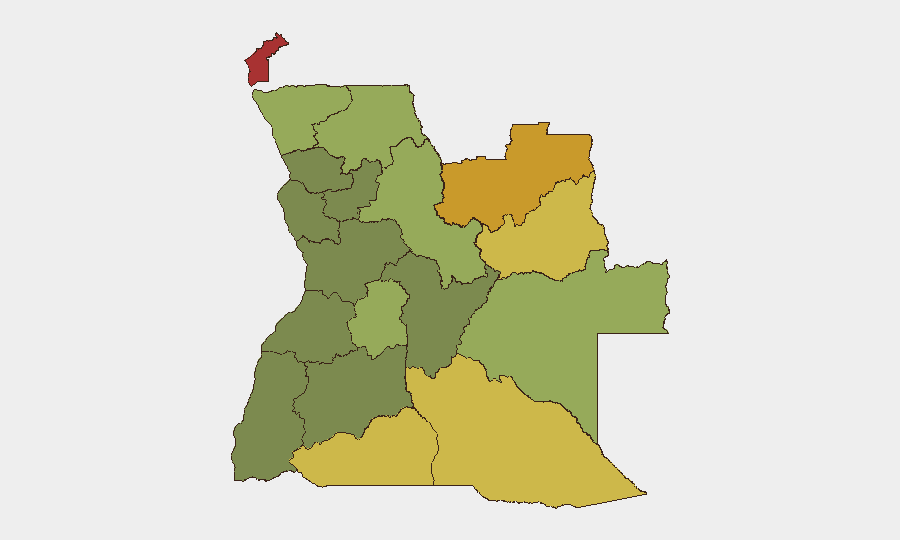
Cabinda Province (risk 78) and the two Lunda provinces (72, 68) remain Angola's highest-risk zones, driven by mineral smuggling, cross-border armed group presence, and weak state authority. Cuando Cubango and Cunene provinces (64, 62 respectively) present secondary concerns linked to border permeability with Zambia and Botswana, facilitating smuggling and transient criminal activity. These eastern and southern provinces account for disproportionate risk relative to coastal and central urban zones; security teams with operations or supply chains in these areas face elevated exposure to kidnapping, armed robbery, and logistical disruption.
How GeoBit Would Assist
Organizations should deploy AOI (Area-of-Interest) Monitoring & Early Warning on Cabinda and Lunda operations to detect cross-border incursions, armed group movement, or political destabilization in real time. Intel Sweep and multi-language OSINT (including X/Twitter, Telegram, and regional media) would provide early signals of cyber threats, civil unrest, or smuggling network activity affecting supply chains. Routing & Network Analysis can identify resilient alternative communication and logistical pathways to mitigate future telecom outages like the current Unitel incident.
7-Day Outlook
Unitel service restoration is expected within days, though full normalization may take longer pending forensic investigation and infrastructure repairs. Baseline security conditions (crime, smuggling, low-level armed activity in eastern provinces) will persist unchanged. Wildfire activity may continue; monitor for escalation into populated areas or critical infrastructure zones.
Highest-Risk Areas — Ranked
| # | State / Region | Risk |
|---|---|---|
| 1 | Cabinda Province | 78 |
| 2 | Lunda Norte Province | 72 |
| 3 | Lunda Sul Province | 68 |
| 4 | Cuando Cubango Province | 64 |
| 5 | Cunene Province | 62 |
| 6 | Moxico Province | 58 |
| 7 | Zaire Province | 54 |
| 8 | Huambo Province | 50 |
| 9 | Uíge Province | 48 |
| 10 | Malanje Province | 42 |
| 11 | Bié Province | 35 |
| 12 | Huíla Province | 32 |
Sources
Previous Daily Briefs
A new Angola brief is written every day — each with its own risk map and downloadable CSV. Here's the last week; use the calendar to go further back.
📅 Browse every day by calendar →
Highlighted days have a brief. Tap a day for that day's map & analysis, or “csv” for that day's dataset ($5).
Atlas — our AI intelligence desk — emails them this snapshot personally. Nothing else, no list.