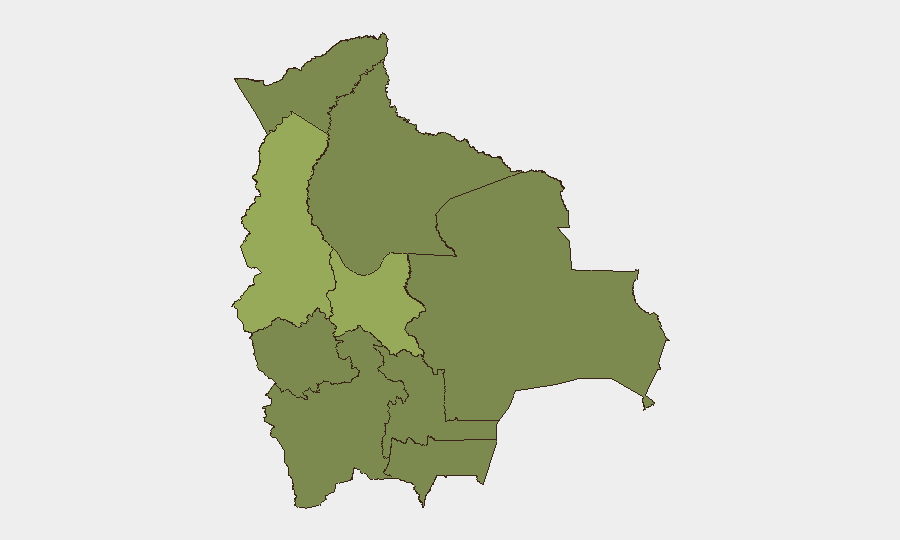
Situation Summary
Bolivia remains in a state of heightened political and social volatility under a nationwide state of emergency declared June 20, 2026, with expanded police and military powers now operative for disrupting roadblocks, detaining protesters, and intervening in demonstrations. Cochabamba department—particularly the Chapare region—is the epicenter of unrest, with composite risk nearly 50% higher than the national average; La Paz follows as the second-highest-risk zone due to ongoing mobilizations and road blockades affecting the capital and surrounding areas. While incident-level reporting for July 13–14 remains sparse in open sources, the legal framework sustaining confrontations between security forces and strike/blockade organizers remains in effect, and foreign ministries continue to warn of rapid escalation potential and unannounced blockade formation nationwide.
Key Developments
- Santa Cruz de la Sierra – July 14, 2026: Public hospitals suspended outpatient consultations for a second consecutive day due to ongoing strikes by doctors and health workers, degrading access to medical services and increasing operational risk for expatriate staff or visitors requiring urgent care.
- La Paz & multi-departmental – as of July 14, 2026: Spanish and German travel advisories (updated early July) report continued social mobilizations and road blockades in and around La Paz; new blockades may form "without advance notice," with government guidance to avoid demonstration zones and prioritize air transport over intercity road travel.
- Chapare region (Cochabamba dept.), Routes 4 & 24 – advisory status July 14, 2026: Foreign ministries maintain strong warnings against travel to the Chapare, citing recent and potentially recurring social unrest, rapid protest escalation, and heightened risk of violent confrontations and roadblocks that can trap vehicles and restrict movement.
- National security apparatus – operative as of July 14, 2026: Under the state of emergency (maximum 90 days from June 20), the government retains expanded authority to deploy military and police against protests, detain individuals for up to eight hours without warrant, and prosecute strike and blockade organizers for terrorism-related offenses; this framework remains active and enforced.
- Supply-chain status – as of July 14, 2026: Fuel and food supply in La Paz is slowly improving but remains constrained; risk of renewed shortages is assessed as elevated nationwide should new blockades form.
Highest-Risk Areas
Cochabamba (risk 58.1) significantly exceeds all other departments and is the primary driver of national threat elevation, with the Chapare region accounting for the most acute risk of violent confrontation, roadblock formation, and protest-related mobility disruption. La Paz (40.5) ranks second and reflects both direct political unrest in the capital and operational cascades (blockades, supply disruption, security-force deployment) affecting the national government seat and principal transport hub. All remaining departments cluster at or near the baseline risk floor (28.1), indicating that Cochabamba and La Paz account for the overwhelming majority of reported event signals and elevated threat composite scores.
How GeoBit Would Assist
Security teams operating in or transiting Bolivia should deploy Area-of-Interest (AOI) Monitoring & Early Warning on Cochabamba and La Paz departments to receive real-time alerts of roadblock formation, protest mobilization, and police/military deployment. Routing & Network Analysis capabilities enable alternative-route planning and journey-risk assessment to bypass high-threat corridors (Ruta 4 & 24 in Chapare, protest zones in La Paz) on short notice. Multi-language OSINT and Sentiment Analysis (social media, local radio, news feeds) provide early detection of emerging mobilizations and security-force movements before they escalate to blockades or violent confrontations.
7-Day Outlook
The state of emergency framework and government's active prosecution of strike organizers are expected to sustain elevated confrontation risk in Cochabamba and La Paz through the remainder of July. Healthcare and transport disruptions are likely to persist or recur in response to government wage and labor disputes; organizations should assume 7–10 day planning horizons for non-emergency travel and maintain contingency supply inventories.
Highest-Risk Areas — Ranked
| # | State / Region | Risk |
|---|---|---|
| 1 | Cochabamba | 58.1 |
| 2 | La Paz | 40.5 |
| 3 | Santa Cruz | 28.6 |
| 4 | Potosí | 28.1 |
| 5 | Tarija | 28.1 |
| 6 | Pando | 28.1 |
| 7 | Beni | 28.1 |
| 8 | Oruro | 28.1 |
| 9 | Chuquisaca | 28.1 |
Sources
Previous Daily Briefs
A new Bolivia brief is written every day — each with its own risk map and downloadable CSV. Here's the last week; use the calendar to go further back.
📅 Browse every day by calendar →
Highlighted days have a brief. Tap a day for that day's map & analysis, or “csv” for that day's dataset ($5).
Atlas — our AI intelligence desk — emails them this snapshot personally. Nothing else, no list.