Situation Summary
The United States ranks as the highest-threat environment globally (composite score 100), driven by convergent domestic violence, institutional strain, and elevated international security operations affecting U.S. interests. The past 48 hours have seen a mass shooting in Arizona, expanded biosecurity screening for international arrivals, and escalating Middle Eastern tensions with direct implications for U.S. military operations and diplomatic infrastructure worldwide. California and Kansas lead sub-national risk rankings, though distributed vulnerabilities across judicial, law enforcement, and critical infrastructure sectors indicate systemic rather than localized threat concentration.
Key Developments
- Tucson, Arizona – early Sunday, July 19, 2026: Ten people, including the suspected shooter, were wounded in a mass shooting in a busy commercial district near downtown Tucson; police investigation ongoing and classified as unconventional violence event.
- U.S. International Travel – updated weekend of July 18–19, 2026: Worldwide Caution advisory expanded to require enhanced Ebola screening at designated airports for all U.S. arrivals from Democratic Republic of Congo, Uganda, or South Sudan within the preceding 21 days.
- State Department Warning – weekend of July 18–19, 2026: Iran-aligned groups assessed as potential threats to U.S. diplomatic facilities and U.S.-linked locations abroad; periodic airspace closures and travel disruptions expected to affect U.S. citizens and infrastructure interests in Middle East region.
- U.S. Central Command Operations – weekend of July 18–19, 2026: Eighth and ninth consecutive nights of airstrikes against Iranian targets reported as of Sunday night, indicating sustained elevated operational tempo and associated security risk to U.S. forces and forward-deployed infrastructure.
- Domestic Judicial/Law Enforcement Activity – July 18, 2026: Multiple simultaneous events logged including appeals court proceedings vs. New Jersey, federal judge interaction with military force authorities, senator arrest in South Carolina, and presidential-level security incident involving abduction/hijack/hostage scenarios; specific details unresolved but indicate institutional stress.
- Critical Infrastructure Vulnerabilities – ongoing since February–March 2026: University of Mississippi Medical Center continues recovery from February ransomware attack affecting 35 clinic closures statewide; Foster City, California municipal systems remain in recovery from March 19 ransomware event with suspected personal data compromise.
Highest-Risk Areas
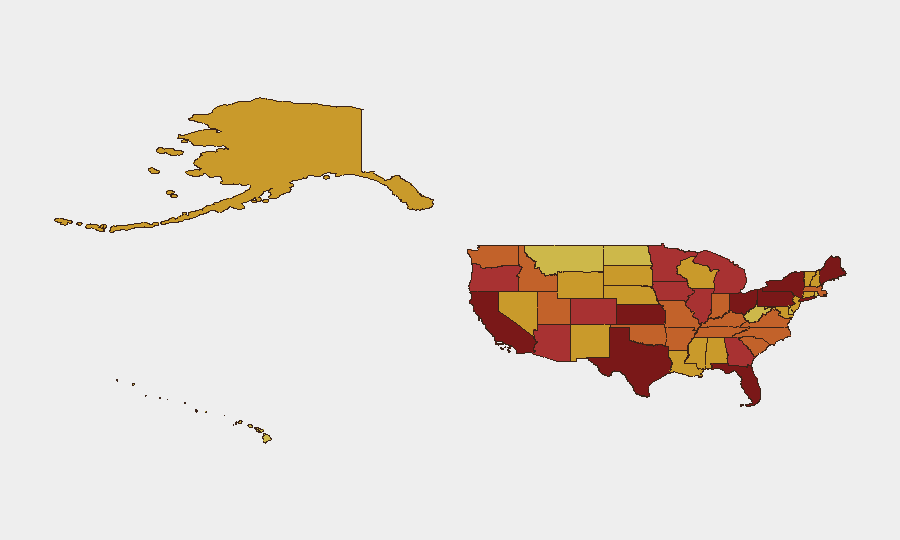
California (100) and Kansas (99.9) drive the highest composite threat scores, followed by New York (94.1) and Texas (93.7). The concentration reflects not geographic isolation but overlapping vulnerabilities: California's scale and critical infrastructure density (finance, technology, ports) amplify both cyber and physical threats; Kansas's ranking reflects agricultural, logistics, and energy sector exposure. Florida (87.5) and the Northeast corridor (Maine, Pennsylvania, New York) show elevated risk correlated with population density, federal presence, and maritime/transportation nodes. The distributed top-12 list across disparate regions signals that threat is national rather than regional.
How GeoBit Would Assist
Security teams would employ Intel Sweep and OSINT fusion across X/Twitter, Telegram, and multi-language feeds to track emerging domestic violence signals in real time; GIS and spatial analysis to correlate the sub-national ranking with asset locations and operational footprints; and AOI Monitoring and Early Warning on critical infrastructure nodes (medical, financial, energy, ports) in high-risk states to detect pre-incident activity. Network and actor analysis applied to recent judicial and law enforcement events would clarify institutional connections and intent.
7-Day Outlook
Threat trajectory remains elevated and likely to persist through the week. Continued operational tempo in Middle East theaters and domestic institutional friction suggest sustained risk to U.S. personnel and assets both domestically and internationally. Biosecurity screening protocols indicate expectation of sustained pandemic-adjacent pressure; cyber recovery timelines for critical infrastructure remain extended, maintaining vulnerability in healthcare and municipal systems.
Highest-Risk Areas — Ranked
| # | State / Region | Risk |
|---|---|---|
| 1 | California | 100 |
| 2 | Kansas | 99.9 |
| 3 | New York | 94.1 |
| 4 | Texas | 93.7 |
| 5 | Florida | 87.5 |
| 6 | Maine | 84.1 |
| 7 | Pennsylvania | 82.1 |
| 8 | Ohio | 81.3 |
| 9 | Illinois | 79.4 |
| 10 | Colorado | 78.2 |
| 11 | Georgia | 77.3 |
| 12 | Minnesota | 76.9 |
Sources
Previous Daily Briefs
A new United States brief is written every day — each with its own risk map and downloadable CSV. Here's the last week; use the calendar to go further back.
📅 Browse every day by calendar →
Highlighted days have a brief. Tap a day for that day's map & analysis, or “csv” for that day's dataset ($5).
Atlas — our AI intelligence desk — emails them this snapshot personally. Nothing else, no list.