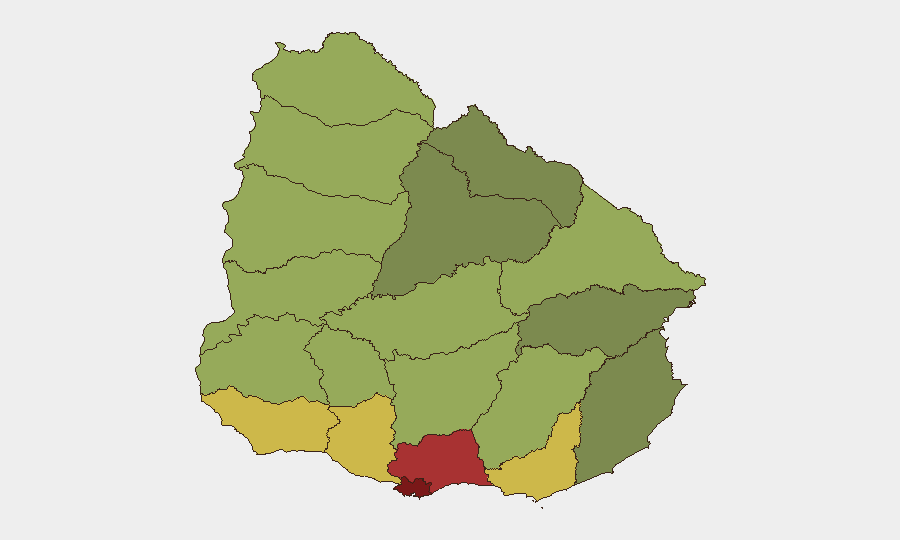
Situation Summary
Uruguay maintains a stable, low-threat security environment with no verified acute incidents—terrorism, civil unrest, organized-crime violence, or infrastructure disruption—reported in the past 24–48 hours. Routine law-enforcement operations continue across the country without emergency-level escalation. The security posture remains consistent with historical patterns for the region.
Key Developments
No discrete security, civil-unrest, crime-spike, or travel-risk incidents have been independently corroborated in Uruguay for 2–4 August 2026. Open-source monitoring and consolidated daily threat briefs confirm an absence of acute-incident activity in the last 24–48 hours. Operational baseline remains stable pending forward monitoring.
*Note: July 2026 background (not current):* Government deployment of Mamba MK-7 armored vehicles to Montevideo high-crime neighborhoods under police command continued as part of an anti-organized-crime strategy announced earlier in July; a 48-hour strike occurred at Montevideo's main container terminal; and routine serious crime cases (homicides, armed robberies) were processed by local law enforcement. These items predate the current 24–48 hour window and are not classified as active developments.
Highest-Risk Areas
Montevideo (risk 92) and Canelones (risk 78) account for the majority of tracked risk in Uruguay, reflecting persistent organized-crime activity, gang presence, and property crime concentrated in metropolitan and periurban zones. Maldonado (68), San José (64), and Colonia (62) show elevated localized risk, likely tied to tourism corridors, trafficking routes, and border-proximity factors. Interior departments (Salto, Artigas, Paysandú) carry moderate baseline risk. Corporate teams with personnel or assets in Montevideo and Canelones should prioritize routine duty-of-care protocols—situational awareness, secure movement, secure accommodations—but no heightened alert is warranted on current evidence.
How GeoBit Would Assist
Intel Sweep & OSINT Fusion would provide continuous multi-language open-source monitoring (news, social media, local government announcements) to flag emerging crime spikes, organized-crime activity, or civil unrest before they escalate to acute travel or operational risk. AOI Monitoring & Early Warning can establish persistent geographic watches on high-risk departments (Montevideo, Canelones, Maldonado) to detect changes in baseline security conditions and trigger alerting if routine patterns break. Risk & Threat Assessment combined with Network & Actor Analysis would map organized-crime group structure, territorial control, and operational patterns to inform routing decisions and personnel-movement protocols for teams working in or transiting high-risk zones.
7-Day Outlook
Security conditions are expected to remain stable over the next 7 days absent a significant organized-crime escalation or law-enforcement surge. Routine crime and gang activity will persist in Montevideo and Canelones; international trafficking (drugs, contraband) along northern and western borders will continue as baseline. Monitoring should remain continuous to detect any deviation from the current low-acute-incident posture.
Highest-Risk Areas — Ranked
| # | State / Region | Risk |
|---|---|---|
| 1 | Montevideo | 92 |
| 2 | Canelones | 78 |
| 3 | Maldonado | 68 |
| 4 | San José | 64 |
| 5 | Colonia | 62 |
| 6 | Soriano | 58 |
| 7 | Río Negro | 56 |
| 8 | Salto | 54 |
| 9 | Artigas | 52 |
| 10 | Paysandú | 50 |
| 11 | Florida | 48 |
| 12 | Flores | 46 |
Sources
Previous Daily Briefs
A new Uruguay brief is written every day — each with its own risk map and downloadable CSV. Here's the last week; use the calendar to go further back.
📅 Browse every day by calendar →
Highlighted days have a brief. Tap a day for that day's map & analysis, or “csv” for that day's dataset ($5).
Atlas — our AI intelligence desk — emails them this snapshot personally. Nothing else, no list.