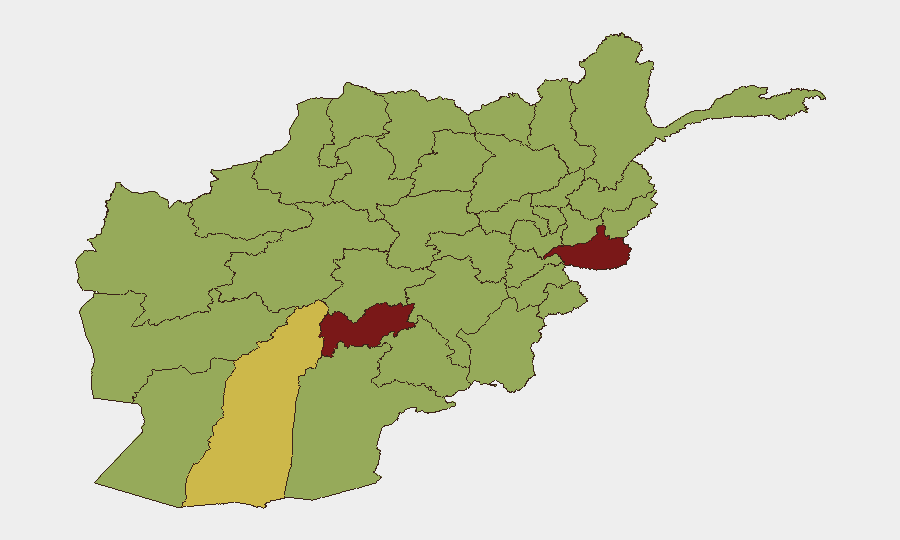
Situation Summary
Afghanistan remains at elevated baseline threat across most provinces, ranked #27 globally with a composite threat score of 75, primarily driven by ongoing insurgency and territorial tensions. As of 15 July 2026, open-source monitoring shows no verified new security incidents (attacks, mass displacement, or major clashes) in the past 24–48 hours in major population centers or border regions. However, the absence of reported events in a short window does not reflect reduced structural risk; the country's security architecture remains fragile, with persistent Taliban control, cross-border tensions with Pakistan, and localized militant activity in eastern and southern provinces.
Key Developments
No verified incident-level security events have been reliably confirmed in Afghanistan in the past 24–48 hours. Open-source and media monitoring (as of 15 July 2026) explicitly note the absence of corroborated new attacks, arrests, or major unrest in that timeframe. Older developments from the preceding week—including Taliban detentions of women activists in Herat (10 July) and ongoing extradition and deportation activity—pre-date the current 24–48 hour window and remain outside the scope of this brief's recency requirement. Significantly, the last major incident cluster referenced in event signals occurred on 13–14 July and involved prosecutorial investigations and territorial-occupation signals rather than ground-level violence confirmations in open sources.
Highest-Risk Areas
Eastern and southern provinces dominate the threat landscape. Nangarhar Province (risk 82.6) and Uruzgan Province (risk 80.6) represent the highest acute danger, driven by Taliban military consolidation, residual Islamic State–Khorasan Province (ISKP) activity, and proximity to Pakistan's tribal areas—a key infiltration and supply route. Helmand Province (65.6) and Kabul Province (59.6) follow, with Kabul's ranking reflecting population density, government infrastructure, and history of insider and militant targeting. The southern cluster (Kandahar, Zabul, Ghazni) and western provinces (Farah, Nimruz) all score 52.6+, indicating persistent insurgent cells, criminal networks, and weak state authority. Northern provinces (Balkh, Jowzjan) round out the top tier at 52.6, reflecting cross-border smuggling and Taliban expansion.
How GeoBit Would Assist
Security teams operating in or monitoring Afghanistan should employ Area-of-Interest (AOI) Monitoring & Early Warning to establish persistent watch on Nangarhar, Uruzgan, Helmand, and Kabul provinces, enabling rapid detection of escalations before they reach mainstream media. Conflict & Military mapping (force structure, Taliban/militant disposition, checkpoint networks) combined with GIS & Spatial Analysis can identify safe routing corridors, assess checkpoint risk, and track territorial control changes. OSINT fusion & corroboration (multi-language Telegram, local radio SIGINT, and entity extraction) fills gaps in English-language reporting and provides ground-truth validation of incidents before they propagate through international news cycles.
7-Day Outlook
No imminent tactical escalation is signaled by current event data or open-source reporting for the week ahead. However, ongoing prosecutorial investigations into Afghan officials and international criminal court activity (noted in 14 July signals) may trigger secondary political volatility or targeted arrests, with spillover risk to expatriate communities or NGO operations. Risk trajectory remains stable but structurally elevated; teams should maintain contingency protocols and avoid unnecessary movement in Nangarhar, Uruzgan, and southern border provinces.
Highest-Risk Areas — Ranked
| # | State / Region | Risk |
|---|---|---|
| 1 | Nangarhar Province | 82.6 |
| 2 | Uruzgan Province | 80.6 |
| 3 | Helmand Province | 65.6 |
| 4 | Kabul Province | 59.6 |
| 5 | Paktika Province | 57.6 |
| 6 | Zabul Province | 52.6 |
| 7 | Kandahar Province | 52.6 |
| 8 | Ghazni Province | 52.6 |
| 9 | Farah Province | 52.6 |
| 10 | Nimruz Province | 52.6 |
| 11 | Jowzjan Province | 52.6 |
| 12 | Balkh Province | 52.6 |
Previous Daily Briefs
A new Afghanistan brief is written every day — each with its own risk map and downloadable CSV. Here's the last week; use the calendar to go further back.
📅 Browse every day by calendar →
Highlighted days have a brief. Tap a day for that day's map & analysis, or “csv” for that day's dataset ($5).
Atlas — our AI intelligence desk — emails them this snapshot personally. Nothing else, no list.