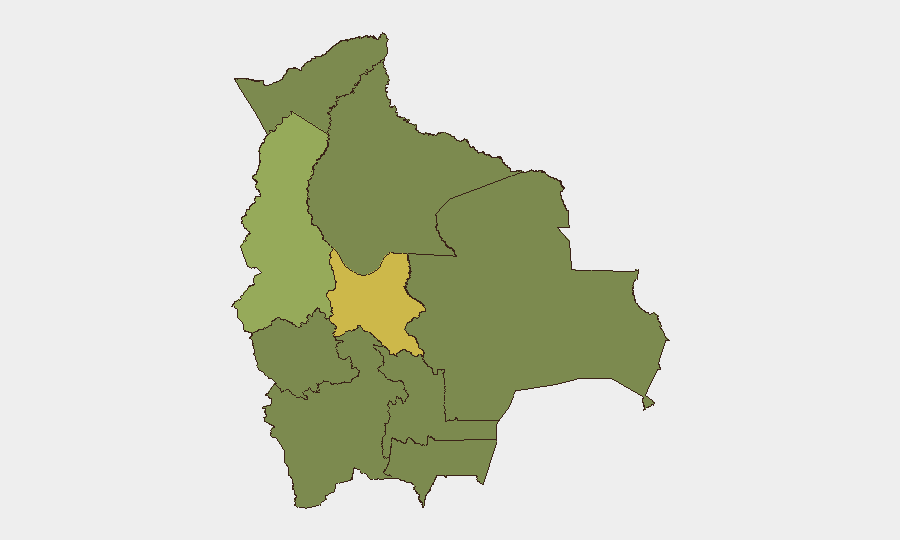
Situation Summary
Bolivia remains in a heightened security state following the government's declaration of a national state of exception on 20 June 2026 to manage widespread road blockades and supply disruptions. Recent event signals indicate sustained tension between state authorities and protest movements, compounded by emerging concerns over foreign military recruitment. While the overall threat ranking places Bolivia at #44 globally, sub-national disparities are significant, with Cochabamba presenting substantially elevated risk.
Key Developments
- Nationwide, 14–16 July — Multiple public statements and diplomatic signals from Bolivian authorities, including a threat statement directed at Moscow on 16 July, suggest escalating tensions over alleged recruitment of Bolivian citizens into Russian military forces; a prosecutor's office investigation was recently announced.
- Cochabamba (Chapare region), 14 July — Conventional military/police operations reported against non-state armed groups; ongoing travel warnings remain in effect for Routes 4 and 24 due to security instability.
- La Paz/nationwide, 14 July — Official disapproval signals logged from Bolivian government toward an uprising; concurrent citizen-level disapproval events recorded, indicating public friction.
- Santa Cruz, 14 July — Hospital sector strike by doctors and workers entered a second day, disrupting patient consultations and affecting essential services.
- La Paz and El Alto, ongoing — Travel advisories remain current for renewed protest activity and roadblock formation; supply and transport disruption risks persist, though no new specific incidents were dated to the last 24–48 hours in available sources.
Highest-Risk Areas
Cochabamba (risk score 63.5) substantially outpaces other departments and is the primary driver of national threat elevation; the Chapare cocaine-producing region continues to generate security incidents and remains off-limits per foreign ministry advisories. La Paz (47.6) ranks second, reflecting political volatility, protest activity, and its role as the seat of government and urban center. Tarija, Santa Cruz, Potosí, Pando, Beni, Oruro, and Chuquisaca cluster at 33.5–33.9, suggesting a baseline of distributed instability outside the capital and Cochabamba, likely tied to labor disputes, localized political friction, and economic stress.
How GeoBit Would Assist
Security teams managing personnel or assets in Bolivia should employ AOI Monitoring & Early Warning across Cochabamba and La Paz to detect roadblock formation, protest escalation, and police/military activity in real time. Multi-language OSINT fusion (X/Telegram, local news, radio SIGINT) combined with sentiment and temporal analysis would clarify the trajectory and scale of anti-government mobilization and supply-chain disruptions. Network & Actor Analysis would map protest leadership, labor-union coordination, and any links to foreign actors or military recruitment networks, enabling duty-of-care teams to anticipate secondary operational impacts.
7-Day Outlook
The combination of an active state-of-exception order, renewed protest signals, and diplomatic friction with Moscow suggests elevated risk for 7–14 days. Roadblock re-emergence in La Paz and Cochabamba remains the highest-probability disruptive event; escalation of police/military responses is possible. Supply and movement restrictions will likely remain the primary operational impact for corporate operations.
Highest-Risk Areas — Ranked
| # | State / Region | Risk |
|---|---|---|
| 1 | Cochabamba | 63.5 |
| 2 | La Paz | 47.6 |
| 3 | Tarija | 33.9 |
| 4 | Santa Cruz | 33.9 |
| 5 | Potosí | 33.5 |
| 6 | Pando | 33.5 |
| 7 | Beni | 33.5 |
| 8 | Oruro | 33.5 |
| 9 | Chuquisaca | 33.5 |
Sources
Previous Daily Briefs
A new Bolivia brief is written every day — each with its own risk map and downloadable CSV. Here's the last week; use the calendar to go further back.
📅 Browse every day by calendar →
Highlighted days have a brief. Tap a day for that day's map & analysis, or “csv” for that day's dataset ($5).
Atlas — our AI intelligence desk — emails them this snapshot personally. Nothing else, no list.