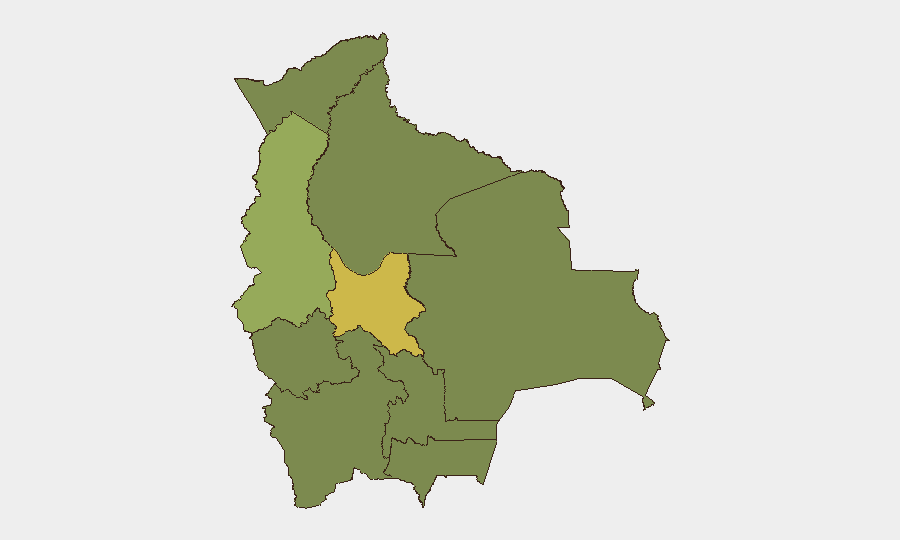
Situation Summary
Bolivia remains under a national state of emergency declared 2026-06-20, with elevated travel risk and potential for short-notice transport disruptions. The security environment is fragmented across sub-national lines, with Cochabamba emerging as the highest-risk jurisdiction (63.2 composite score) and multiple governance actors issuing public statements and demands as of 2026-07-18. Recent event signals indicate tension between provincial governors, the central government, and law-enforcement agencies, alongside arrests and allegations spanning peasant organizing, prison management, and cross-border diplomatic friction with Argentina. The composite threat picture remains moderate globally (rank #44) but volatile at provincial level.
Key Developments
- 2026-07-18 · La Paz (nationwide) — Government and Governor public statements: Central and regional executives issued coordinated or conflicting public statements on 2026-07-18, signaling active governance disagreements; nature and specifics of statements require real-time corroboration.
- 2026-07-18 · Multiple locations — Arrest/detention events: Peasant organizing figures and prison-system detainees were arrested or detained on 2026-07-18; no casualty or escalation reports as of brief publication.
- 2026-07-18 · La Paz — Governor statement vs. La Paz authority: A provincial governor issued a public statement in opposition to La Paz municipal or departmental authority, reflecting possible inter-jurisdictional conflict.
- 2026-07-18 · Diplomatic friction — Argentina and Saint (religious/social actor): Both Argentina and a religious/social organization issued disapproval statements regarding Bolivia; a physical assault by the Saint entity was also signaled, location unconfirmed.
- 2026-07-18 · Prosecutor threat signal: A prosecutor issued a threat-level statement; context (directed at whom, subject matter) requires live verification.
- 2026-07-14 · La Paz — Russian recruitment investigation (recent context): Bolivian prosecutors opened an investigation into allegations that citizens were recruited via social media to fight for Russia; this development is 4 days old relative to brief date and reflects potential transnational security spillover but is not a same-day event.
Highest-Risk Areas
Cochabamba (63.2) is the dominant risk driver, indicating persistent armed, criminal, or governance instability in the central highlands. La Paz (41.1)—the capital and seat of government—ranks second, consistent with current inter-agency tensions and diplomatic friction. Potosí (39.4) and Santa Cruz (37.7) remain elevated, likely reflecting coca-trafficking, land-use conflict, and indigenous organizing activity. The clustering of mid-range risk (33–37) across Tarija, Oruro, Pando, Beni, and Chuquisaca suggests distributed but non-critical pressure points; however, Cochabamba's isolation at the top warrants concentrated monitoring.
How GeoBit Would Assist
Corporate security teams should deploy AOI Monitoring & Early Warning on Cochabamba and La Paz to capture short-notice blockade formation, detention sweeps, and governance conflicts before they affect supply chains or staff movement. Network & Actor Analysis would identify provincial governor factions, prosecutor alignments, and peasant-organizing nodes to clarify which actors pose direct vs. indirect risk to company operations. Intel Sweep (multi-language OSINT, X/Telegram, radio SIGINT) would provide real-time corroboration of the same-day event signals and clarify the Russian-recruitment investigation's trajectory and any links to Bolivian security institutions.
7-Day Outlook
The state of emergency is likely to remain in effect, maintaining baseline transport and assembly-gathering restrictions. Governance tensions between La Paz and provincial governors may intensify if resource allocation or election-cycle positioning accelerates. No major escalation is signaled for the immediate week, though short-notice blockades or detention operations remain possible in Cochabamba and highland zones.
Highest-Risk Areas — Ranked
| # | State / Region | Risk |
|---|---|---|
| 1 | Cochabamba | 63.2 |
| 2 | La Paz | 41.1 |
| 3 | Potosí | 39.4 |
| 4 | Santa Cruz | 37.7 |
| 5 | Tarija | 33.5 |
| 6 | Oruro | 33.5 |
| 7 | Pando | 33.2 |
| 8 | Beni | 33.2 |
| 9 | Chuquisaca | 33.2 |
Sources
Previous Daily Briefs
A new Bolivia brief is written every day — each with its own risk map and downloadable CSV. Here's the last week; use the calendar to go further back.
📅 Browse every day by calendar →
Highlighted days have a brief. Tap a day for that day's map & analysis, or “csv” for that day's dataset ($5).
Atlas — our AI intelligence desk — emails them this snapshot personally. Nothing else, no list.