Situation Summary
China's security environment remains moderate-to-elevated, ranked #8 globally with 1,088 tracked events. The past 48 hours have been dominated by natural disaster (Typhoon Bavi), regulatory action (anti-corruption, AI oversight), and economic data release (Q2 GDP miss), rather than acute conflict or unrest. Coastal disruption and heightened scrutiny of Taiwan-linked personnel represent the most immediate operational risks for foreign entities and their staff.
Key Developments
- Typhoon Bavi landfall, Zhejiang & Fujian provinces (14–15 July 2026): Typhoon continues to disrupt ports, rail, and air corridors along the eastern seaboard. Immediate risks include power outages, logistics delays, and travel disruptions affecting Shanghai, Hangzhou, and other coastal hubs.
- Taiwan-linked missing-person cases (12–15 July 2026, mainland China): Intelligence reporting discloses newly emerged disappearance cases involving Taiwanese nationals. Signals heightened political-detention risk for Taiwan-affiliated personnel and organizations operating on the mainland.
- Anti-corruption investigation, Beijing (15 July 2026): China's National Supervisory Commission announced investigation into former media regulator Cai Fuchao for suspected disciplinary and legal violations. Reflects ongoing tightening of propaganda and state-media leadership; may affect publishing, media, and state-linked corporate partners in Beijing.
- Apple Intelligence regulatory approval, Beijing (15 July 2026): Cyberspace Administration confirmed official registration of Apple's on-device generative AI service for iPhones in China. Signals selective, controlled expansion of AI services under enhanced oversight; companies operating in China should anticipate content and security compliance requirements.
- Q2 2026 economic growth miss (15 July 2026, national): Official GDP growth fell to 4.3%, below government and market targets, reflecting weak domestic demand and external shocks. Slower growth increases structural risk (labor instability, tighter controls) over the medium term, though no large-scale unrest reported in the past 48 hours.
- Chinese national kidnapping cases, Philippines (14–15 July 2026): Chinese Embassy reported 7 kidnapping cases in H1 2026 and repatriation of 56 Chinese nationals involved in criminal activity. Relevant for security planning involving China–Philippines corridor movements and cross-border personnel.
Highest-Risk Areas
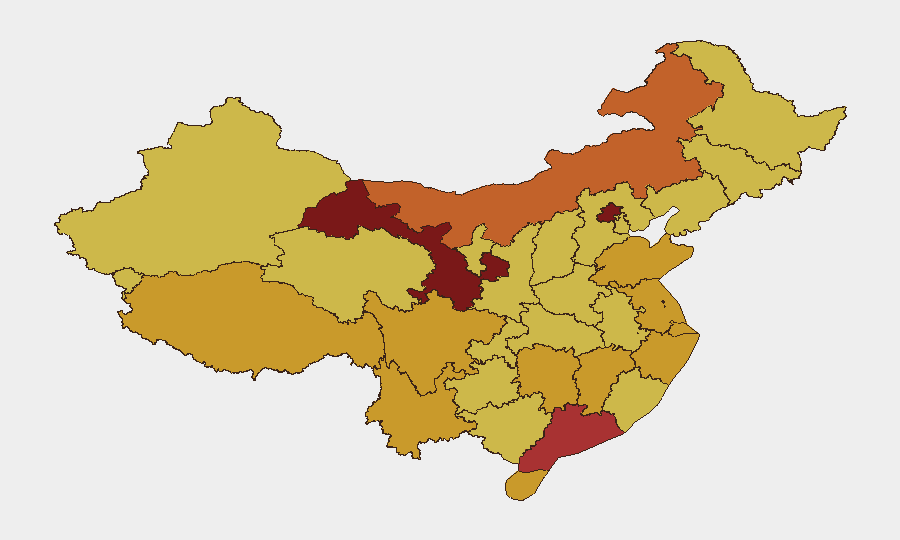
Gansu, Beijing, and Guangdong dominate the sub-national risk ranking, with Gansu at maximum score (100) and Beijing at 95.2. Beijing's elevation reflects ongoing anti-graft action, regulatory tightening, and national-level policy volatility affecting corporate and media sectors. Coastal provinces (Guangdong, Shanghai, Jiangsu, Zhejiang) face elevated infrastructure and logistics risk from Typhoon Bavi, compounded by baseline political and economic sensitivity. Gansu's high score warrants closer investigation through sector-specific and regional intelligence to understand driver(s).
How GeoBit Would Assist
Security teams should deploy AOI Monitoring & Early Warning on Shanghai, Hangzhou, and other coastal hubs to track typhoon impact and recovery timelines. Intel Sweep and multi-language OSINT targeting Taiwan-linked organizations and personnel in China will provide early signals of detention or regulatory action. Economic & Trade analysis combined with regime-stability assessment will help quantify medium-term risk from slowing GDP growth and internal political tightening.
7-Day Outlook
Typhoon Bavi disruption will likely persist through mid-week, with gradual recovery in coastal logistics by 18–19 July. Regulatory momentum (anti-corruption, AI oversight) is expected to continue without acceleration. No major escalation in cross-strait tensions or internal unrest is forecast; however, Taiwan-affiliated personnel should maintain heightened situational awareness.
Highest-Risk Areas — Ranked
| # | State / Region | Risk |
|---|---|---|
| 1 | Gansu | 100 |
| 2 | Beijing | 95.2 |
| 3 | Guangdong Province | 76.4 |
| 4 | Inner Mongolia | 73.4 |
| 5 | Sichuan | 72.8 |
| 6 | Shanghai | 72.8 |
| 7 | Jiangsu | 72.7 |
| 8 | Shandong | 72.7 |
| 9 | Jiangxi | 72 |
| 10 | Zhejiang | 71.9 |
| 11 | Tibet | 71.8 |
| 12 | Hainan Province | 71.8 |
Sources
Previous Daily Briefs
A new China brief is written every day — each with its own risk map and downloadable CSV. Here's the last week; use the calendar to go further back.
📅 Browse every day by calendar →
Highlighted days have a brief. Tap a day for that day's map & analysis, or “csv” for that day's dataset ($5).
Atlas — our AI intelligence desk — emails them this snapshot personally. Nothing else, no list.