Situation Summary
Iraq remains at elevated composite threat level (rank #14 globally, score 80) with insurgency as the primary driver across 444 tracked events. The past 24–48 hours show intensifying regional military posturing and drone/strike activity concentrated in the Kurdistan Region and cross-border Iranian operations. Concurrent anti-corruption enforcement and financial sanctions against designated entities suggest Iraqi authorities are attempting to manage internal security pressures while navigating external military tensions.
Key Developments
- Erbil, Kurdistan Region — July 16: Iraqi air defenses intercepted multiple drones over Erbil; Kurdish and coalition sources reported eight drones shot down, with one explosive-laden drone neutralized. Prime Minister subsequently condemned the incursion as a violation of Iraqi airspace.
- Near Erbil, Kurdistan Region — July 16: A drone strike targeted an Iranian Kurdish opposition camp north of Erbil, consistent with a broader pattern of Iranian cross-border strikes against Kurdish armed groups operating in Iraq.
- Iraqi Kurdistan — July 19: A U.S. service member was killed by unexploded ordnance from a downed Iranian attack drone, according to CENTCOM reporting.
- Kurdistan Region — July 19: A combined drone and rocket strike killed nine members of an Iranian Kurdish armed opposition group, according to exiled party and allied sources.
- Baghdad — July 20: Iraqi authorities detained more than 20 suspects in an anti-corruption operation focused on corruption-related charges.
- Across Iraq — July 20: Iraqi authorities reportedly added Hezbollah and other terror-designated entities to the banking sanctions list, reportedly following U.S. request.
- Regional Military Signals — July 18–20: Event tracking shows conventional military force signals between Iran–Iraq, Iraq–U.S., Iraq–Saudi Arabia, Iraq–Qatar, and Iraqi–Kurdistan factions, alongside small-arms combat reporting (Iran vs. Iraq), indicating heightened military posturing across multiple vectors.
Highest-Risk Areas
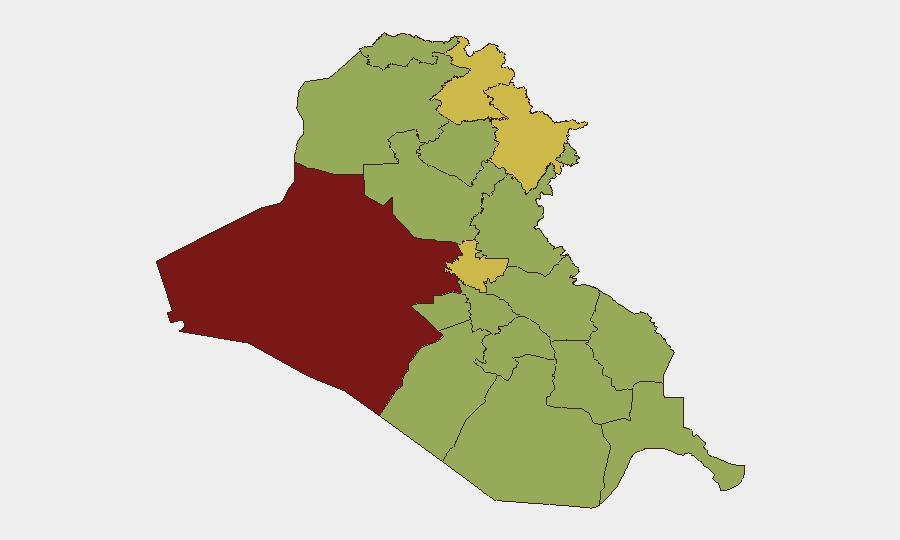
Al-Anbar Governorate (86.1) remains the highest-risk sub-national zone, reflecting sustained insurgency activity and conventional military pressure. The Kurdistan Region—comprising Sulaymaniyah (64.3), Erbil (63.3), and Nineveh (56.2)—is the active flashpoint for cross-border Iranian drone and strike operations targeting Kurdish armed opposition groups, with recent incidents directly impacting coalition personnel. Baghdad (61.3) and the southern governorates (Karbala, Najaf, Babil, Dhi Qar) cluster in the 56–61 range, driven by sectarian tensions, militia activity, and political fragmentation. The concentration of risk in Al-Anbar and the Kurdistan Region reflects both legacy ISIS-affiliated insurgency and current Iranian regional assertiveness.
How GeoBit Would Assist
Security teams with personnel or assets in Iraq should deploy AOI (Area-of-Interest) Monitoring & Early Warning on high-risk governorates—particularly Erbil, Baghdad, and Al-Anbar—to receive persistent alerts on drone activity, military movement, and civil unrest. Intel Sweep, multi-language OSINT feeds, and X/Telegram monitoring of Iraqi security officials, coalition accounts, and Kurdish media outlets provide real-time corroboration of incidents and official statements, filling gaps in mainstream reporting latency. Conflict & Military battle mapping and force-structure tracking enable duty-of-care teams to monitor Iranian, Iraqi military, and militia deployments near company locations or transit routes.
7-Day Outlook
Iranian cross-border drone and strike operations are likely to continue against Kurdish armed opposition groups in the Kurdistan Region, with elevated risk to coalition and civilian personnel in Erbil and surrounding areas. Iraqi central authority appears to be attempting to assert control via anti-corruption and financial sanctions enforcement, but fragmented militia networks and regional military pressure limit effectiveness. Risk trajectory remains elevated; no immediate de-escalation signal is apparent.
Highest-Risk Areas — Ranked
| # | State / Region | Risk |
|---|---|---|
| 1 | Al-Anbar Governorate | 86.1 |
| 2 | Sulaymaniyah Governorate | 64.3 |
| 3 | Erbil Governorate | 63.3 |
| 4 | Baghdad Governorate | 61.3 |
| 5 | Dhi Qar Governorate | 56.5 |
| 6 | Karbala | 56.5 |
| 7 | Babil Governorate | 56.4 |
| 8 | Al-Najaf Governorate | 56.2 |
| 9 | Nineveh Governorate | 56.2 |
| 10 | Wasit Governorate | 56.1 |
| 11 | Al-Qadisiyah Governorate | 56.1 |
| 12 | Al-Muthanna Governorate | 56.1 |
Sources
Previous Daily Briefs
A new Iraq brief is written every day — each with its own risk map and downloadable CSV. Here's the last week; use the calendar to go further back.
📅 Browse every day by calendar →
Highlighted days have a brief. Tap a day for that day's map & analysis, or “csv” for that day's dataset ($5).
Atlas — our AI intelligence desk — emails them this snapshot personally. Nothing else, no list.