Situation Summary
Russia faces sustained Ukrainian drone operations targeting critical infrastructure across southern and central regions, with coordinated strikes on energy, maritime, and military assets over the past 24 hours. Domestic political activity (Constitutional Court demands, Federation Council statements, State Duma banking inquiries) and administrative sanctions signal internal institutional pressure concurrent with external military pressure. The composite threat score of 100 and 494 tracked events reflect a multi-domain risk environment combining kinetic attacks, infrastructure vulnerability, and governance instability.
Key Developments
- Taganrog seaport, Rostov Oblast (July 12–13): Ukrainian drone strike triggered fire and evacuation of residents; port infrastructure damaged as part of coordinated Sea of Azov campaign.
- Ilsky oil refinery, Krasnodar Krai (July 12–13): Drone attack caused fire at petroleum facility; no injuries reported but energy infrastructure degradation confirmed.
- Vyazniki oil depot, Stavropol Krai (July 12–13): Tank storage struck by drones ~600 km inside Russia; part of broader multi-target operation on fuel and logistical nodes.
- Kerch Strait ferry corridor (July 12–13): Drones targeted Yeysk, Maria, Lavrentyi, and Panagiya ferries, plus petroleum tank trains and storage; transport and civilian movement risk elevated.
- Bagherove air base and radar sites, occupied Crimea (July 12–13): Military hangars and three stationary unmanned-detection radar stations struck; air defense and coastal surveillance capability degraded.
- Black Sea naval assets (July 12–13): Two Russian Project 12150 Mangust patrol boats damaged by drones; maritime security operations compromised.
- Constitutional Court demand and Federation Council statement (July 11–12): Domestic institutional activity suggests internal governance strain; context for broader instability.
Highest-Risk Areas
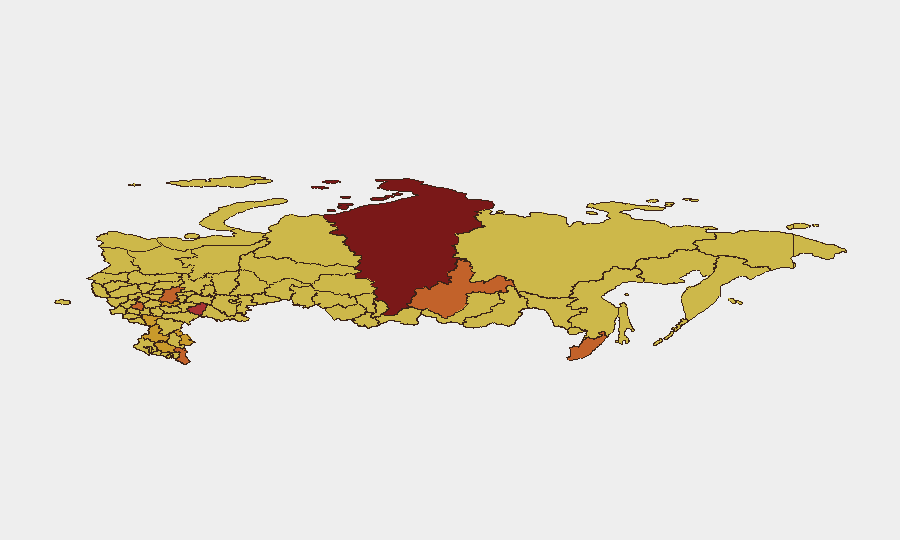
Moscow (100) and Krasnoyarsk Krai (87.5) lead the sub-national ranking, followed by Samara, Primorsky, and Tula oblasts (76–74). Risk in southern regions—Rostov, Stavropol, Krasnodar, and Astrakhan—reflects active drone operations against energy infrastructure and military logistics; coastal and Sea of Azov proximity increases exposure to Ukrainian long-range strikes. Moscow's maximum score reflects political sensitivity, concentration of government and financial assets, and status as a command-and-control node. Northern and Siberian regions (Krasnoyarsk, Irkutsk) carry elevated composite risk despite lower current kinetic activity, likely reflecting supply-chain vulnerabilities, resource-sector exposure, and strategic importance to regime stability.
How GeoBit Would Assist
Intel Sweep and OSINT Fusion would correlate real-time event feeds, Telegram/X reporting, and SBU releases to confirm strike locations and asset damage in near-real time, enabling corporate teams to validate supply-chain and facility status. AOI Monitoring & Early Warning on high-risk regions (Rostov, Krasnodar, Stavropol, Crimea maritime zones) would provide persistent watch and alerting on drone operations, port activity, and infrastructure fires before public announcement. Conflict & Military mapping, Maritime & Aviation tracking, and Satellite/Imagery analysis would support damage assessment, route re-planning, and facility-status monitoring for companies operating energy, logistics, or maritime assets in southern Russia and occupied territories.
7-Day Outlook
Coordinated Ukrainian drone operations targeting energy and logistics hubs are likely to continue at current or elevated tempo, focusing on southern Russia and Crimea to degrade fuel supply and transport capacity. Domestic political friction (evidenced by Constitutional Court and Duma activity) may produce new administrative measures or asset freezes affecting corporate operations. Companies with personnel or assets in Rostov, Krasnodar, Stavropol, and maritime zones should expect ongoing disruption to port, rail, and fuel infrastructure through mid-to-late July.
Highest-Risk Areas — Ranked
| # | State / Region | Risk |
|---|---|---|
| 1 | Moscow | 100 |
| 2 | Krasnoyarsk Krai | 87.5 |
| 3 | Samara Oblast | 76.6 |
| 4 | Primorsky Krai | 74.5 |
| 5 | Tula Oblast | 74 |
| 6 | Nizhny Novgorod Oblast | 73.5 |
| 7 | Dagestan | 73.5 |
| 8 | Irkutsk Oblast | 73.4 |
| 9 | Saint Petersburg | 72.4 |
| 10 | Astrakhan Oblast | 72.2 |
| 11 | Rostov Oblast | 72 |
| 12 | Stavropol Krai | 71.8 |
Sources
Previous Daily Briefs
A new Russia brief is written every day — each with its own risk map and downloadable CSV. Here's the last week; use the calendar to go further back.
📅 Browse every day by calendar →
Highlighted days have a brief. Tap a day for that day's map & analysis, or “csv” for that day's dataset ($5).
Atlas — our AI intelligence desk — emails them this snapshot personally. Nothing else, no list.