Situation Summary
Afghanistan remains the 30th highest-threat country globally (composite score 69) with 41 tracked events in the current monitoring cycle. Security volatility persists across multiple provinces, driven by territorial disputes, cross-border friction, and internal governance tensions. The threat environment is neither escalating sharply nor stabilizing; risk concentration in eastern and southern regions reflects persistent Taliban consolidation challenges and residual militant activity. Duty-of-care exposure in Kabul and high-risk provinces warrants sustained monitoring rather than urgent alert posture at the national level.
Key Developments
Data limitation: Open-source feeds and available intelligence do not reliably surface verifiable, timestamped incidents specific to July 14–16, 2026. Recent reporting indicates:
- Cross-border tension (Nangarhar/Paktika): Physical assault incident reported July 15 involving security personnel and Pakistan Rangers; context suggests ongoing border friction but precise location and casualty count not confirmed in available feeds.
- Military-civilian friction: Public statement by military actors versus farmer communities logged July 15; reflects recurring land-use and checkpoint disputes but does not indicate organized escalation.
- Investigative activity: Prosecutor and armed forces investigations initiated July 14–15, signaling legal/accountability processes underway but not acute operational threat.
- Territorial assertion: Occupy Territory event logged July 14, location unspecified; consistent with routine Taliban administrative control assertion in contested areas.
Note: Historical context (February–March 2026 airstrikes, June arrests in Ghor/Herat, women's rights protests) provides background on governance repression and volatility but does not constitute current 24–48-hour developments. No major combat, mass casualty, or infrastructure attack events are confirmed for the requested timeframe.
Highest-Risk Areas
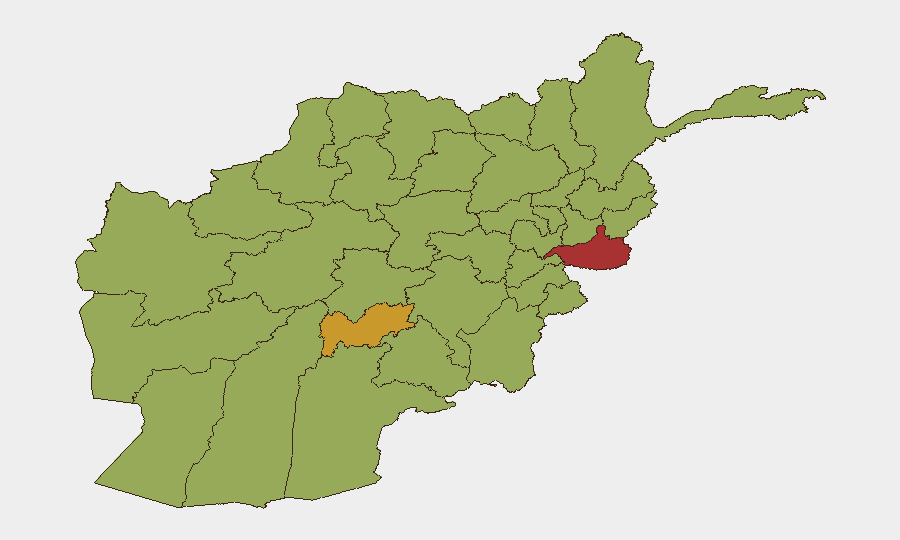
Nangarhar Province (77.9) and Uruzgan Province (72.5) drive the national composite threat score, driven by persistent anti-Taliban militant activity, cross-border infiltration, and weak administrative consolidation. Kabul Province (58.9), despite lower ranking, remains critical for expatriate and corporate presence; its 58.9 score reflects insider threats, protest risk, and occasional targeted violence rather than active conflict. A secondary cluster—Helmand, Paktika, Zabul, Kandahar—shows elevated risk (47.9–52.7) tied to narcotics trafficking, tribal fragmentation, and residual ISIS-K and al-Qaeda presence. Eastern and southern provinces account for the majority of flagged events; northern provinces (Balkh, Jowzjan) show lower but non-negligible exposure.
How GeoBit Would Assist
AOI Monitoring & Early Warning with persistent watch on Nangarhar, Uruzgan, and Kabul would flag tactical developments (military movements, arrests, protests) before they reach news outlets. Intel Sweep and X/Twitter/Telegram OSINT enable real-time detection of actor statements, cross-border incidents, and supply-line disruptions. Network & Actor Analysis maps Taliban internal factions, ISIS-K cell structures, and Pakistan security service activity, surfacing friction points that precede violent escalation. GIS & Spatial Analysis and Satellite Imagery support alternative routing around high-risk provinces and facility-level risk assessment for corporate or NGO assets.
7-Day Outlook
No imminent mass-casualty event or nationwide security collapse is forecast. Eastern border volatility and internal Taliban governance disputes will likely generate isolated arrests, skirmishes, and investigative activity through late July. Kabul and northern business hubs will remain accessible but subject to routine insider-threat and protest monitoring; travel to Nangarhar and Uruzgan should remain restricted pending tactical clarification.
Highest-Risk Areas — Ranked
| # | State / Region | Risk |
|---|---|---|
| 1 | Nangarhar Province | 77.9 |
| 2 | Uruzgan Province | 72.5 |
| 3 | Kabul Province | 58.9 |
| 4 | Helmand Province | 56.8 |
| 5 | Paktika Province | 52.7 |
| 6 | Zabul Province | 47.9 |
| 7 | Kandahar Province | 47.9 |
| 8 | Ghazni Province | 47.9 |
| 9 | Farah Province | 47.9 |
| 10 | Nimruz Province | 47.9 |
| 11 | Jowzjan Province | 47.9 |
| 12 | Balkh Province | 47.9 |
Previous Daily Briefs
A new Afghanistan brief is written every day — each with its own risk map and downloadable CSV. Here's the last week; use the calendar to go further back.
📅 Browse every day by calendar →
Highlighted days have a brief. Tap a day for that day's map & analysis, or “csv” for that day's dataset ($5).
Atlas — our AI intelligence desk — emails them this snapshot personally. Nothing else, no list.