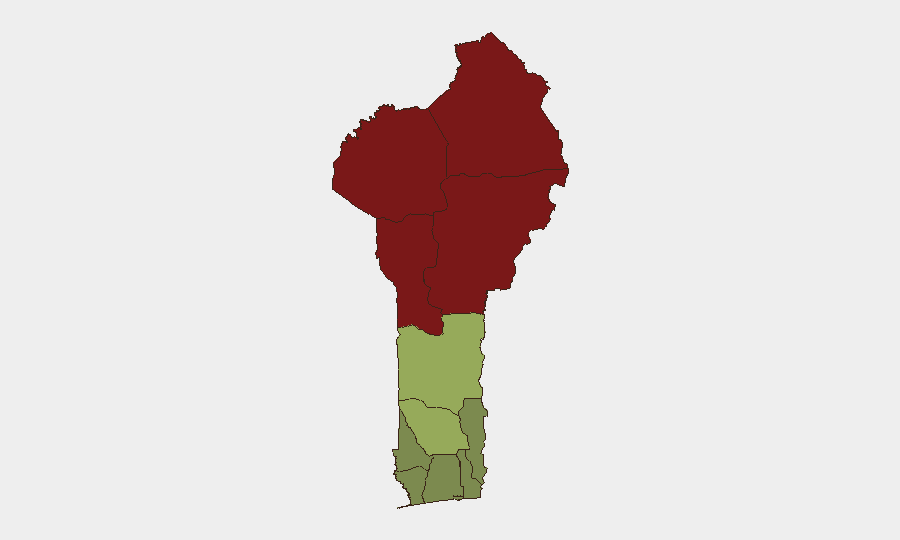
Situation Summary
Benin remains a moderate-tier terrorism and insurgency risk (#51 globally), with active jihadist pressure concentrated in the northern border departments. The past week saw one significant security response—closure of schools in northern Benin on 12 September due to heightened jihadist incursion concerns—alongside routine property crime and public-order incidents in southern and central regions. The security posture is stable but fragile in the north; southern and coastal areas continue to experience low-level criminal activity without acute organized threats.
Key Developments
- Northern Benin school closures (12 September 2026): Authorities ordered closure of multiple schools in northern departments due to security concerns linked to jihadist border incursions, particularly in Alibori and Atakora departments. Reflects operational response to sustained Al-Qaeda-linked (JNIM) activity in the Sahel border zone.
- Cotonou airport drug-trafficking arrest (2–4 September 2026): Beninese authorities arrested Nigerian fugitive Festus Ibewuike at Cotonou airport on 2 September; he was wanted in connection with a 49.70 kg heroin seizure at Lagos airport. Extradited to Nigerian NDLEA on 4 September, underscoring Benin's role as a transnational narcotics transit route.
- Armed home invasion and robbery, Affoutoufadji (night of 2–3 September 2026): Three robbers broke into a farmer's home, stealing approximately 140,000 CFA francs and mobile phones. One suspect was apprehended following an accidental shooting during the incident; reported 9 September.
- Motorcycle theft and arrests, Zè commune (5 September 2026): A thief broke into a residence at 03:00 and stole a Honda Wave motorcycle. Police arrested two suspects for theft and handling of stolen goods; case reported 8 September. Reflects continued petty property crime in peri-urban southern areas.
- Ritual-violence assault, Awokpa/Zè (night of 3–4 September 2026): A woman was physically assaulted during nocturnal Oro cult rituals in Awokpa, Zè commune (southern Benin). Multiple suspects were arrested and placed in custody; reported 10 September. Indicates localized religious-practice tensions in southern communities.
- Ongoing jihadist incursions (context to current week): Since approximately May 2026, JNIM has expanded operations southward into northern Benin's border parks and settlements, prompting military responses and civilian displacement. The 12 September school closures are a direct operational consequence of this sustained pressure.
Highest-Risk Areas
The four northernmost departments—Alibori (92), Atakora (88), Donga (85), and Borgou (83)—account for the vast majority of terrorism and insurgency risk, driven by sustained Al-Qaeda-linked jihadist incursions from the Sahel and direct cross-border pressure from Mali and Burkina Faso. Central departments (Zou, Collines, Plateau) register moderate residual risk, while southern coastal zones (Atlantique, Littoral, Ouémé) remain relatively secure with primarily localized crime and public-order concerns. Northern risk is asymmetric: border areas and protected parks are high-threat zones; major towns and populated corridors face lower but non-negligible risk. Schools, military installations, and remote settlements in the north should be flagged for heightened vigilance.
How GeoBit Would Assist
Security teams should deploy AOI Monitoring & Early Warning on northern border departments (Alibori, Atakora) with persistent alerting for jihadist activity, and Conflict & Military tracking (force structure, attack patterns, displacement) to anticipate further school closures or travel restrictions. Multi-language OSINT and Telegram/X monitoring will capture real-time jihadist messaging and recruitment targeting Benin. Routing & Network Analysis enables calculation of alternate travel and supply routes around northern closures; Satellite & Imagery analysis supports assessment of displaced populations and armed-group movement in border parks.
7-Day Outlook
Northern security will remain reactive to cross-border jihadist pressure; expect sporadic school and market closures in Alibori and Atakora through the coming weeks as insurgents test Beninese force disposition. Southern crime (robbery, theft, ritual violence) will continue at baseline levels. No imminent major attack or regime instability is signaled; the threat trajectory is gradual expansion of northern insurgency, not sudden escalation.
Highest-Risk Areas — Ranked
| # | State / Region | Risk |
|---|---|---|
| 1 | Alibori Department | 92 |
| 2 | Atakora Department | 88 |
| 3 | Donga Department | 85 |
| 4 | Borgou Department | 83 |
| 5 | Zou Department | 45 |
| 6 | Collines Department | 42 |
| 7 | Plateau Department | 38 |
| 8 | Kouffo Department | 35 |
| 9 | Mono Department | 32 |
| 10 | Atlantique Department | 28 |
| 11 | Littoral | 25 |
| 12 | Ouémé Department | 22 |
Sources
Previous Weekly Briefs
A new Benin brief is written every Monday, covering the week — each with its own risk map and downloadable CSV. Use the calendar to go further back.
- September 7, 2026
- September 1, 2026
- August 30, 2026
- August 28, 2026
- August 26, 2026
- August 24, 2026
- August 22, 2026
📅 Browse past briefs by calendar →
Highlighted days have a brief. Tap a day for that day's map & analysis, or “csv” for that day's dataset ($5).
Atlas — our AI intelligence desk — emails them this snapshot personally. Nothing else, no list.