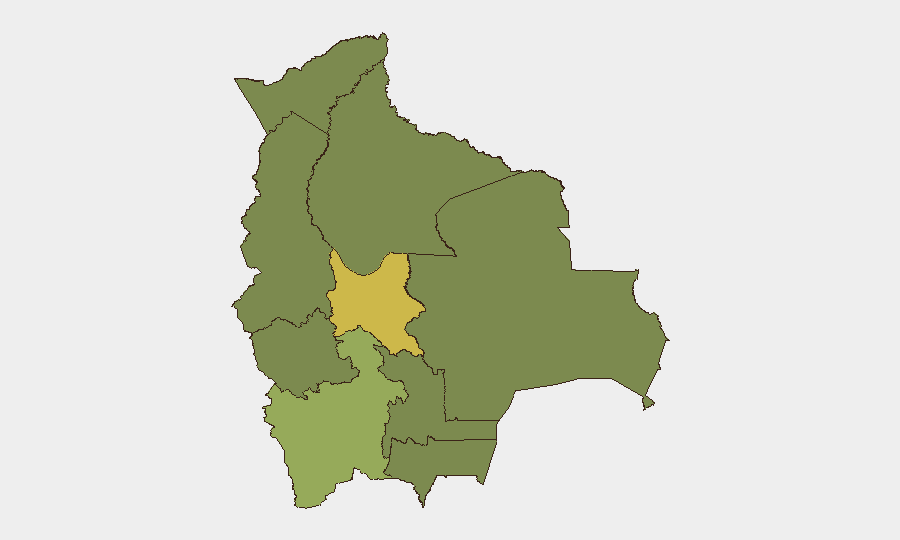
Situation Summary
Bolivia remains under a national state of emergency (declared June 20) with expanded police and military powers to suppress road blockades and restrict weapon/fuel movement. Recent 24–48 hour activity shows continued law-enforcement operations against human-trafficking networks and armed violence in Santa Cruz, alongside ongoing investigations into recruitment of Bolivians for Russian military service. The country's composite threat score of 48 places it at rank #47 globally; Cochabamba (63.9) and Potosí (41.9) remain highest-risk departments, but Santa Cruz is seeing elevated operational police activity and documented homicides.
Key Developments
- Santa Cruz de la Sierra (Santa Cruz Dept.), July 18: Police raids ("allanamientos") linked to Russian military recruitment resulted in at least two arrests. Operations are part of an Attorney General investigation into human trafficking and alleged coercion of Bolivians to fight in Ukraine.
- San Ignacio de Velasco, Barrio San Miguel (Santa Cruz Dept.), mid-July, reported within 48h: Two men were shot dead inside a warehouse in what local media characterize as an armed attack consistent with execution-style killings; this continues a pattern of concentrated armed fatalities in Santa Cruz in 2026.
- National State of Emergency (ongoing as of mid-July): The June 20 declaration remains in force, permitting security forces to detain violators for up to eight hours and restrict weapons/fuel movement. Authorities warn that protest blockades and supply disruptions can re-emerge at short notice.
- Santa Cruz Dept., child-trafficking enforcement (current): Following a suspicious infant death in hospital, authorities have tightened travel restrictions on minors without parental authorization and expanded investigations into syndicates using children for forced begging. Expect heightened police checks involving family documentation.
- National / Northern communities, Russia recruitment probe (ongoing): Families in northern communities report at least 16 men missing for months, believed to be in war zones; videos of Bolivians in Russian uniforms are circulating. This has triggered sustained investigative activity by prosecutors and police.
- Conflict event concentration (April–June, reported mid-July): SIMAT recorded 246 conflict events in Q2 2026 (212 active, 34 announced), heavily concentrated in La Paz, Cochabamba, and Santa Cruz, indicating sustained localized protest and road-blockade risk in these departments.
Highest-Risk Areas
Cochabamba's risk score of 63.9 significantly outpaces all other departments and reflects sustained labor unrest and localized protest activity. Potosí (41.9) and Santa Cruz (39.7) follow; Santa Cruz in particular is experiencing simultaneous operational police activity (raids, trafficking investigations) and armed violence (homicides), creating a compound threat environment for corporate assets and personnel. La Paz (38.8), as the administrative capital, continues to see political pressure and civil unrest. The remaining departments cluster at 33.9–34.3, indicating baseline elevated risk but less acute escalation.
How GeoBit Would Assist
Security teams with personnel or assets in Bolivia should employ AOI Monitoring & Early Warning on Cochabamba, Potosí, and Santa Cruz to detect blockade formation, protest activity, and police operations in near-real time. Multi-language OSINT and social-media intelligence (X/Twitter, Telegram) will track recruitment-related criminal networks, protest announcements, and official prosecutor statements. Routing & Network Analysis can identify alternative supply and personnel movement corridors in the event of renewed national blockades.
7-Day Outlook
The state of emergency will likely remain in force, with security forces continuing targeted enforcement against trafficking networks and armed crime in Santa Cruz. Road-blockade risk remains elevated across Cochabamba and Potosí, and further protest activity could trigger supply disruptions with minimal warning. Personnel movements should factor in checkpoint delays and documentation requirements, particularly in Santa Cruz.
Highest-Risk Areas — Ranked
| # | State / Region | Risk |
|---|---|---|
| 1 | Cochabamba | 63.9 |
| 2 | Potosí | 41.9 |
| 3 | Santa Cruz | 39.7 |
| 4 | La Paz | 38.8 |
| 5 | Oruro | 34.3 |
| 6 | Tarija | 33.9 |
| 7 | Pando | 33.9 |
| 8 | Beni | 33.9 |
| 9 | Chuquisaca | 33.9 |
Sources
Previous Daily Briefs
A new Bolivia brief is written every day — each with its own risk map and downloadable CSV. Here's the last week; use the calendar to go further back.
📅 Browse every day by calendar →
Highlighted days have a brief. Tap a day for that day's map & analysis, or “csv” for that day's dataset ($5).
Atlas — our AI intelligence desk — emails them this snapshot personally. Nothing else, no list.