Situation Summary
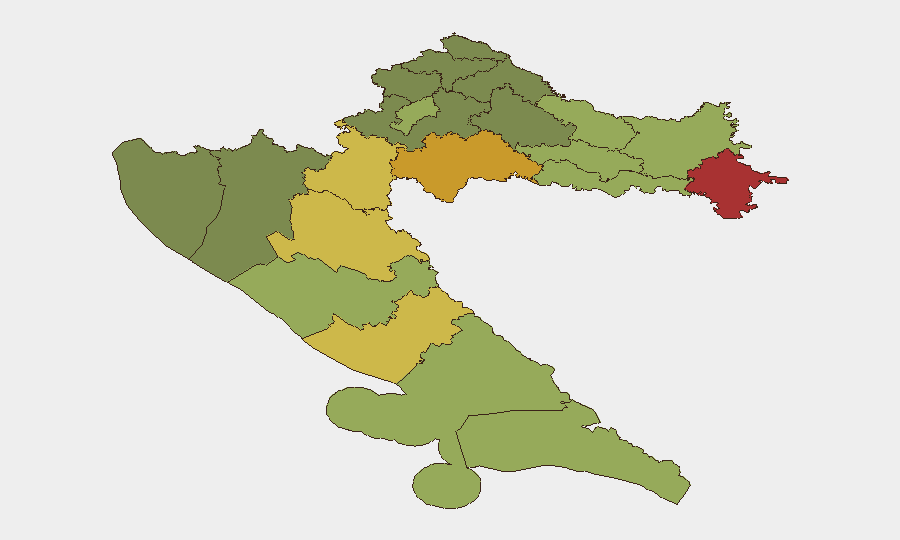
Croatia remains a low-threat environment (global rank #150, composite score 7) with no tracked acute security incidents; however, concentrated risk persists in eastern and border regions, particularly Vukovar-Srijem, Sisak-Moslavina, and Karlovac counties, driven by historical conflict legacies and ongoing infrastructure vulnerabilities. Recent tactical incidents—armed robbery in Zagreb, arson arrests in Zadar County, and detention of a Nord Stream sabotage suspect—are isolated events rather than indicators of systemic destabilization. Regional political tension over Serbian armament and domestic environmental disputes add low-order political friction but do not materially elevate national threat posture. The security trajectory remains stable but regionally fragmented.
Key Developments
- Armed robbery, Zagreb (Špansko), evening 2026-08-25: An unidentified perpetrator robbed a neighborhood shop on Trg Ivana Kukuljevića using a knife, fled with an undisclosed cash amount; search ongoing and multiple police units deployed.
- Nord Stream suspect detention, Pula, 2026-08-26: A Ukrainian national (Volodymyr Zhuravlev) arrested on European warrant in connection with 2022 Nord Stream pipeline sabotage remains in custody pending extradition; investigative judge ordered detention.
- Political tension escalation, Gospić/Zagreb Parliament, 2026-08-21 to -26: Opposition called for 5 September protest following extraordinary parliamentary session on illegal waste dump in Gospić; environmental and governance security concerns framed as ongoing dispute.
- Regional military rhetoric, Zagreb, 2026-08-22 to -25: Croatian Parliament president publicly warned Western allies of Serbian offensive weapons acquisition, framing regional security risk; no incident on Croatian territory but contributes to political-security messaging.
- Traffic congestion, A1/A3/A4/DC1 motorways and coastal routes, 2026-08-22 to -26: Intensified congestion on major road corridors (Karlovac–Lučko, Bregana–Lipovac, Jadranska magistrala) increases accident risk; heavy weekend traffic with ongoing construction impacts.
- Maritime transport disruption, Adriatic routes, through 2026-08-26: Multiple ferry and catamaran services suspended (Zadar–Ancona, Zadar–Pula, Split routes, island services) due to adverse weather and orange-level storm warnings; affects coastal and island connectivity.
Highest-Risk Areas
Eastern and border counties dominate the sub-national ranking, with Vukovar-Srijem (risk 78), Sisak-Moslavina (72), and Karlovac (68) reflecting post-1990s conflict legacies, land-mine contamination, infrastructure fragility, and proximity to Serbian border. These regions experience persistent economic marginalization and residual inter-ethnic sensitivities. Zadar County (rank 55, but recently active for arson) and Lika-Senj (65, site of environmental dispute) show tactical volatility. Zagreb (rank 50) and Split-Dalmatia (48), though lower-ranked, house significant expatriate, corporate, and tourist populations and remain subject to petty criminal opportunism.
How GeoBit Would Assist
Corporate security teams should deploy AOI Monitoring & Early Warning on high-risk counties (especially Vukovar-Srijem, Sisak-Moslavina) to detect escalations in civil unrest, environmental incidents, or border-zone activity. Routing & Network Analysis capabilities support duty-of-care teams in real-time traffic and maritime rerouting given current congestion and weather disruptions. Network & Actor Analysis of the Zagreb robbery, arson arrests, and Nord Stream detention provides context on localized criminal networks and transnational security actors; OSINT fusion tracking Telegram/social-media activity around the 5 September planned protest in Gospić offers early warning of potential turnout and security flashpoints.
7-Day Outlook
No imminent escalation is forecast. The 5 September Gospić protest carries moderate monitoring importance but is unlikely to trigger broad-spectrum disruption. Maritime and road conditions are expected to normalize as weather patterns stabilize, reducing accident and delay risk. Expect continued low-order political rhetoric on regional security and ongoing standard law-enforcement activity (robbery investigations, arson prosecutions); no surge in threat indicators is anticipated through early September.
Highest-Risk Areas — Ranked
| # | State / Region | Risk |
|---|---|---|
| 1 | Vukovar-Srijem County | 78 |
| 2 | Sisak-Moslavina County | 72 |
| 3 | Karlovac County | 68 |
| 4 | Lika-Senj County | 65 |
| 5 | Šibenik-Knin County | 62 |
| 6 | Brod-Posavina County | 58 |
| 7 | Zadar County | 55 |
| 8 | Osijek-Baranja County | 52 |
| 9 | City of Zagreb | 50 |
| 10 | Split-Dalmatia County | 48 |
| 11 | Požega-Slavonia County | 45 |
| 12 | Virovitica-Podravina County | 42 |
Sources
Previous Daily Briefs
A new Croatia brief is written every day — each with its own risk map and downloadable CSV. Here's the last week; use the calendar to go further back.
- August 24, 2026
- August 22, 2026
- August 20, 2026
- August 18, 2026
- August 16, 2026
- August 14, 2026
- August 12, 2026
📅 Browse every day by calendar →
Highlighted days have a brief. Tap a day for that day's map & analysis, or “csv” for that day's dataset ($5).
Atlas — our AI intelligence desk — emails them this snapshot personally. Nothing else, no list.