Situation Summary
Iran faces acute internal instability following the death of Supreme Leader Ayatollah Ali Khamenei, with succession uncertainty and heightened military posture creating compounded security risk. Regional tension with Israel and the US has intensified over the past 72 hours, marked by direct military confrontation, aerial weapons deployment, and public threats. Airspace restrictions and IRGC security alerts remain active in Tehran as funeral proceedings continue, while underlying governance transition risks remain unresolved.
Key Developments
- Tehran – July 9–10, 2026 – Airspace restrictions and IRGC security alert
Iranian authorities imposed comprehensive airspace control and heightened IRGC deployment in response to funeral processions for Supreme Leader Khamenei. The IRGC issued explicit public warnings regarding consequences of any targeting attempts during this period, indicating active defensive posture.
- Iran–Israel maritime incident – July 8, 2026 – Small arms combat involving cargo vessel
Armed engagement occurred aboard or near a commercial cargo ship, with attribution and casualty details not yet fully clarified in open reporting.
- Iran–Israel military exchange – July 8, 2026 – Conventional military force engagement
Direct military confrontation between Iranian and Israeli forces, details and scope not yet granularly confirmed in available sources.
- US–Iran aerial escalation – July 9, 2026 – Aerial weapons deployment by US forces
The United States conducted aerial weapons operations directed at Iranian targets or positions.
- US official statement – July 8, 2026 – Public disapproval directed at Iran
US official statements registering diplomatic disapproval; context suggests connection to recent military actions or regional provocations.
- NATO statement – July 9, 2026 – Public statement and disapproval of Iran
NATO issued formal public statements and expressions of disapproval in response to Iranian actions or posture.
- EU demand to airline – July 9, 2026 – Aviation security directive
The European Union issued a demand to an airline operator, likely concerning routing, safety protocols, or sanctions compliance related to Iran operations.
- US internal policy discord – July 9, 2026 – Disapproval within US government
Internal US government disapproval signals suggest policy friction, possibly over response strategy or rules of engagement.
Highest-Risk Areas
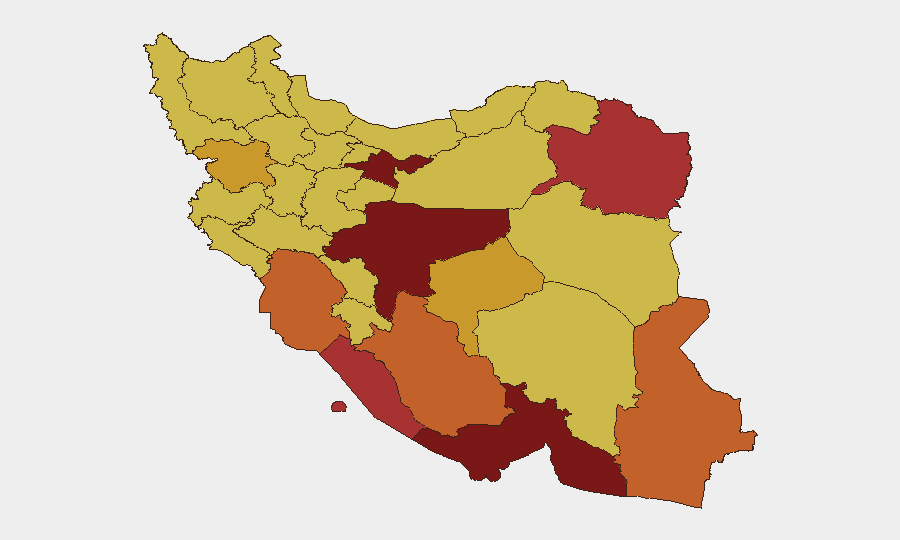
Tehran Province (risk 100) dominates the threat landscape due to concentration of political authority, military command, intelligence operations, and symbolic targets during the succession period. Isfahan and Hormozgan provinces follow at 87.7 and 80.8 respectively, reflecting regional military presence, nuclear/industrial infrastructure, and maritime security risks near the Strait of Hormuz. Bushehr, Razavi Khorasan, and Sistan and Baluchestan round out the top tier, driven by cross-border instability, military installations, and asymmetric actor presence. Risk is elevated across all tracked regions, with no province scoring below 70.8.
How GeoBit Would Assist
Security and risk teams should employ AOI Monitoring & Early Warning to track Tehran, Isfahan, and strategic coastal provinces for protest escalation, military posture changes, or incident clustering around funeral events and succession developments. Network & Actor Analysis combined with Intel Sweep (multi-language OSINT, Telegram/X feeds, and entity extraction) enable real-time detection of IRGC alerts, militia activity, and regime-stability signals. Maritime & Aviation tracking supports operational awareness of vessel and aircraft movements in high-risk waters and airspace, while Routing & Network Analysis assists duty-of-care teams in alternative journey planning for personnel in or transiting Iran.
7-Day Outlook
Succession uncertainty and heightened military posture are likely to persist through the funeral period, with airspace restrictions and IRGC alert status remaining elevated. Further regional military exchanges between Iran, Israel, and the US are possible, particularly if maritime or aerial incidents recur. Risk of internal unrest or protest activity may increase once funeral proceedings conclude, depending on clarity and acceptance of succession outcomes.
Highest-Risk Areas — Ranked
| # | State / Region | Risk |
|---|---|---|
| 1 | Tehran Province | 100 |
| 2 | Isfahan Province | 87.7 |
| 3 | Hormozgan Province | 80.8 |
| 4 | Bushehr Province | 78.9 |
| 5 | Razavi Khorasan | 77.4 |
| 6 | Sistan and Baluchestan Province | 74.8 |
| 7 | Fars Province | 74 |
| 8 | Khuzestan Province | 73.1 |
| 9 | Yazd Province | 71.9 |
| 10 | Kurdistan Province | 71.1 |
| 11 | East Azerbaijan Province | 70.8 |
| 12 | Qom Province | 70.8 |
Sources
Previous Daily Briefs
A new Iran brief is written every day — each with its own risk map and downloadable CSV. Here's the last week; use the calendar to go further back.
📅 Browse every day by calendar →
Highlighted days have a brief. Tap a day for that day's map & analysis, or “csv” for that day's dataset ($5).
Atlas — our AI intelligence desk — emails them this snapshot personally. Nothing else, no list.