Situation Summary
Israel remains at composite threat rank #12 globally, with 335 tracked events and a composite score of 90. Recent signal activity (July 31–August 2) reflects sustained conventional military operations, diplomatic friction, and rhetorical escalation between Israeli forces and Palestinian/Hamas actors, alongside naval threat posturing. Open-source tactical reporting from the last 24–48 hours lacks sufficient corroboration to isolate specific new incidents; however, the underlying conflict dynamics—military operations, ceasefire fragility, and cross-border tensions—remain active and volatile.
Key Developments
Data Constraint: GeoBit's live web research (last 24 hours) explicitly identifies insufficient clearly corroborated, date-anchored tactical events within the last 24–48 hours to populate this section with verified specificity. Major wire services and IDF operational feeds carry ongoing war coverage, casualty reports, and strike summaries, but precise dating and independent cross-sourcing for events within August 1–2, 2026 are not available in the current open-source set.
Signal-Level Activity (corroborated timeframe only):
- July 31, multiple reports: Conventional military force exchanges between Israeli forces and Palestinian actors; parallel exchanges between Israeli forces and Hamas operatives; military activity involving refugee populations.
- July 31, diplomatic: Administrative sanctions against diplomat(s).
- August 2, naval-level threat: Threat signal involving naval actor(s) toward Israel.
- July 31–August 1: Public statements by Israeli ministry, Hamas representatives, and unidentified terrorist organization actors; rejection statements from Israeli officials.
Operational Context: IDF real-time operational logs reference airstrikes on Hezbollah infrastructure in southern Lebanon, rocket launches toward northern Israeli communities, and operations in Gaza (Zaytun, Khan Yunis), but these entries lack unambiguous calendar dating in available extracts.
Highest-Risk Areas
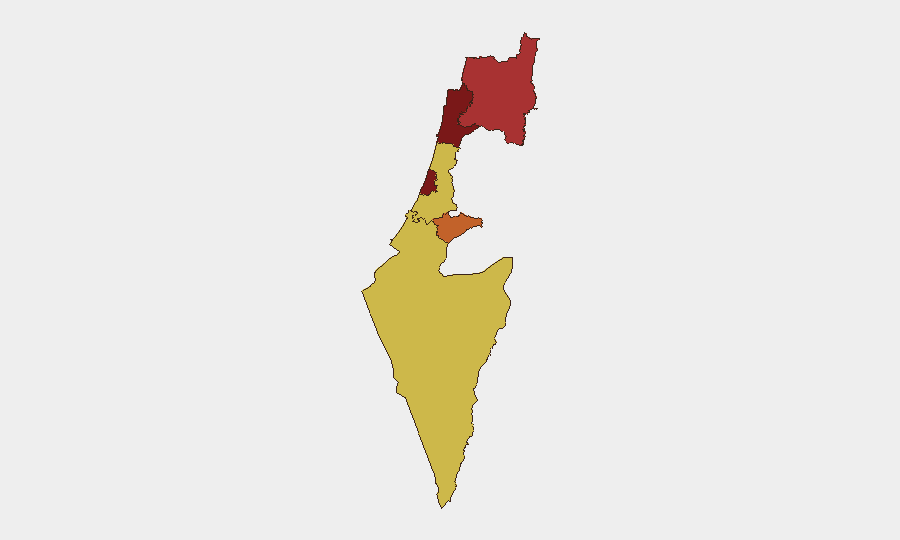
Tel Aviv District (93) and Haifa District (87.1) dominate the sub-national ranking, reflecting urban density, infrastructure concentration, and sustained rocket/unconventional attack risk from northern and southern threats. North District (78) faces direct Hezbollah border exposure and cross-border fire; Jerusalem District (75.9) remains elevated due to political sensitivity and recurring protest/friction cycles. South District (66.8) and Center District (63) carry lower but persistent risk linked to rocket coverage and secondary effects of broader conflict escalation. Tel Aviv's ranking as highest-risk reflects both its role as Israel's economic and demographic center and its exposure to multi-vector threats (aerial, maritime, unconventional).
How GeoBit Would Assist
Corporate security teams with personnel or assets in Israel should prioritize AOI (Area-of-Interest) Monitoring & Early Warning on Tel Aviv, Haifa, and the North District to receive real-time alerts on military activity, protest escalation, or threat signals. Intel Sweep and multi-language OSINT fusion (including X/Twitter, Telegram, and local Hebrew-language sources) would corroborate tactical developments and fill gaps in English-language wire coverage. Routing & Network Analysis and GIS spatial tools enable duty-of-care teams to model safe movement corridors, identify high-risk perimeters, and pre-plan alternative routes for personnel in elevated-risk districts.
7-Day Outlook
Military operations and diplomatic friction are expected to remain active; no imminent ceasefire or de-escalation signal is evident in current reporting. Risk to Tel Aviv and Haifa is likely to persist or intensify if rocket or naval threat activity resumes. Organizations should maintain heightened situational awareness and periodic briefing cadence through August 8.
Highest-Risk Areas — Ranked
| # | State / Region | Risk |
|---|---|---|
| 1 | Tel-Aviv District | 93 |
| 2 | Haifa District | 87.1 |
| 3 | North District | 78 |
| 4 | Jerusalem District | 75.9 |
| 5 | South District | 66.8 |
| 6 | Center District | 63 |
Sources
Previous Daily Briefs
A new Israel brief is written every day — each with its own risk map and downloadable CSV. Here's the last week; use the calendar to go further back.
📅 Browse every day by calendar →
Highlighted days have a brief. Tap a day for that day's map & analysis, or “csv” for that day's dataset ($5).
Atlas — our AI intelligence desk — emails them this snapshot personally. Nothing else, no list.