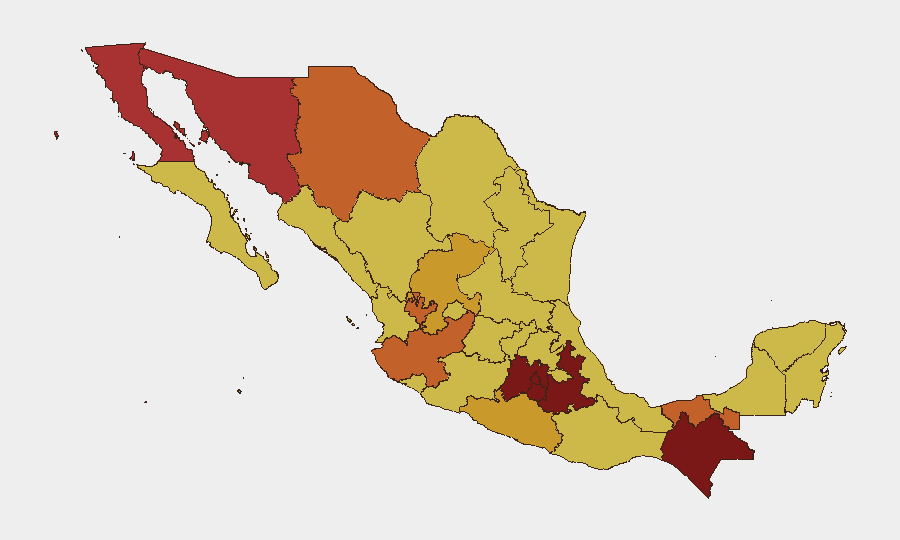
Situation Summary
Mexico remains the ninth-highest global security threat (composite score 96), driven primarily by ongoing drug-trafficking organization violence and territorial competition across multiple states. Recent event signals (1,122 tracked incidents) show elevated activity involving organized crime, local government, and security-force engagement, particularly in the State of Mexico, Chiapas, and Morelos. The national homicide trend has shown some moderation in recent months, though sub-national volatility and institutional stress remain persistent. Overall trajectory reflects a complex, fragmented threat landscape with localized acute risk rather than nationwide destabilization.
Key Developments
- 2026-07-25 · Organized crime engagement with municipal authority. Signals indicate investigation and arrest/detention activity linked to organized crime vs. mayor-level officials, suggesting renewed targeting or pressure on local governance. Specific location and victim status under clarification.
- 2026-07-25 · Assassination event reported. A mayor-level official death signal recorded; confirmation of location, motive, and perpetrator pending. Such incidents typically trigger institutional and security-force response and elevate sub-national risk in affected jurisdiction.
- 2026-07-25 · Military/security force deployment and territory occupation. Conventional military force and territory occupation signals suggest government response operation, likely counter-cartel or counter-organized-crime action. Regional locus (state-level) under determination.
- 2026-07-25 · Civil dissent and indigenous statement activity. Public statements from indigenous and civilian populations and village-level disapproval of mayor recorded. Context (resource grievance, security failure, governance dispute) requires local reporting clarification.
- 2026-07-24 · Arrest/detention operation (government). National-level arrest/detention signal; subject and location unconfirmed pending secondary reporting.
- 2026-07-24–25 · Activist and firefighter conventional force engagement. Non-state actor (activist) and emergency-services personnel involved in force-related incidents; motive and casualty status unclear pending confirmation.
Note: Event signals are confirmed flagged but lack granular location detail and full context. Multi-source corroboration from regional SSP (Secretaría de Seguridad Pública), Protección Civil, and local media sources pending to establish operational timeline and tactical significance.
Highest-Risk Areas
The State of Mexico (96.9) and Chiapas (95.6) dominate the sub-national risk ranking, together accounting for the most acute organized-crime, institutional-stress, and violence indicators. State of Mexico's proximity to the capital, role as a major cartel transit and settlement zone, and structural weaknesses in municipal governance create compounding vulnerability; Chiapas's geographic position (Central American border, drug-trafficking corridor), indigenous population dynamics, and historical land-tenure conflicts amplify localized instability. Morelos (89.4) and Puebla (87.8) follow, reflecting cartel competition and forced-displacement pressure. Mexico City (80.2), despite lower ranking, concentrates high-value targets, critical infrastructure, and institutional assets requiring sustained protective posture.
How GeoBit Would Assist
Security teams operating in Mexico should employ Intel Sweep and X/Twitter & Telegram OSINT for real-time incident detection across cartel, government, and activist channels; AOI Monitoring & Early Warning to establish persistent watch on highest-risk states (State of Mexico, Chiapas, Morelos) with automated alerting on force deployment, arrests, and leadership changes; and Network & Actor Analysis to map organized-crime and municipal-governance relationships and predict targeting patterns. Routing & Network Analysis supports alternative route planning for personnel movement in unstable jurisdictions, while Conflict & Military tracking monitors military/police deployment and force-posture shifts that signal escalation or de-escalation.
7-Day Outlook
Immediate risk likelihood remains elevated in State of Mexico and Chiapas, with ongoing cartel repositioning and municipal-level institutional stress. Watch for secondary enforcement actions, leadership consolidation within trafficking organizations, and further civil or indigenous-community mobilization tied to governance failures or displacement. Homicide rate trend should remain monitored for inflection points signaling renewed cartel conflict.
Highest-Risk Areas — Ranked
| # | State / Region | Risk |
|---|---|---|
| 1 | State of Mexico | 96.9 |
| 2 | Chiapas | 95.6 |
| 3 | Morelos | 89.4 |
| 4 | Puebla | 87.8 |
| 5 | Mexico City | 80.2 |
| 6 | Sonora | 78.3 |
| 7 | Baja California | 77.1 |
| 8 | Jalisco | 75.6 |
| 9 | Chihuahua | 75.2 |
| 10 | Tabasco | 74 |
| 11 | Guerrero | 72.6 |
| 12 | Zacatecas | 72.5 |
Sources
Previous Daily Briefs
A new Mexico brief is written every day — each with its own risk map and downloadable CSV. Here's the last week; use the calendar to go further back.
📅 Browse every day by calendar →
Highlighted days have a brief. Tap a day for that day's map & analysis, or “csv” for that day's dataset ($5).
Atlas — our AI intelligence desk — emails them this snapshot personally. Nothing else, no list.