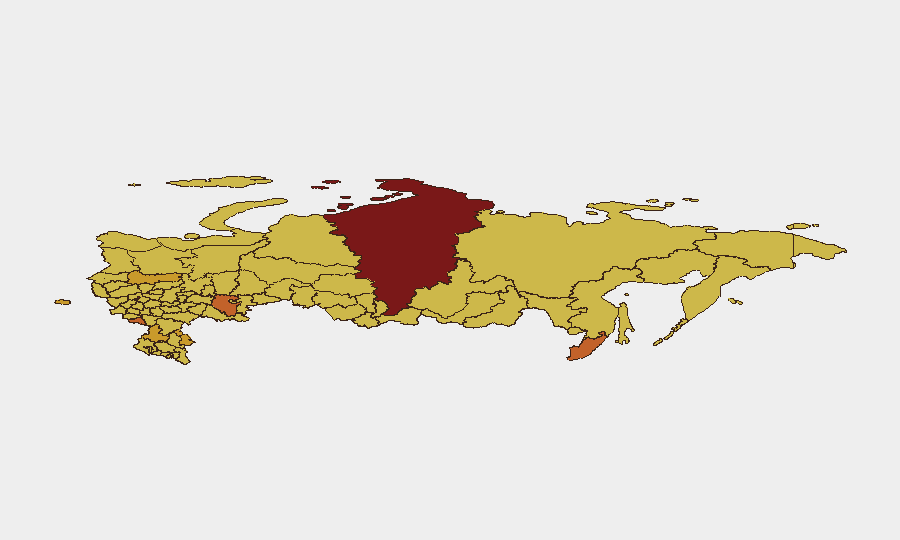
Situation Summary
Russia remains in elevated threat condition (composite rank #5 globally) with 745 tracked events, driven by ongoing Ukrainian drone strikes on civilian and energy infrastructure, sustained enforcement activity against perceived dissent, and regional security pressures across southern and eastern territories. The last 24 hours have seen active drone impact events in the Moscow region and Stavropol Krai, environmental contamination incidents along the Black Sea coast, and continued military-court prosecutions of terrorism and sabotage cases. Risk trajectory remains upward in border regions and energy-dependent areas, with compounding pressures on fuel supply and transport logistics.
Key Developments
- Moscow region – 17 July 2026: Ukrainian drone strikes hit a residential area near the capital overnight; at least one impact confirmed in a suburban neighborhood despite air-defense interception of multiple drones, resulting in fire damage and civilian exposure risk.
- Stavropol Krai – 17 July 2026: Ukrainian drone strike ignited a major industrial fire at a Rosneft oil facility, underlining continuing vulnerability of energy infrastructure to airborne attack in southern Russia.
- Krasnodar Krai coastline – 17 July 2026: Oil product spills detected approximately 1 km from the Black Sea coast near Primorsko-Akhtarsky District; separate fuel oil and algae deposits reported along a 6 km stretch of Temryuk District coastline, triggering emergency response and maritime contamination concern.
- Krasnodar city – 17 July 2026: Local resident detained for Telegram chat comments allegedly calling for strikes on Moscow, reflecting ongoing enforcement against online dissent and pro-Ukrainian messaging.
- Rostov Oblast – 17 July 2026: Southern District Military Court convicted two residents from Ukraine's Zaporizhzhia region of preparing terrorist attacks on Russian railway infrastructure, with long sentences handed down; separate sentencing of a Cherkessk resident to nine years for terrorism recruitment underscores counterterrorism prosecutions in the North Caucasus.
- Stavropol Krai – 17 July 2026: Governor Vladimir Vladimirov ordered reduction in official vehicle use to free an estimated 3,000 tons of fuel monthly for commercial market, signaling fuel-supply strain and logistics stress impacting regional mobility and supply chains.
Highest-Risk Areas
Krasnoyarsk Krai (risk 100) and Moscow (91.5) lead the sub-national ranking, with Moscow's elevated score reflecting the combination of drone strike exposure, political enforcement activity, and critical infrastructure concentration. Southern regions—Belgorod Oblast, Rostov Oblast, and Krasnodar Krai—face compounded risk from proximity to the Ukrainian border, energy-infrastructure vulnerability, environmental contamination events, and active counterterrorism operations. Eastern regions, particularly Primorsky Krai (74.8), maintain elevated threat scores linked to cross-border tensions and North Pacific geopolitical dynamics. The clustering of high-risk zones in the south and east reflects active conflict proximity and consequent security enforcement pressure.
How GeoBit Would Assist
Security teams with personnel or assets in Russia should employ AOI Monitoring & Early Warning on critical infrastructure zones (energy facilities, transport nodes, ports) in Krasnodar, Stavropol, and Rostov to detect drone activity, spill events, or attack preparation signals in near-real time. Intel Sweep and Telegram/X OSINT capabilities enable rapid tracking of enforcement actions, detention events, and online dissent signals that may signal increased political-security risk. Environmental & Health and Maritime tracking would provide early detection of contamination spread, port disruption, and supply-chain impact from ongoing coastal incidents.
7-Day Outlook
Drone strike frequency and targeting patterns are expected to persist, with Moscow region and energy infrastructure remaining high-probability targets. Enforcement activity against online dissent and alleged sabotage networks will likely continue, particularly in border regions and North Caucasus territories. Fuel logistics constraints and environmental incidents will compound mobility and supply-chain risk through the forecast period.
Highest-Risk Areas — Ranked
| # | State / Region | Risk |
|---|---|---|
| 1 | Krasnoyarsk Krai | 100 |
| 2 | Moscow | 91.5 |
| 3 | Primorsky Krai | 74.8 |
| 4 | Bashkortostan | 74.6 |
| 5 | Belgorod Oblast | 74.5 |
| 6 | Saint Petersburg | 72.2 |
| 7 | Kaliningrad | 71.3 |
| 8 | Astrakhan Oblast | 71.3 |
| 9 | Vologda Oblast | 71.2 |
| 10 | Rostov Oblast | 71 |
| 11 | Ingushetia | 70.9 |
| 12 | Kabardino-Balkaria | 70.9 |
Sources
Previous Daily Briefs
A new Russia brief is written every day — each with its own risk map and downloadable CSV. Here's the last week; use the calendar to go further back.
📅 Browse every day by calendar →
Highlighted days have a brief. Tap a day for that day's map & analysis, or “csv” for that day's dataset ($5).
Atlas — our AI intelligence desk — emails them this snapshot personally. Nothing else, no list.