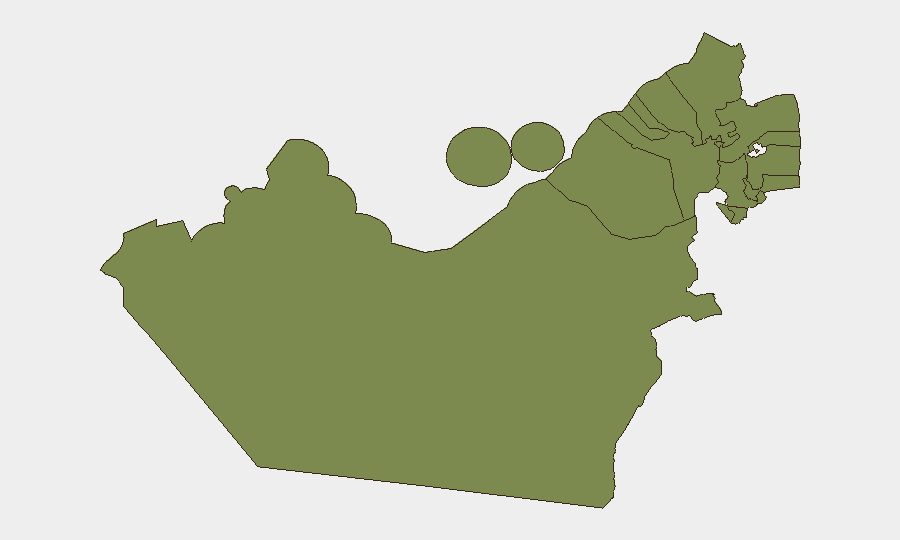
Situation Summary
The United Arab Emirates maintains internal stability with no confirmed security incidents, attacks, civil unrest, or infrastructure breaches reported in the last 24–48 hours. However, the country remains exposed to elevated regional threat from Iran-linked actors, evidenced by a May 2026 drone strike on the Barakah nuclear facility and ongoing Iranian rhetoric targeting UAE ports and airports. Dubai carries a substantially higher risk profile (31.3) compared to other emirates (1.3 each), reflecting its status as a major commercial and logistics hub. Current trajectory shows sustained geopolitical tension without active escalation on UAE soil.
Key Developments
- Country-wide (July 24–25, 2026): Open-source and cross-platform monitoring confirms no new terrorist attacks, bombings, mass-casualty incidents, civil unrest, or major crime events within UAE territory during the 24–48 hour window. Airport, port, and transportation services remain operational under normal conditions. [2][5]
- Country-wide (July 24–25, 2026): Iranian officials and IRGC-aligned channels continue issuing public warnings that UAE maritime and aviation hubs (Dubai International Airport, Abu Dhabi Jebel Ali and Khalifa ports, Fujairah facilities) are potential targets if U.S. military operations against Iran persist. No strikes on these facilities have been confirmed as of latest reporting. [1][9]
- Gulf region (July 24–25, 2026): U.S.–Iran de-escalation negotiations around the Strait of Hormuz remain ongoing. No new UAE-flagged vessel attacks or direct strikes on UAE maritime assets have been documented in the last 24–48 hours; prior tanker incidents date to July 18–20. [1][6][7]
- Diplomatic (July 24–25, 2026): Multiple states, including the U.S. (Secretary Austin), have issued statements disapproving of UAE positions or actions; Kazakhstan has signaled intent to reduce bilateral relations. These developments reflect diplomatic strain but do not constitute security incidents. [Event signals]
- Regional military activity (July 23, 2026 – context): Multiple confirmed conventional military force events involving the UAE, Iran, Bahrain, and the U.S. were recorded in early reporting windows. These underpin current heightened alertness but do not represent new incidents in the last 24–48 hours. [Event signals]
Highest-Risk Areas
Dubai's risk score of 31.3 significantly outpaces all other emirates (baseline 1.3), reflecting its role as the UAE's primary commercial, financial, and logistics center. This concentration of international business, tourism, aviation infrastructure, and maritime traffic—combined with proximity to the Strait of Hormuz and regional tensions—elevates exposure to both direct attacks and secondary effects (disruption, sanctions, travel restrictions). All other emirates (Abu Dhabi, Sharjah, Ajman, Ras al-Khaimah, Fujairah, Umm al-Quwain) carry equivalent and substantially lower risk, though Abu Dhabi's hosting of the Barakah nuclear facility and Jebel Ali port warrants sustained monitoring independent of the current ranking.
How GeoBit Would Assist
Security teams should deploy persistent Area-of-Interest (AOI) monitoring and early warning on Dubai International Airport, Jebel Ali Port, and Barakah Nuclear Facility to detect escalation signals in real-time. OSINT Fusion and multi-language social/news feed analysis (X, Telegram, regional news, IRGC statements) will track Iranian threat rhetoric and militia activity planning. Maritime and Aviation tracking coupled with conflict event monitoring enable duty-of-care teams to identify vessel or flight disruptions and route personnel away from high-risk corridors before incidents mature.
7-Day Outlook
No imminent attack indicators are present on UAE soil, but Iranian threat rhetoric and regional U.S.–Iran military posturing create sustained background risk through early August. Escalation would most likely manifest as targeted strikes on Dubai or Abu Dhabi logistics infrastructure, cyber operations, or maritime harassment in the Strait of Hormuz rather than mass-casualty domestic terrorism. Continued diplomatic strain and military posturing suggest risk will remain elevated but contained absent a major regional flashpoint.
Highest-Risk Areas — Ranked
| # | State / Region | Risk |
|---|---|---|
| 1 | Dubai | 31.3 |
| 2 | Sharjah Emirate | 1.3 |
| 3 | Ajman Emirate | 1.3 |
| 4 | Ras al-Khaimah | 1.3 |
| 5 | Fujairah Emirate | 1.3 |
| 6 | Umm al-Quwain | 1.3 |
| 7 | Abu Dhabi Emirate | 1.3 |
Sources
Previous Daily Briefs
A new United Arab Emirates brief is written every day — each with its own risk map and downloadable CSV. Here's the last week; use the calendar to go further back.
📅 Browse every day by calendar →
Highlighted days have a brief. Tap a day for that day's map & analysis, or “csv” for that day's dataset ($5).
Atlas — our AI intelligence desk — emails them this snapshot personally. Nothing else, no list.