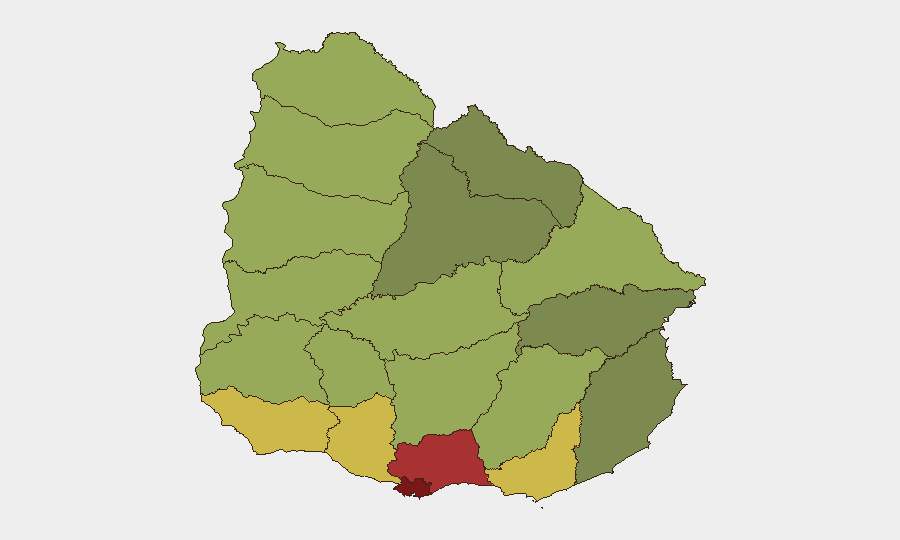
Situation Summary
Uruguay remains among the world's lowest-risk jurisdictions (global rank #134, composite score 12), with no tracked major security incidents in the current window. However, labor unrest, police accountability investigations, and localized criminal activity in Montevideo and surrounding departments are generating operational friction for transport, education, and commerce sectors. The security environment is stable but marked by sectoral disruption and institutional pressure on law enforcement credibility.
Key Developments
- Montevideo port strike (2026-09-21): SUPRA port union initiated a 24-hour strike affecting container terminal and cargo operations at Montevideo's main port; minimum services ordered; retail, banking, public transport, and Carrasco airport not directly impacted.
- Interior Ministry protest (2026-09-19): Guardia Republicana union (Unipolgr) held a peaceful demonstration outside the Ministry of the Interior demanding improved public security and the resignation of Interior Minister Carlos Negro.
- School assault and education strike (2026-09-18–19): A school employee was assaulted at School 326 (Nuevo Ellauri, Montevideo); Ademu Montevideo called a 24-hour strike in public schools the following day in response.
- "Caranchos" police investigation (2026-09-15): Nine police officers were arrested in an ongoing inquiry into alleged police involvement in criminal networks.
- Operation Trazado enforcement (2026-09-18): Authorities arrested four individuals and seized approximately 300 kg of drugs following searches in Brazo Oriental and Pérez Castellanos neighborhoods (Montevideo).
- Balkan/Albanian mafia monitoring (2026-09-17–20): Uruguay's police monitored arrivals of Balkan nationals following a DEA alert on Albanian organized crime activity; no criminal activity was detected in-country as of reporting.
- Port labor escalation context (2026-09-16): Shipping sector reporting indicated accumulated port labor disruptions throughout 2026, with the current strike part of a broader labor confrontation at Montevideo's port.
- Salto security concerns (2026-09-15): Local commercial interests in Salto called for enhanced security measures amid crime and informal-sector activity.
Highest-Risk Areas
Montevideo (risk 92) dominates the national threat profile, accounting for the overwhelming majority of discrete incidents—labor action, police accountability investigations, street crime, and drug enforcement operations. Canelones (risk 78) and Maldonado (risk 68) follow at a significant distance, reflecting spillover effects from the capital and localized criminal networks in coastal regions. The concentration of risk in the southern metropolitan corridor underscores that threat exposure for corporate operations is heavily geographic; inland and northern departments (Paysandú, Artigas, Salto) report substantially lower composite scores despite localized public-order concerns.
How GeoBit Would Assist
A security team with personnel or assets in Uruguay would use Intel Sweep and multi-language web research to track labor actions, protest activity, and law-enforcement developments affecting Montevideo's port, schools, and transport sectors in near-real time. AOI Monitoring & Early Warning on Montevideo's highest-risk neighborhoods (Brazo Oriental, Nuevo Ellauri, Pérez Castellanos) would provide persistent alerting on criminal enforcement and public-order incidents. Network & Actor Analysis on police corruption cases ("Caranchos") and organized-crime investigations (Operation Trazado, Balkan mafia monitoring) would establish links between international and domestic criminal actors and identify secondary risk to corporate operations.
7-Day Outlook
Labor disruption in the port sector is expected to continue intermittently through late September as wage and security negotiations persist. Police accountability investigations will remain active, creating operational uncertainty around law-enforcement capacity and institutional stability. Expect continued routine criminal enforcement and localized public-order management in Montevideo; no broad systemic deterioration is forecast.
Highest-Risk Areas — Ranked
| # | State / Region | Risk |
|---|---|---|
| 1 | Montevideo | 92 |
| 2 | Canelones | 78 |
| 3 | Maldonado | 68 |
| 4 | San José | 64 |
| 5 | Colonia | 62 |
| 6 | Soriano | 58 |
| 7 | Río Negro | 56 |
| 8 | Salto | 54 |
| 9 | Artigas | 52 |
| 10 | Paysandú | 50 |
| 11 | Florida | 48 |
| 12 | Flores | 46 |
Sources
Previous Weekly Briefs
A new Uruguay brief is written every Monday, covering the week — each with its own risk map and downloadable CSV. Use the calendar to go further back.
- September 14, 2026
- September 7, 2026
- September 2, 2026
- September 1, 2026
- August 31, 2026
- August 30, 2026
- August 29, 2026
📅 Browse past briefs by calendar →
Highlighted days have a brief. Tap a day for that day's map & analysis, or “csv” for that day's dataset ($5).
Atlas — our AI intelligence desk — emails them this snapshot personally. Nothing else, no list.