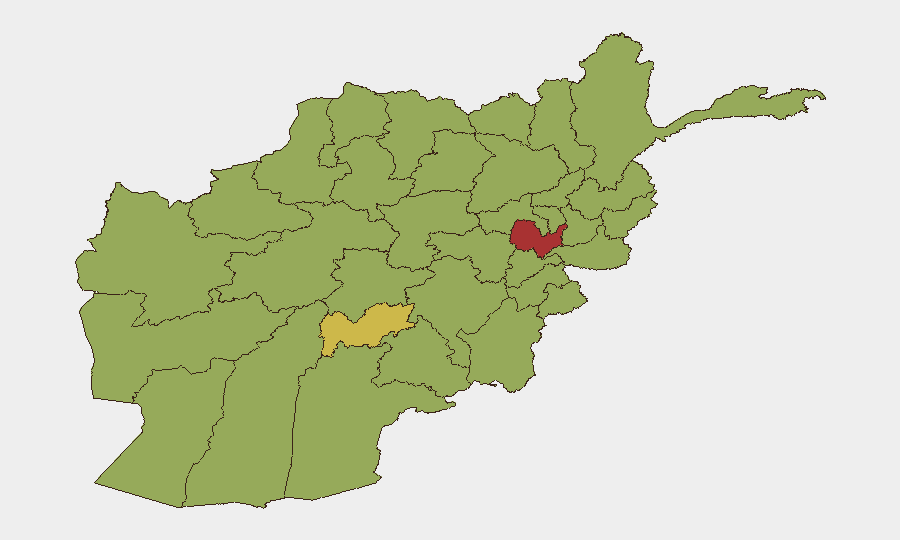
Situation Summary
Afghanistan remains at composite threat level 71 globally (#28 worldwide), with 40 tracked security events. The security environment is characterized by persistent Taliban state control challenged by nascent armed opposition activity, cross-border Pakistani military operations, and localized civil unrest. No major tactical escalation has been confirmed in major urban centers in the last 24–48 hours, though district-level insurgent activity and provincial military deployments indicate ongoing instability outside Kabul.
Key Developments
- Yaftali Sufla district, Badakhshan province (within last 48h): Armed opposition forces briefly seized the district center from Taliban control—the first such capture since the Taliban's 2021 takeover. Taliban provincial police confirmed the overnight incursion occurred while officials were absent. Taliban army chief Fasihuddin Fitrat was subsequently deployed to lead clearing operations, indicating a significant kinetic response.
- Herat province (recent, within last few days): Multiple reports document heavy Taliban military mobilization in Herat city to deter planned protests and confirmed Taliban suppression of a peaceful demonstration. Precise event dating is unclear from open sources; this reflects elevated civil-unrest risk but cannot be time-confirmed to the last 24–48 hours.
- Kabul and major urban centers (last 24–48h): No verified, location-specific security incidents—including attacks, displacement events, or casualty incidents—have been identified by open-source monitoring in the immediate 24-hour window, despite baseline threat environment remaining elevated.
- Cross-border tension with Pakistan: Ongoing Pakistani military operations in eastern border regions (Kunar and neighboring provinces) and Taliban claims of civilian casualties and infrastructure damage persist; however, specific events in this window cannot be confirmed as occurring in the last 24–48 hours.
Highest-Risk Areas
Kabul Province (78.8) dominates the threat landscape as the capital and seat of Taliban authority, followed by Uruzgan (69.9) and Daykundi (57.1) in the central highlands. Nangarhar and Helmand provinces (56.6 and 55.5 respectively) maintain elevated risk due to proximity to Pakistani border and historical insurgent activity. The clustering of high-risk provinces in the east (Nangarhar, Kunar, Paktika) and south (Kandahar, Helmand, Zabul) reflects Pakistan border volatility and residual anti-Taliban armed opposition presence; Kabul's elevation above all other provinces underscores administrative, diplomatic, and security-force concentration risks for international organizations and corporate presence.
How GeoBit Would Assist
Security teams with personnel or assets in Afghanistan should employ AOI Monitoring & Early Warning on Kabul, Nangarhar, Helmand, and Uruzgan provinces to detect tactical escalation or displacement in real time. Intel Sweep and multi-language OSINT fusion (X/Twitter, Telegram, Afghanistan International, local media) provide rapid corroboration and temporal confirmation of reported incidents, critical given the fog surrounding event dating in open reporting. Network & Actor Analysis paired with battle mapping capabilities enable tracking of armed-opposition organization, Taliban force disposition, and Pakistani cross-border activity—essential for route planning and duty-of-care assessments.
7-Day Outlook
The Badakhshan opposition seizure suggests localized but organized anti-Taliban military activity may be emerging; Taliban clearing operations will likely intensify over the next 7 days in that province. Civil-unrest risk in Herat and other urban centers remains elevated, particularly around planned demonstrations. No imminent nationwide tactical escalation is indicated, but the absence of reporting does not eliminate risk; corporate security teams should maintain heightened alert posture for Kabul and eastern provinces.
Highest-Risk Areas — Ranked
| # | State / Region | Risk |
|---|---|---|
| 1 | Kabul Province | 78.8 |
| 2 | Uruzgan Province | 69.9 |
| 3 | Daykundi Province | 57.1 |
| 4 | Nangarhar Province | 56.6 |
| 5 | Helmand Province | 55.5 |
| 6 | Kunar Province | 55.5 |
| 7 | Balkh Province | 54.3 |
| 8 | Paktika Province | 49.9 |
| 9 | Zabul Province | 48.8 |
| 10 | Kandahar Province | 48.8 |
| 11 | Ghazni Province | 48.8 |
| 12 | Farah Province | 48.8 |
Previous Daily Briefs
A new Afghanistan brief is written every day — each with its own risk map and downloadable CSV. Here's the last week; use the calendar to go further back.
📅 Browse every day by calendar →
Highlighted days have a brief. Tap a day for that day's map & analysis, or “csv” for that day's dataset ($5).
Atlas — our AI intelligence desk — emails them this snapshot personally. Nothing else, no list.