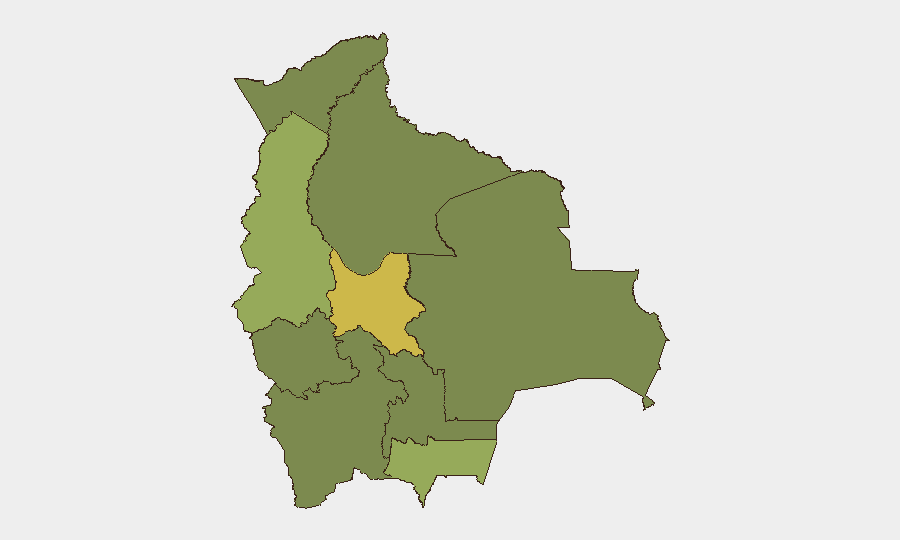
Situation Summary
Bolivia remains under a nationwide state of emergency (declared 20 June 2026) as security forces conduct operations to clear road blockades that have disrupted supply chains and movement. The composite threat score of 47 (#46 globally) reflects sustained unrest driven by labor and indigenous mobilization, compounded by localized criminal violence, drug-trafficking enforcement, and ongoing investigations into human trafficking linked to Russian recruitment. The security picture is volatile but not deteriorating uniformly; risk is heavily concentrated in Cochabamba (risk 63), where the Chapare coca-growing region remains the epicenter of protest activity and blockade enforcement.
Key Developments
- Cochabamba (Chapare region) – 19 July 2026: Road blockades remain in place under the ongoing state of emergency; authorities warn that new protests and disruptions can arise with little notice, maintaining elevated risk to supply chains and personnel movement across the region.[1]
- Santa Cruz de la Sierra – 18–19 July 2026: Police raids apprehended two individuals in connection with the investigation into Bolivian nationals recruited for Russian military service; human-trafficking and procurement networks remain under active investigation.[5][6]
- San Ignacio de Velasco (Santa Cruz Department) – 18 July 2026: Two men were killed in a shooting inside a warehouse in the San Miguel neighborhood; evidence collection and homicide investigation ongoing, consistent with a pattern of armed violence in the region.[4]
- Oruro city (Oruro Department) – 19 July 2026: A woman was found dead with visible signs of violence; homicide investigation opened and case classified as violent crime.[2]
- El Alto (La Paz Department) – 19 July 2026: Police detained a suspect carrying marijuana following a neighbor report; arrest processed for drug-trafficking charges in an urban enforcement context.[2]
- Potosí–Chuquisaca highway – 19 July 2026: A motorcyclist fatality resulting from collision with a bus; emergency response and scene investigation completed.[2]
- National security operations – 20 July 2026: Government aerial weapons deployment noted as part of ongoing state-of-emergency enforcement operations.[event signal]
Highest-Risk Areas
Cochabamba (risk 63) dominates the threat landscape, driven by sustained blockade activity in the Chapare coca-growing zone and associated protest mobilization. Tarija (41.8) and La Paz (40.3) rank second and third, reflecting both the capital's proximity to protest centers and border-region instability in the south. Potosí (37.4) and Santa Cruz (34.4) show elevated violence signals, including homicides and trafficking investigations; the remaining six departments cluster in the 33–34 range, suggesting diffuse but persistent localized crime and resource-conflict drivers.
How GeoBit Would Assist
Security teams operating in Bolivia should deploy AOI Monitoring & Early Warning against Cochabamba and Tarija to track blockade formation, police checkpoints, and protest convergence in near-real time. Intel Sweep and OSINT fusion across X, Telegram, and local media enable rapid detection of labor-union and indigenous-movement announcements that precede roadway disruptions. Routing & Network Analysis provides alternative journey planning around blocked corridors, while Event Feed and Sentiment Analysis quantify shifts in protest rhetoric and official posture, supporting duty-of-care decision-making on personnel movement and supply logistics.
7-Day Outlook
The state of emergency is likely to remain in effect through late July, with blockade-clearing operations continuing in Cochabamba and adjacent regions. Localized criminal violence in Santa Cruz and Oruro is expected to remain steady-state; no imminent change in the broader political or security posture is signaled by current event data. Personnel and asset security planning should account for sudden mobility restrictions and continued police/military checkpoints on major routes.
Highest-Risk Areas — Ranked
| # | State / Region | Risk |
|---|---|---|
| 1 | Cochabamba | 63 |
| 2 | Tarija | 41.8 |
| 3 | La Paz | 40.3 |
| 4 | Potosí | 37.4 |
| 5 | Santa Cruz | 34.4 |
| 6 | Oruro | 33.7 |
| 7 | Pando | 33 |
| 8 | Beni | 33 |
| 9 | Chuquisaca | 33 |
Sources
Previous Daily Briefs
A new Bolivia brief is written every day — each with its own risk map and downloadable CSV. Here's the last week; use the calendar to go further back.
📅 Browse every day by calendar →
Highlighted days have a brief. Tap a day for that day's map & analysis, or “csv” for that day's dataset ($5).
Atlas — our AI intelligence desk — emails them this snapshot personally. Nothing else, no list.