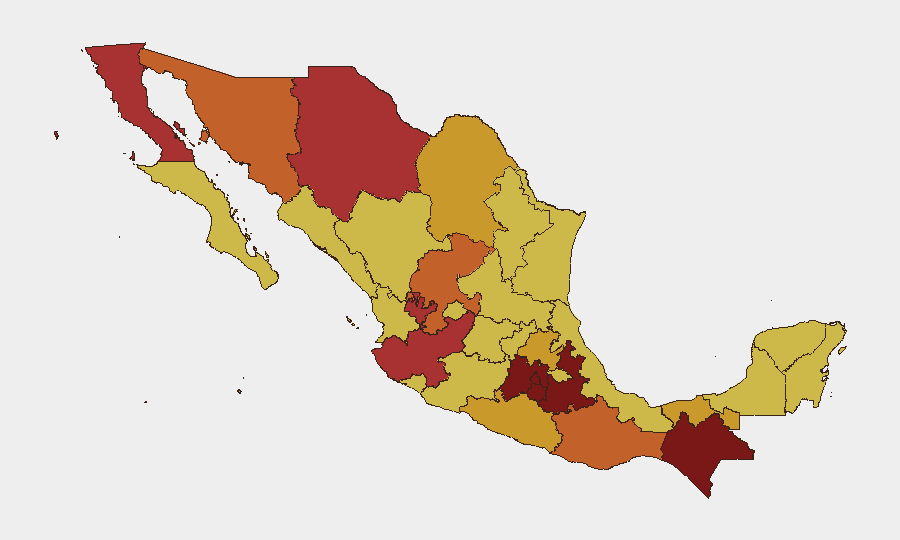
Situation Summary
Mexico remains at elevated criminality and state-fragmentation risk (composite score 96), driven by territorial conflict between organized crime groups, localized state incapacity, and sporadic direct violence against law enforcement and government officials. Recent 24–48 hour activity signals continued armed confrontations with police, major weapons seizures, journalist assault, and judicial processing of urban extortion cells, indicating sustained operational tempo across multiple criminal ecosystems. The threat profile reflects both cartel-linked insurgency-style activities in southern and central states and organized-crime penetration of major metropolitan areas including Mexico City.
Key Developments
- Apatzingán, Michoacán (July 25, afternoon): Armed civilians attacked Guardia Civil and Policía Municipal patrols in Nueva colony; one municipal officer wounded, one Guardia Civil officer (Andrik Aldair Montañez Solís) killed in direct firefight.
- San Luis Río Colorado, Sonora (July 25): Joint federal-state operation (Army, National Guard, Navy, FGR, state/local police) seized major CJNG-linked arsenal: 81 long guns including 4 high-caliber anti-aircraft machine guns, 128 magazines, ~275,000 rounds—among largest recent regional weapons seizures.
- Tecomán, Colima (July 25): Journalist Juan Pablo Ávila Martínez physically assaulted outside his home in context of local insecurity; incident flagged by press-freedom advocates as targeting threat to media.
- Mexico City (July 25): Prosecutor's Office secured linkage-to-process (vinculación a proceso) for five members of "La Glendisa" and "UJ-40" cells (La Unión Tepito affiliate) on aggravated extortion and drug-dealing charges.
- State of Mexico / Neza-Bordo prison (July 25): State prosecutor obtained linkage-to-process for "El Geisler" (alleged Los Vallarta / CJNG member) in connection with February 14 explosive attack on court facilities—prosecutorial progress on prior terror-style incident.
- Mexico City federal judiciary (July 25): Judge cancelled house arrest for former Attorney General Jesús Murillo Karam (Ayotzinapa case); replaced with electronic monitoring bracelet—signals shift in legal status around politically sensitive national investigation.
- Sinaloa state (July 25 clarification): Federal security cabinet denied authenticity of viral video claiming military deployment for governor-on-leave Rubén Rocha Moya; clarified images belonged to state security secretary operation—misinformation mitigation with public-order implications.
Highest-Risk Areas
Chiapas (97.5) and State of Mexico (95.3) lead the sub-national ranking, followed by Puebla (90.8) and Morelos (87.4). Chiapas and Puebla reflect southern/central state fragmentation, indigenous territorial dispute, and cartel-linked armed conflict; State of Mexico and Morelos indicate criminal penetration of high-population areas adjacent to Mexico City. Mexico City itself (83.0) faces organized extortion and drug-dealing networks operating within the capital, while northern border zones (Sonora, Baja California, Chihuahua) sustain cartel logistics and weapons-trafficking activity. The ranking confirms risk is not uniformly distributed: southern indigenous/rural zones experience territorial insurgency-like dynamics, while central and metropolitan areas face urban organized-crime infiltration.
How GeoBit Would Assist
Security teams would deploy AOI Monitoring & Early Warning on highest-risk state capitals and corporate facilities to track armed-group activity, law-enforcement operations, and public disorder in real time. Network & Actor Analysis and multi-language OSINT (X, Telegram, YouTube) enable tracking of cartel communications, splinter-group formation, and targeting signals against journalists or officials. Routing & Network Analysis supports alternative journey planning for personnel in Chiapas, Puebla, and State of Mexico during periods of heightened confrontation or roadblock activity.
7-Day Outlook
Armed confrontations between criminal groups and state forces are expected to continue at current tempo in Michoacán, Sonora, and State of Mexico. Prosecutorial activity against urban cells will likely accelerate, potentially triggering retaliatory violence. Media and judicial personnel remain elevated-risk targets; operational security protocols should remain elevated across Mexico City and central states.
Highest-Risk Areas — Ranked
| # | State / Region | Risk |
|---|---|---|
| 1 | Chiapas | 97.5 |
| 2 | State of Mexico | 95.3 |
| 3 | Puebla | 90.8 |
| 4 | Morelos | 87.4 |
| 5 | Mexico City | 83 |
| 6 | Chihuahua | 79.7 |
| 7 | Baja California | 76.6 |
| 8 | Jalisco | 76.3 |
| 9 | Sonora | 74.9 |
| 10 | Zacatecas | 74.6 |
| 11 | Oaxaca | 73.3 |
| 12 | Coahuila | 72.6 |
Sources
Previous Daily Briefs
A new Mexico brief is written every day — each with its own risk map and downloadable CSV. Here's the last week; use the calendar to go further back.
📅 Browse every day by calendar →
Highlighted days have a brief. Tap a day for that day's map & analysis, or “csv” for that day's dataset ($5).
Atlas — our AI intelligence desk — emails them this snapshot personally. Nothing else, no list.