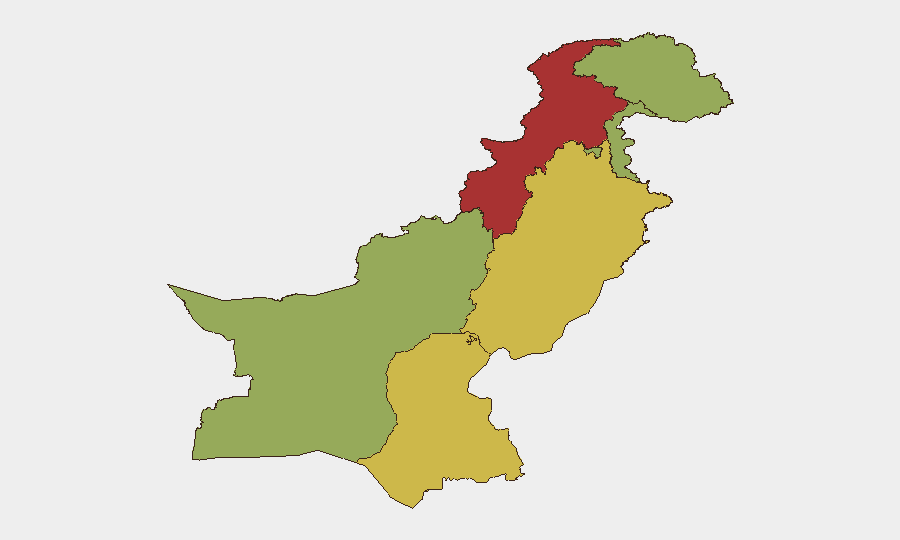
Situation Summary
Pakistan remains under sustained pressure from militant activity concentrated in the northwestern border regions and Balochistan, with a composite threat score of 68 (rank #21 globally). The past 48 hours have seen a significant escalation in attacks on security infrastructure and counter-terror operations, including a high-casualty assault on a joint police–military check post in Tank district (Khyber Pakhtunkhwa) on 26 July that killed 15 personnel. Concurrent security-force operations across Balochistan have eliminated at least 13 militants and detained suspected female suicide bombers, while Taliban denials of harboring anti-Pakistan militants underscore the contested nature of cross-border attribution and threat claims.
Key Developments
- Tank district, Khyber Pakhtunkhwa (26 July): A joint police–military check post was attacked with gunfire and a vehicle-borne IED, resulting in 15 security and government personnel killed (12 soldiers, 2 police, 1 official); security forces killed 12 attackers in response.
- South Waziristan, Khyber Pakhtunkhwa (26 July): Pakistani troops foiled a suicide assault on a security check post, destroying a VBIED outside the perimeter and killing 4 militants including the suicide bomber with no security-force casualties reported.
- Mastung district, Balochistan (25–26 July): Security forces arrested 2 female suicide bombers and a facilitator, seized weapons and explosives, and killed 3 militants in intelligence-based counter-terror operations.
- Khad Kocha area, Mastung; Surab district, Balochistan (25–27 July): As part of Operation Al-Azm/Operation Shaban, security forces killed at least 13 militants affiliated with groups described as "Fitna-al-Hindustan," destroyed hideouts, and recovered IED-making materials.
- Ziarat, Balochistan (26–27 July): Terrorists attacked a police picket; Quick Response Forces engaged the attackers with multiple militants reported killed.
- Taliban statement (24 July, reported 25–26 July): Taliban spokesman Zabihullah Mujahid publicly rejected Pakistan's claims that Afghan territory hosts anti-Pakistan militants, asserting Pakistan's security problems originate domestically, amid Islamabad's cross-border operations.
- Islamabad, G-9 Markaz (26 July): A fire broke out in the commercial area; authorities extinguished the blaze with no major casualties reported and investigation ongoing.
Highest-Risk Areas
Khyber Pakhtunkhwa (77.7) and Punjab (62.3) drive the highest composite risk scores nationally. Khyber Pakhtunkhwa's score reflects active cross-border militant networks, organized attacks on security infrastructure, and proximity to Afghanistan; the Tank and South Waziristan incidents exemplify this volatility. Balochistan (52.4), despite ranking lower, remains a sustained operational theater for both security forces and separatist/militant networks, with ongoing counter-terror campaigns and detentions of organized attack cells. Islamabad Capital Territory (58.9) carries elevated risk from urban-based extremist cells and spillover from northern instability, though direct incident frequency remains lower than northwestern provinces.
How GeoBit Would Assist
Security teams would deploy AOI Monitoring & Early Warning on high-casualty zones (Tank, South Waziristan, Mastung) to detect attack-preparation signals and force concentrations in near-real time. Network & Actor Analysis corroborating Telegram/X open-source feeds and radio SIGINT would disambiguate Taliban claims from actual cross-border militant sanctuaries and track "Fitna-al-Hindustan" cell structures across Balochistan operations. Conflict & Military force-structure tracking combined with GIS & Spatial Analysis would map security-checkpoint vulnerability patterns and inform duty-of-care routing for corporate personnel in KP and Balochistan.
7-Day Outlook
High operational tempo in Balochistan and KP is expected to persist as security forces maintain counter-terror campaigns. Retaliation risk against soft targets—commercial zones, transportation hubs, urban centers in Punjab and Islamabad—remains elevated given the scale of militant losses in the past 48 hours. Cross-border attribution disputes with Afghanistan are unlikely to de-escalate absent diplomatic engagement.
Highest-Risk Areas — Ranked
| # | State / Region | Risk |
|---|---|---|
| 1 | Khyber Pakhtunkhwa | 77.7 |
| 2 | Punjab | 62.3 |
| 3 | Sindh | 60.4 |
| 4 | Islamabad Capital Territory | 58.9 |
| 5 | Balochistan | 52.4 |
| 6 | Gilgit-Baltistan | 51.6 |
| 7 | Azad Kashmir | 50.2 |
Sources
Previous Daily Briefs
A new Pakistan brief is written every day — each with its own risk map and downloadable CSV. Here's the last week; use the calendar to go further back.
📅 Browse every day by calendar →
Highlighted days have a brief. Tap a day for that day's map & analysis, or “csv” for that day's dataset ($5).
Atlas — our AI intelligence desk — emails them this snapshot personally. Nothing else, no list.