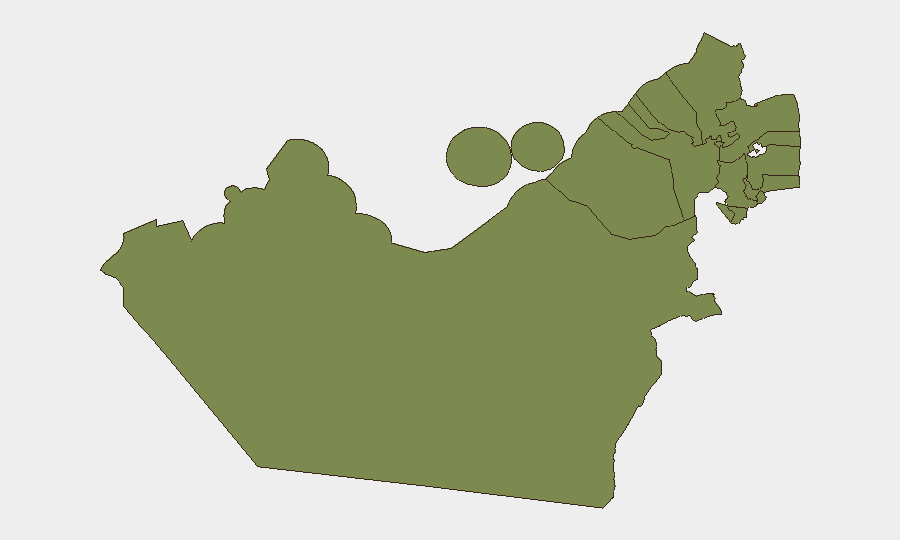
Situation Summary
The United Arab Emirates remains a low-threat, stable operating environment with no major security incidents reported in the last 24–48 hours. However, recent diplomatic friction—including U.S. disapproval statements, military posturing toward neighboring Bahrain and Kuwait, and a demand from Chicago authorities—signals elevated diplomatic tension that warrants monitoring. Dubai's disproportionately higher risk profile (31.4 vs. national 28) reflects its role as a major commercial and logistics hub; all other emirates cluster at baseline risk (1.4), indicating threat concentration rather than systemic instability.
Key Developments
- Country-wide, UAE – 2026-07-25 to 2026-07-27: Multiple U.S. federal entities issued disapproval statements and demands toward the UAE (Austin, Inspector General, Chicago), citing unspecified policy or compliance concerns. No corroboration of domestic security incidents; messaging appears focused on bilateral governance or enforcement matters.
- UAE military posture – 2026-07-25 (vs. Bahrain) and 2026-07-26 (vs. Kuwait): Unconventional military force signaling and artillery/tank deployments reported; context suggests regional reaction to Iranian strikes on Bahrain and Kuwait (July 24–26, occurring *outside* UAE territory). No escalation inside UAE.
- Diplomatic friction – 2026-07-24: Kazakhstan reduced relations with the UAE, suggesting broader regional alignment tensions; specific trigger not confirmed in open sources.
- Sri Lankan detention – 2026-07-25: Sri Lanka reported an arrest/detain event involving the UAE; insufficient detail available on scope, individuals, or operational impact to UAE security posture.
- Commercial aviation – 2026-07-25 to present: Dubai International Airport (DXB) and UAE civil aviation remain fully operational; no airspace closures, curfews, or movement restrictions reported. Schedule volatility expected only for Kuwait and Bahrain connections due to *regional* incidents, not UAE-internal disruption.
- No civil unrest, protests, or terrorist activity – 2026-07-25 to 2026-07-27: Social-media and open-source monitoring confirm absence of corroborated attacks, shootings, organized demonstrations, or emergency alerts across major cities (Dubai, Abu Dhabi, Sharjah).
Highest-Risk Areas
Dubai significantly outranks all other emirates (31.4 vs. 1.4 baseline), driven by its status as a global financial, logistics, and transit hub—making it inherently more exposed to international supply-chain disruption, financial-sector volatility, and cross-border activity monitoring by multiple state actors. Sharjah, Ajman, Ras al-Khaimah, Fujairah, Umm al-Quwain, and Abu Dhabi cluster at equivalent baseline risk, indicating that security threats in the UAE are concentrated in Dubai rather than distributed across the federation. The disparity suggests corporate and asset-protection focus should weight Dubai exposure accordingly, while other emirates present lower-complexity risk profiles.
How GeoBit Would Assist
Organizations operating in the UAE would leverage Intel Sweep and global event feeds for continuous monitoring of bilateral diplomatic signals and military posturing; AOI Monitoring & Early Warning on Dubai and critical infrastructure (ports, airports, energy facilities); and Network & Actor Analysis to map the political and commercial relationships driving recent U.S. and regional state actions. Maritime & Aviation tracking and Routing & Network Analysis would support supply-chain continuity and personnel movement planning amid regional tensions.
7-Day Outlook
Near-term risk to the UAE itself remains low, though diplomatic friction and regional military activity may create secondary effects on commercial operations, flight connectivity to Bahrain and Kuwait, and executive-movement planning. Continued monitoring of U.S.–UAE bilateral messaging and Iranian regional posturing is warranted; no evidence suggests imminent domestic instability.
Highest-Risk Areas — Ranked
| # | State / Region | Risk |
|---|---|---|
| 1 | Dubai | 31.4 |
| 2 | Sharjah Emirate | 1.4 |
| 3 | Ajman Emirate | 1.4 |
| 4 | Ras al-Khaimah | 1.4 |
| 5 | Fujairah Emirate | 1.4 |
| 6 | Umm al-Quwain | 1.4 |
| 7 | Abu Dhabi Emirate | 1.4 |
Sources
Previous Daily Briefs
A new United Arab Emirates brief is written every day — each with its own risk map and downloadable CSV. Here's the last week; use the calendar to go further back.
📅 Browse every day by calendar →
Highlighted days have a brief. Tap a day for that day's map & analysis, or “csv” for that day's dataset ($5).
Atlas — our AI intelligence desk — emails them this snapshot personally. Nothing else, no list.