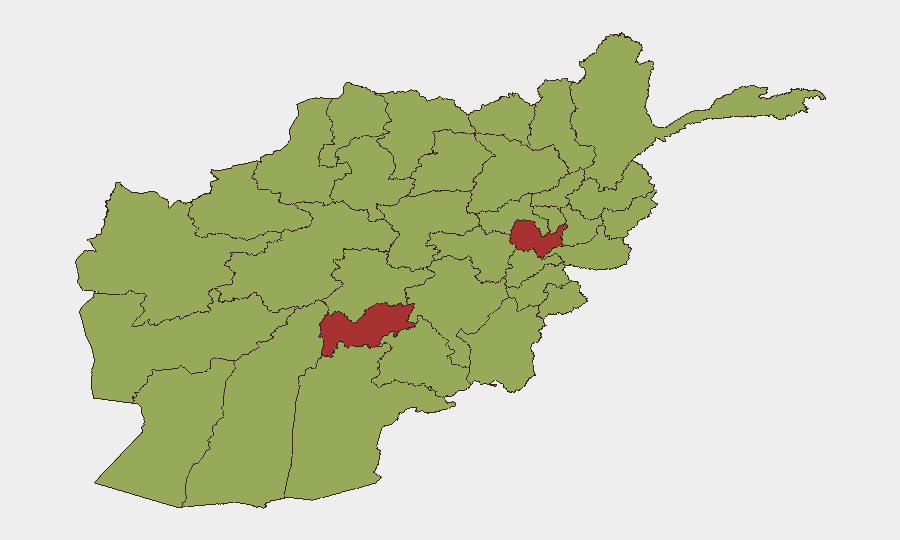
Situation Summary
Afghanistan remains in the 28th position globally on GeoBit's composite threat ranking, with a sustained score of 71 across 35 tracked events. The security environment continues to be shaped by Taliban consolidation efforts, opposition-group activity, and cross-border friction. Recent 48-hour activity confirms localized armed seizures and military movements, particularly in the north and east, indicating persistent territorial contestation despite Taliban administrative control.
Key Developments
- Badakhshan Province, Yaftali Sufla district (2026-07-18): Armed opposition forces briefly seized the district center from Taliban control before withdrawing. Taliban officials were reported absent during the incursion; Taliban clearing operations were launched in response. This event signals renewed opposition capability in the northeast corridor.
- Cross-border aerial activity (2026-07-16): Pakistani aerial weapons use affecting civilian areas was recorded, indicating continued spillover from regional tensions and potential civilian casualty exposure in border provinces.
- Military and government responses (2026-07-18): Multiple conventional military force exchanges between Afghan government/army elements and Taliban forces, alongside physical assaults attributed to government actors, suggest intensified operational tempo and potential command-and-control friction.
- Taliban small-arms engagement (2026-07-18): Small-arms combat involving Taliban forces indicates sustained combat operations beyond administrative consolidation.
- Education-sector disruption (2026-07-17): Administrative sanctions involving schools signal potential pressure on civilian institutions and possible restrictions on educational access.
Highest-Risk Areas
Uruzgan and Kabul provinces dominate the risk landscape, with composite scores of 79.8 and 76.7 respectively. Uruzgan's volatility reflects persistent opposition presence and Taliban resource-intensive security operations; Kabul's ranking reflects both the capital's political sensitivity and ongoing security incidents in and around the city. Daykundi, Helmand, and Kunar provinces (56.4–55.1) form a secondary tier of concern, driven by terrain-enabled insurgent activity, criminal networks, and cross-border infiltration routes. The southern and eastern provinces (Kandahar, Paktika, Zabul, Ghazni) remain consistently elevated at approximately 49.8, indicating endemic instability despite lower absolute event counts.
How GeoBit Would Assist
Security teams should employ AOI Monitoring & Early Warning capabilities on high-risk provinces—particularly Uruzgan, Badakhshan, and border regions—to detect opposition movement and military escalation before they affect personnel or assets. Conflict & Military modules (force structure tracking, battle mapping) and Network & Actor Analysis would clarify Taliban command coherence and opposition-group composition, essential for assessing local security partner reliability. OSINT Fusion & Corroboration across Telegram, radio SIGINT, and event feeds would provide real-time confirmation of incident scope and trajectory, reducing exposure to unverified claims during operational decision-making.
7-Day Outlook
Localized opposition activity in the north and east is likely to persist as groups test Taliban defenses in remote districts. Cross-border pressure from Pakistan and potential regional actor involvement suggest that border provinces will remain volatile. Absent a significant shift in Taliban command cohesion or external intervention, the threat environment is expected to remain in the current elevated range, with sporadic small-scale military engagements rather than nationwide destabilization.
Highest-Risk Areas — Ranked
| # | State / Region | Risk |
|---|---|---|
| 1 | Uruzgan Province | 79.8 |
| 2 | Kabul Province | 76.7 |
| 3 | Daykundi Province | 56.4 |
| 4 | Helmand Province | 55.1 |
| 5 | Kunar Province | 55.1 |
| 6 | Balkh Province | 54.2 |
| 7 | Zabul Province | 49.8 |
| 8 | Kandahar Province | 49.8 |
| 9 | Ghazni Province | 49.8 |
| 10 | Paktika Province | 49.8 |
| 11 | Farah Province | 49.8 |
| 12 | Nimruz Province | 49.8 |
Previous Daily Briefs
A new Afghanistan brief is written every day — each with its own risk map and downloadable CSV. Here's the last week; use the calendar to go further back.
📅 Browse every day by calendar →
Highlighted days have a brief. Tap a day for that day's map & analysis, or “csv” for that day's dataset ($5).
Atlas — our AI intelligence desk — emails them this snapshot personally. Nothing else, no list.