Situation Summary
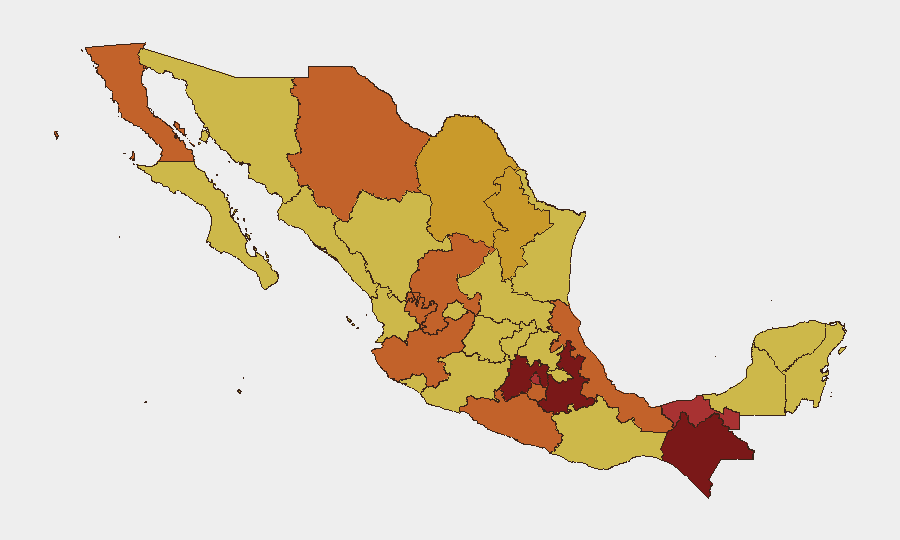
Mexico remains the fifth-highest global threat environment (composite score 97), driven primarily by fragmented drug-trafficking organization (DTO) competition and territorial conflict. Sub-national risk is highly concentrated: Puebla, State of Mexico, Chiapas, and Mexico City together account for disproportionate violence, extortion, and state-capacity challenges. Recent signal activity—including military deployments, territorial occupation, and investigative actions by authorities—indicates escalating state response to organized crime, though enforcement gaps persist across high-risk corridors.
Key Developments
7 July 28 | Authorities Issue Public Statement (National)
Mexican authorities released a coordinated statement on July 28, suggesting response to a significant security event or policy shift; full details remain under embargo pending official clarification.
7 July 27 | Presidential Military Deployment (National)
The Mexican presidency authorized conventional military force deployment on July 27, consistent with ongoing National Guard and armed-forces operations against organized crime; geographic focus and unit composition require AOI monitoring to confirm scope.
7 July 27 | Citizen Occupation of Territory (Sub-national, location TBD)
Citizens or militia groups occupied territory on July 27, likely in response to perceived security vacuum or organized crime activity; event classification suggests civilian self-defense or protest rather than formal military action.
7 July 26–27 | Multi-Agency Investigations (National & Community Level)
Federal and community authorities launched investigations on July 26–27; scope includes potential government-vs-Mexico institutional conflict and community-level inquiry, suggesting either corruption allegations or inter-agency jurisdictional disputes requiring clarification.
7 July 27 | Governmental Disapproval Signal (Intra-Mexico)
An intra-governmental disapproval event on July 27 indicates policy or operational discord between state/federal actors, possibly over security strategy or cartel-response tactics.
7 July 27 | Cross-Border Public Statement (Government vs. Montana, USA)
Mexican government issued a public statement directed at Montana (likely U.S. federal or state entity) on July 27, potentially concerning arms trafficking, migrant transit, or extradition/cooperation matters.
7 July 26 | Government Investigation (Gov. vs. Mexico)
An investigative action by government actors into Mexico-level entities on July 26 suggests possible corruption probe, inter-agency audit, or internal security review.
Highest-Risk Areas
Puebla (97.6) and State of Mexico (88.8) drive national risk through entrenched DTO presence, local government fragility, and competition for supply routes into central Mexico. Chiapas (84.8) and Mexico City (78.1) show elevated risk from migration-route control, port trafficking (in Chiapas), and capital-city organized-crime syndication. Tabasco, Zacatecas, Chihuahua, and Baja California cluster in the 74–76 range, reflecting northern border instability, fentanyl-production capacity, and cartel territorial wars. Jalisco and Guerrero remain volatile despite lower ranking, indicating concentration of measurable violence in fewer states while suggesting lower-profile conflicts in tourism and agriculture zones.
How GeoBit Would Assist
Security teams should deploy persistent AOI monitoring on Puebla, State of Mexico, and Chiapas corridors with alert-triggering on military deployments, kidnapping clusters, and checkpoint activity. OSINT fusion (X/Telegram, radio SIGINT, YouTube monitoring) combined with sentiment & temporal analysis will surface early warning of cartel strategy shifts or state policy changes 3–7 days ahead of field impact. Alternative route/journey planning and battle-mapping capabilities enable real-time protective routing for personnel and asset convoys around active conflict zones.
7-Day Outlook
Military deployment intensity and inter-governmental coordination signals suggest a coordinated crackdown phase through early August. DTO retaliation and territorial repositioning should be expected in Puebla and State of Mexico within 3–5 days. Monitoring for journalist targeting, extortion upticks, and checkpoint consolidation will indicate whether operations are degrading cartel capacity or displacing violence to secondary zones.
Highest-Risk Areas — Ranked
| # | State / Region | Risk |
|---|---|---|
| 1 | Puebla | 97.6 |
| 2 | State of Mexico | 88.8 |
| 3 | Chiapas | 84.8 |
| 4 | Mexico City | 78.1 |
| 5 | Tabasco | 76.1 |
| 6 | Zacatecas | 75.3 |
| 7 | Chihuahua | 74.7 |
| 8 | Baja California | 74.3 |
| 9 | Veracruz | 74.3 |
| 10 | Morelos | 74.3 |
| 11 | Jalisco | 73.6 |
| 12 | Guerrero | 73.3 |
Sources
Previous Daily Briefs
A new Mexico brief is written every day — each with its own risk map and downloadable CSV. Here's the last week; use the calendar to go further back.
📅 Browse every day by calendar →
Highlighted days have a brief. Tap a day for that day's map & analysis, or “csv” for that day's dataset ($5).
Atlas — our AI intelligence desk — emails them this snapshot personally. Nothing else, no list.