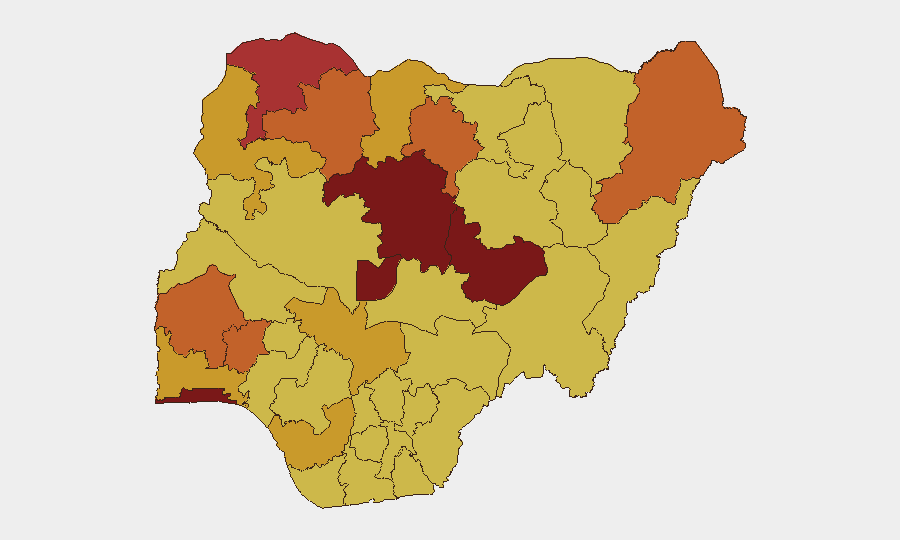
Situation Summary
Nigeria remains the third-highest global security threat (composite score 98/100), driven predominantly by active insurgency, banditry, and kidnapping campaigns across the northwest, north-central, and northeast regions. Over the past 48 hours, military and police counter-operations have yielded significant tactical gains—27 terrorists killed, 75+ kidnap victims rescued, and coordinated raids across 11 states—but the underlying threat tempo remains elevated. President Tinubu's 23–24 July announcement of 28,000 additional soldiers and four new army divisions signals recognition that existing force posture is insufficient to contain the geographic and operational scope of the threat.
Key Developments
- Magami village, Gusau LGA, Zamfara State (26 July): Operation Fansan Yamma troops repelled a ~40-motorcycle-borne terrorist/bandit assault and rescued 48 kidnapped victims abandoned during the engagement; attackers fled under fire.
- Sokoto State (past 48 hours to 27 July): Sector 2, Joint Task Force Northwest Operation Fansan Yamma conducted separate rescue operations yielding 22 abducted victims recovered from terrorist custody.
- Kogi State (past 48 hours to 27 July): 12 Brigade, Nigerian Army (2 Division) intercepted fleeing terrorists and rescued five kidnapped victims during counter-terrorism operations.
- Nationwide coordinated police operations (24 hours to 27 July): Nigeria Police Force reported foiling bandit attacks, arresting suspected kidnappers, armed robbers, cultists, and child traffickers across 11 states; recovered firearms, ammunition, stolen vehicles, and livestock.
- Broader 48-hour military tally (to 27 July): Nigerian Army reported 27 terrorists neutralized, 10 suspected criminals arrested, and eight kidnap victims rescued, with recovery of arms and logistics across multiple theatres.
- National force expansion (announced 23–24 July): President Tinubu approved enlisting 28,000 additional soldiers and creating four new army divisions in response to village massacres (Zamfara, July) and mass student abductions (Borno, July).
Highest-Risk Areas
Lagos State (98.3) and Kaduna State (97.4) rank highest, but they reflect distinct drivers: Lagos faces organized crime, armed robbery, and urban-based kidnapping; Kaduna, adjacent to active bandit/insurgent zones, experiences spillover violence and highway insecurity. The northwest cluster—Sokoto (77.7), Zamfara (74.2), and Katsina (72.3)—remains the primary active theater, where armed banditry and mass abduction remain operationally effective. Borno State (73.5) continues to host Boko Haram/ISWAP cells despite sustained military pressure. Plateau and Kogi states (83.4 and 72.4 respectively) serve as conflict nodes where communal, herder–farmer, and criminal violence intersect.
How GeoBit Would Assist
Security teams should leverage AOI Monitoring & Early Warning to sustain persistent watch on Kaduna, Zamfara, Sokoto, and Borno states, with automated alerting on event clustering and temporal patterns signaling mass abduction or large-scale attacks. Conflict & Military battle-mapping and force-structure tracking would provide real-time visibility of Operation Fansan Yamma disposition and army division deployment, enabling duty-of-care assessments. Routing & Network Analysis can model safe passage corridors and alternative routes for personnel and supply movement through high-risk zones, incorporating live bandit/insurgent activity into journey planning.
7-Day Outlook
Tactical military gains over 26–27 July may create a brief operational pause, but strategic threat remains unchanged: bandit/insurgent networks retain recruitment capacity, territorial control in ungoverned spaces, and demonstrated ability to mass forces for coordinated attacks. The planned 28,000-soldier expansion will take weeks to operationalize; interim risk trajectory for Zamfara, Sokota, Kaduna, and Borno states remains elevated. Monitor for renewed mass abduction attempts or coordinated attacks as non-state actors adjust to increased military density.
Highest-Risk Areas — Ranked
| # | State / Region | Risk |
|---|---|---|
| 1 | Lagos State | 98.3 |
| 2 | Kaduna State | 97.4 |
| 3 | Federal Capital Territory | 83.9 |
| 4 | Plateau State | 83.4 |
| 5 | Sokoto State | 77.7 |
| 6 | Osun State | 74.8 |
| 7 | Zamfara State | 74.2 |
| 8 | Oyo State | 74.1 |
| 9 | Borno State | 73.5 |
| 10 | Kano State | 73.3 |
| 11 | Kogi State | 72.4 |
| 12 | Katsina State | 72.3 |
Sources
Previous Daily Briefs
A new Nigeria brief is written every day — each with its own risk map and downloadable CSV. Here's the last week; use the calendar to go further back.
📅 Browse every day by calendar →
Highlighted days have a brief. Tap a day for that day's map & analysis, or “csv” for that day's dataset ($5).
Atlas — our AI intelligence desk — emails them this snapshot personally. Nothing else, no list.