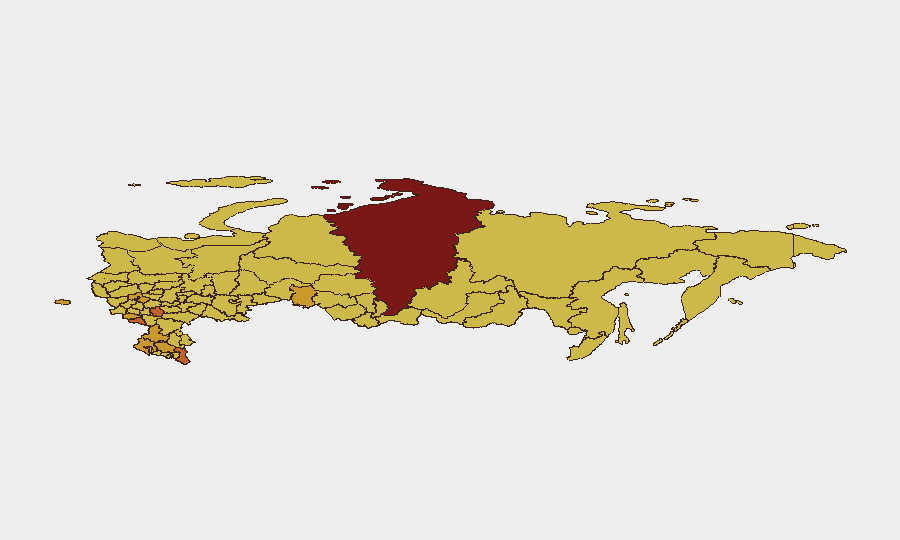
Situation Summary
Russia faces sustained kinetic pressure along its western border and interior logistics infrastructure as of 20 July 2026, with Ukrainian drone and conventional strikes continuing across multiple regions. Composite threat activity remains at the highest global level (rank #1, score 100), driven by military operations, civilian targeting, and investigative actions against domestic populations. The security environment shows no sign of de-escalation; risk concentration in border-adjacent and interior industrial zones (Krasnoyarsk, Moscow, Tambov, Belgorod) reflects both direct strike exposure and second-order supply-chain disruption.
Key Developments
- Kotovsk, Tambov Oblast – 19 July – Ukrainian drone strike on a Wildberries logistics warehouse killed seven night-shift workers and wounded multiple others; Tambov Oblast ranks #3 in GeoBit's sub-national risk index (75.1).
- Noginsk and Elektrostal, Moscow Oblast – 19 July – Drone strikes on a second Wildberries facility and an oil depot; the depot fire triggered evacuation of a maternity hospital and residential buildings. Moscow Oblast risk score 72.9.
- Moscow region – 19 July – Drone debris ignited a kindergarten fire; regional authorities reported 61 total wounded from the overnight attack wave across the region (risk 92.7).
- Vladimir Oblast – 19 July – Ukrainian drone hit a residential building; no casualties reported.
- Belgorod Oblast – 19 July – One killed, one wounded in a cross-border drone attack; Belgorod ranks #4 in regional risk (74.3).
- Russia-wide air defense – 19 July – Russian Defense Ministry claimed interception of 379 Ukrainian drones across 19 regions, Crimea, and Black Sea approaches; claim unverified by independent sources.
- Black Sea and Odesa logistics – 19 July – Ukrainian strikes on Russian Black Sea logistics centers reported concurrent with Russian strikes damaging port infrastructure at Odesa and Chornomorsk; maritime-route disruption ongoing.
Highest-Risk Areas
Krasnoyarsk Krai (100), Moscow (92.7), and Tambov Oblast (75.1) dominate the risk ranking and reflect distinct threat vectors: Krasnoyarsk's position as a remote industrial and energy hub increases supply-chain fragility; Moscow's population density and infrastructure concentration amplify civilian exposure; Tambov and Belgorod Oblasts sit on the de facto conflict zone, receiving direct drone and artillery strike activity. Border-adjacent regions (Belgorod, Kursk, Rostov, Kaliningrad) cluster in the 71–74 range, indicating sustained cross-border kinetic activity and civilian casualty risk.
How GeoBit Would Assist
Security teams with personnel or assets in Russia should employ AOI Monitoring & Early Warning on Krasnoyarsk, Moscow, and Tambov to track drone-strike patterns and logistics disruptions in real time. Conflict & Military mapping and force-structure tracking provide 24–48 hour situational awareness of strike locations and intensity trends, enabling duty-of-care evacuation or shelter-in-place decisions. Multi-language OSINT fusion (X, Telegram, official statements) corroborates Russian air-defense claims and identifies secondary effects (hospital evacuations, fire spread, supply delays) missed by single-source reporting.
7-Day Outlook
Drone strikes on logistics and energy infrastructure are expected to continue at current or elevated frequency, with particular risk to civilian-adjacent facilities in Moscow, Moscow Oblast, and Tambov. No imminent shift in operational tempo is indicated; corporate presence in top-10 risk zones should anticipate supply-chain delays, power disruptions, and potential evacuation orders for staff in or near targeted sectors (warehousing, energy, transport hubs).
Highest-Risk Areas — Ranked
| # | State / Region | Risk |
|---|---|---|
| 1 | Krasnoyarsk Krai | 100 |
| 2 | Moscow | 92.7 |
| 3 | Tambov Oblast | 75.1 |
| 4 | Belgorod Oblast | 74.3 |
| 5 | Dagestan | 73.8 |
| 6 | Moscow Oblast | 72.9 |
| 7 | Stavropol Krai | 72.5 |
| 8 | Kaliningrad | 71.5 |
| 9 | Omsk Oblast | 71.2 |
| 10 | Kursk Oblast | 71.1 |
| 11 | Krasnodar Krai | 71 |
| 12 | Rostov Oblast | 71 |
Sources
Previous Daily Briefs
A new Russia brief is written every day — each with its own risk map and downloadable CSV. Here's the last week; use the calendar to go further back.
📅 Browse every day by calendar →
Highlighted days have a brief. Tap a day for that day's map & analysis, or “csv” for that day's dataset ($5).
Atlas — our AI intelligence desk — emails them this snapshot personally. Nothing else, no list.