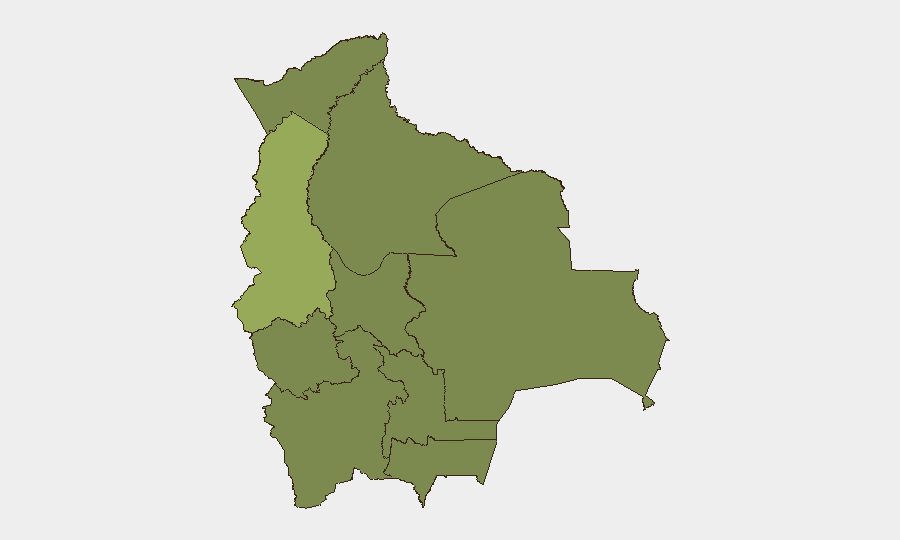
Situation Summary
Bolivia remains elevated on the global threat ranking (#59, composite score 34) in the context of a national state of emergency declared 20 June 2026 in response to widespread road blockades and protests that began in May. La Paz dominates the risk profile (53.7), reflecting political instability, civil unrest, and security-force activity. While authorities report gradual improvement in supply-line access since mid-June, the risk environment remains volatile, with security forces conducting operations and political actors issuing competing demands.
Key Developments
GeoBit's event signals from 24–25 July 2026 indicate rapid institutional activity, though specific incident details remain under verification:
- 24 July · La Paz / National – Intelligence forces conducted conventional military operations against targets in La Paz; simultaneous public statements from a senator and prosecutor suggest concurrent political or legal proceedings related to ongoing state-of-emergency enforcement.
- 24 July · Financial System – Central Bank rejected a formal demand, signaling tension over fiscal or monetary policy amid the emergency period.
- 24 July · Municipal Level – A mayor issued a public statement concurrent with a separate municipal-level demand, indicating sub-national pressure or grievance activity.
- 25 July · National – Arrest/detainment operations were conducted by Bolivian authorities; Central Bank occupied territory (status and location under clarification), suggesting potential security-force action at critical infrastructure.
- 25 July · National Authority – Authorities released a public statement, likely clarifying the scope or justification of ongoing enforcement actions.
Note: Precise locations, casualty counts, and operational context for 24–25 July events remain incomplete in open sources. GeoBit's platform is monitoring for corroboration and timeline confirmation.
Highest-Risk Areas
La Paz's dominance (53.7) reflects its status as the capital, seat of executive and judicial power, and epicenter of protest and political activity. Tarija (31.9) shows secondary risk, likely tied to resource-sector tensions or cross-border activity. Cochabamba, despite ranking ninth, carries elevated baseline risk due to the Chapare region's persistent criminality, drug-trafficking presence, and history of rapid protest escalation; travel warnings from foreign governments remain in effect there.
The eight-point clustering of mid-tier departments (Potosí through Cochabamba, all 23.7–25.9) suggests diffuse provincial grievances, possibly linked to mining, indigenous rights, or supply-chain disruption from the national emergency.
How GeoBit Would Assist
AOI Monitoring & Early Warning on La Paz, El Alto, and key departmental capitals would detect emerging clashes, blockade formation, or force movements within 2–4 hours of onset. Intel Sweep and multi-language OSINT fusion (X/Twitter, Telegram, local radio, YouTube) would corroborate timestamps and operational scope of security-force actions and arrests. Network & Actor Analysis would map political and military decision-makers, allowing teams to anticipate demand cycles and enforcement windows. Routing & Network Analysis would enable real-time alternative route planning for personnel and supply chains if primary corridors face blockade or closure.
7-Day Outlook
The next week is likely to see continued enforcement activity by security forces under emergency powers, with political actors (senators, mayors, prosecutors) pursuing competing agendas through public statements and legal proceedings. Risk of renewed mass protests or blockades remains elevated if food, fuel, or medicine access deteriorates or if a major arrest triggers organized response. Teams with personnel or assets in La Paz, El Alto, or Cochabamba should maintain heightened situational awareness and pre-positioned contingency plans.
Highest-Risk Areas — Ranked
| # | State / Region | Risk |
|---|---|---|
| 1 | La Paz | 53.7 |
| 2 | Tarija | 31.9 |
| 3 | Potosí | 25.9 |
| 4 | Santa Cruz | 24.8 |
| 5 | Chuquisaca | 24.3 |
| 6 | Pando | 23.7 |
| 7 | Beni | 23.7 |
| 8 | Oruro | 23.7 |
| 9 | Cochabamba | 23.7 |
Previous Daily Briefs
A new Bolivia brief is written every day — each with its own risk map and downloadable CSV. Here's the last week; use the calendar to go further back.
📅 Browse every day by calendar →
Highlighted days have a brief. Tap a day for that day's map & analysis, or “csv” for that day's dataset ($5).
Atlas — our AI intelligence desk — emails them this snapshot personally. Nothing else, no list.