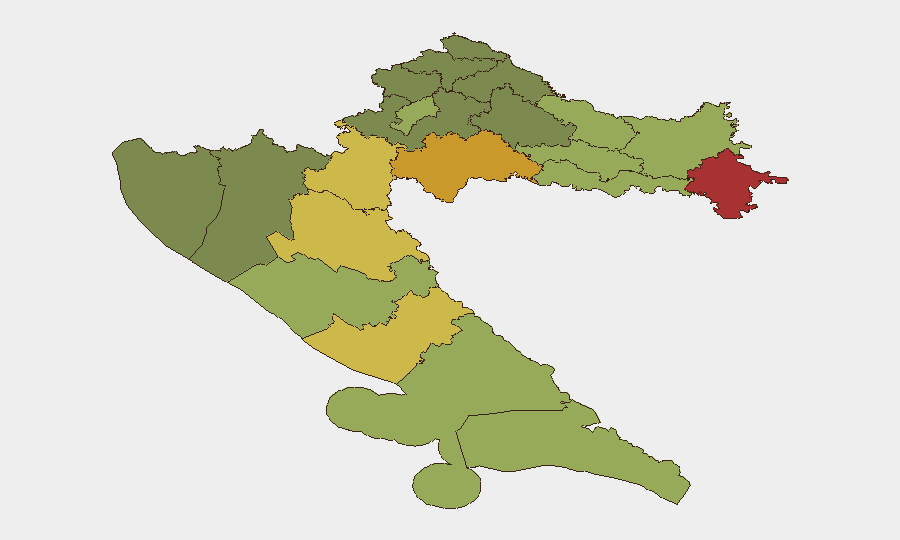
Situation Summary
Croatia remains a low-threat environment globally (ranked #159, composite score 7), but recent incidents signal localized spikes in violent crime and extremism requiring focused attention. A high school stabbing in Zagreb on 11 September, followed by a violent extremist event triggering international content-removal coordination on 14 September, indicate concentrated risk in the capital. Eastern and border counties (Vukovar-Srijem, Sisak-Moslavina, Karlovac) sustain elevated structural risk scores, though discrete violent events this week clustered in Zagreb and scattered rural/coastal zones.
Key Developments
- Zagreb school stabbing (11 September): A masked student attacked a fellow pupil and cleaner with a sharp object at the School of Electrical Engineering on Konavoska Street, Voltino, causing serious injury; attacker detained and building cordoned off during investigation.
- Zagreb violent extremist event (14–15 September): The Global Internet Forum to Counter Terrorism activated its Perpetrator Content Incident process on 14 September in response to a violent extremist event in Zagreb, coordinating multi-platform content removal and signaling elevated online amplification and radicalization risk.
- Ozalj murder indictment (9 September): State Attorney's Office filed indictment against a 32-year-old for murdering a 44-year-old Uzbek national near Ozalj, Karlovac County; prosecutors sought extended detention citing repeat-offending risk.
- Umag labor-related extortion and threats (15 September): Police arrested two men in the Umag/Buje area for non-payment of wages and death threats against a 45-year-old worker demanding back pay; formal processing underway for extortion and wage violations.
- Brač wildfires (13 September): Fire near Milna brought under control; new outbreak above Bol in inaccessible terrain requiring Canadair aircraft deployment; localized travel and infrastructure disruption ongoing.
- Istrian maritime explosive device (active through 7 September, continuing references): Croatian Hydrographic Institute maintains navigation ban within 100-meter radius of a sprengkörper off west Istria (45°21.850′ N / 13°32.417′ E); all sea transit, anchoring, diving, and fishing prohibited; warning Nr. 324/2026 persists.
- Environmental protest momentum (5 September, sustained impact): "Walk for Lika, Walk for Croatia" demonstration drew tens of thousands to Zagreb demanding cleanup of illegally dumped hazardous waste near Gospić and a ban on waste imports; demands and civil pressure remain active into mid-September.
- Life imprisonment law reform (10 September): Criminal law amendments introduced life sentences with 25-year parole eligibility for 15 gravest offenses; affects sentencing policy for violent and high-impact crimes.
Highest-Risk Areas
Vukovar-Srijem County (risk 78) and Sisak-Moslavina County (risk 72) lead sub-national rankings, reflecting historical conflict legacies, border proximity, and residual organized-crime and trafficking networks along the Danube corridor. Karlovac County (68) and Lika-Senj County (65) maintain elevated scores owing to terrain isolation, weak infrastructure, and persistent transnational crime routes. Zagreb (50) ranks tenth sub-nationally but this week's school violence and extremist coordination underscore that capital-based incidents carry disproportionate public and institutional impact despite lower composite county scoring.
How GeoBit Would Assist
Security teams would deploy AOI Monitoring & Early Warning on high-risk counties (especially Vukovar-Srijem and Sisak-Moslavina) to detect organized-crime and trafficking activity before escalation. OSINT fusion (X/Twitter, Telegram, YouTube, multi-language search) would track extremist narratives and online radicalization signals in Zagreb in real time, enabling rapid threat assessment ahead of planned institutional gatherings. Multi-source intelligence sweeps correlated with sentiment & temporal analysis would flag emerging labor disputes, environmental activism cycles, and protest escalation risk across regions where staff or operations exist.
7-Day Outlook
No imminent mass-casualty incidents are forecast, but isolated violent crime and labor-related threats will likely persist in regional hubs. Extremist content amplification in Zagreb warrants sustained digital monitoring to detect copycat or retaliatory ideation. Maritime and wildfire risks remain localized and manageable with standard hazard protocols.
Highest-Risk Areas — Ranked
| # | State / Region | Risk |
|---|---|---|
| 1 | Vukovar-Srijem County | 78 |
| 2 | Sisak-Moslavina County | 72 |
| 3 | Karlovac County | 68 |
| 4 | Lika-Senj County | 65 |
| 5 | Šibenik-Knin County | 62 |
| 6 | Brod-Posavina County | 58 |
| 7 | Zadar County | 55 |
| 8 | Osijek-Baranja County | 52 |
| 9 | City of Zagreb | 50 |
| 10 | Split-Dalmatia County | 48 |
| 11 | Požega-Slavonia County | 45 |
| 12 | Virovitica-Podravina County | 42 |
Sources
Previous Weekly Briefs
A new Croatia brief is written every Monday, covering the week — each with its own risk map and downloadable CSV. Use the calendar to go further back.
- September 9, 2026
- September 3, 2026
- August 31, 2026
- August 28, 2026
- August 26, 2026
- August 24, 2026
- August 22, 2026
📅 Browse past briefs by calendar →
Highlighted days have a brief. Tap a day for that day's map & analysis, or “csv” for that day's dataset ($5).
Atlas — our AI intelligence desk — emails them this snapshot personally. Nothing else, no list.