Situation Summary
Iran is engaged in active multi-front military conflict with U.S. forces and their regional partners, with confirmed strikes on Iranian territory (Bushehr nuclear facility, Khuzestan, Sistan-Baluchestan) and Iranian missile and drone attacks on U.S. bases in Jordan, Bahrain, and Kuwait as of July 12–13. Civilian and critical infrastructure casualties have been reported across five Iranian provinces (14 dead, 78 injured), and the IRGC Navy has declared the Strait of Hormuz closed "until further notice," triggering severe maritime traffic disruption. Risk trajectory remains sharply elevated with escalatory signals persisting across military, paramilitary, and state-actor channels.
Key Developments
- Bushehr Province (07-13): U.S. projectiles struck the perimeter of Bushehr Nuclear Power Plant and adjacent facilities; damage reported but initial casualty figures unclear; represents direct threat to critical nuclear infrastructure.
- Khuzestan Province (07-13): At least 3 killed in southwestern province during U.S. airstrikes; part of wider two-day campaign across five provinces accounting for 14 dead and 78 injured per Iran's Health Ministry.
- Strait of Hormuz (07-12 to 07-13 overnight): IRGC Navy declared strait closure "until further notice"; Iran conducted at least two missile attacks on commercial vessels overnight; third vessel struck by drone since July 12; vessel transits collapsed to six on July 13 (lowest in five weeks), indicating severe maritime disruption and elevated commercial/shipping risk.
- Sistan-Baluchestan Province (07-13): Firefighter killed at Iranshahr airport during U.S. airstrikes; reflects strikes across southeastern region.
- Multi-city strike wave (07-12 to 07-13 overnight): Explosions and strikes reported across Qeshm, Bandar Abbas, Bushehr, Ahvaz, and Abadan; at least one worker killed in Bushehr; widespread infrastructure damage in southern Iran.
- Kuwait (07-12 to 07-13 overnight): Iranian state outlets claim ballistic missile impacts on U.S. military position with three reported U.S. casualties; U.S. sources have not fully confirmed casualty figures; confirms Iranian strike capability against regional U.S. bases.
- Bahrain/Jordan (07-12 to 07-13 overnight): IRGC states it conducted multi-phase retaliatory operations with missiles and drones against U.S. bases; air-raid sirens reported near Fifth Fleet facilities; fuel/ammunition depot damage claimed by Iranian sources.
Highest-Risk Areas
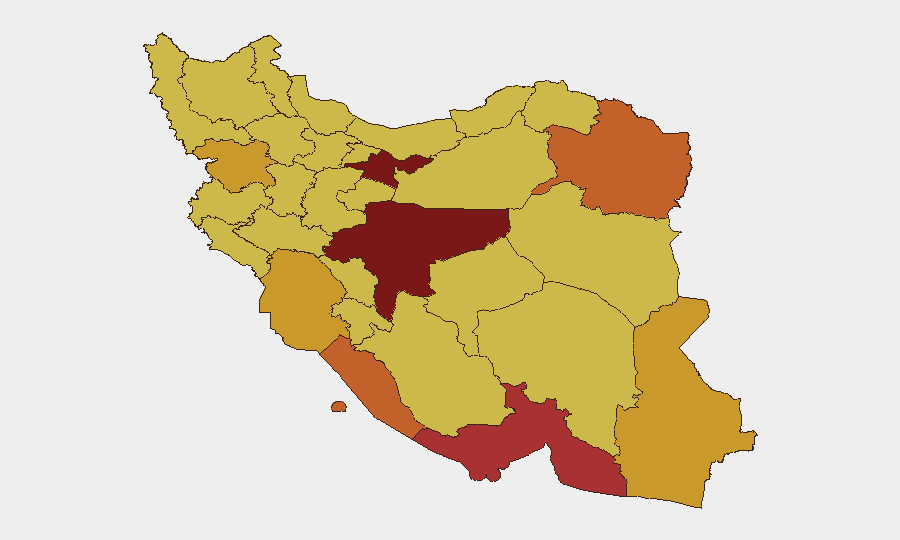
Tehran Province (risk 100) remains the control and decision-making center and thus the focal point for conflict escalation signaling. However, southern and southwestern provinces—Isfahan (87.1), Hormozgan (78.5), Bushehr (74.7), and Khuzestan (71.4)—are now the acute operational risk zones, hosting nuclear facilities, major ports, military installations, and strategic infrastructure that have been confirmed strike targets in the past 48 hours. Sistan-Baluchestan (71.3) and Kurdistan (71.3) face elevated risk from paramilitary activity and ongoing tensions. Northern provinces (Razavi Khorasan, East Azerbaijan, Gilan) remain elevated due to cross-border instability.
How GeoBit Would Assist
Security and duty-of-care teams should employ AOI Monitoring & Early Warning on critical facilities in Bushehr, Khuzestan, and Hormozgan to detect strike patterns and escalation signals in real time. Conflict & Military tracking (force structure, weapons capability, battle mapping) and Network & Actor Analysis on IRGC statements and paramilitary channels will provide tactical and strategic intent signals. Maritime & Aviation tracking combined with Routing & Network Analysis are essential to identify safe passage windows through or around the Strait of Hormuz and alternative logistics corridors.
7-Day Outlook
Continued U.S. strike operations against Iranian military and nuclear infrastructure are likely, with Iranian retaliatory drone and missile attacks on regional U.S. bases expected to persist through the near term. The Strait of Hormuz closure will remain in effect absent de-escalation talks, creating sustained disruption to energy and commercial shipping. Risk of broader regional escalation—including potential attacks on shipping, energy facilities, or personnel—remains high.
Highest-Risk Areas — Ranked
| # | State / Region | Risk |
|---|---|---|
| 1 | Tehran Province | 100 |
| 2 | Isfahan Province | 87.1 |
| 3 | Hormozgan Province | 78.5 |
| 4 | Bushehr Province | 74.7 |
| 5 | Razavi Khorasan | 74.1 |
| 6 | Khuzestan Province | 71.4 |
| 7 | Sistan and Baluchestan Province | 71.3 |
| 8 | Kurdistan Province | 71.3 |
| 9 | East Azerbaijan Province | 70.5 |
| 10 | Gilan Province | 70.4 |
| 11 | Yazd Province | 70.3 |
| 12 | North Khorasan Province | 70 |
Sources
Previous Daily Briefs
A new Iran brief is written every day — each with its own risk map and downloadable CSV. Here's the last week; use the calendar to go further back.
📅 Browse every day by calendar →
Highlighted days have a brief. Tap a day for that day's map & analysis, or “csv” for that day's dataset ($5).
Atlas — our AI intelligence desk — emails them this snapshot personally. Nothing else, no list.