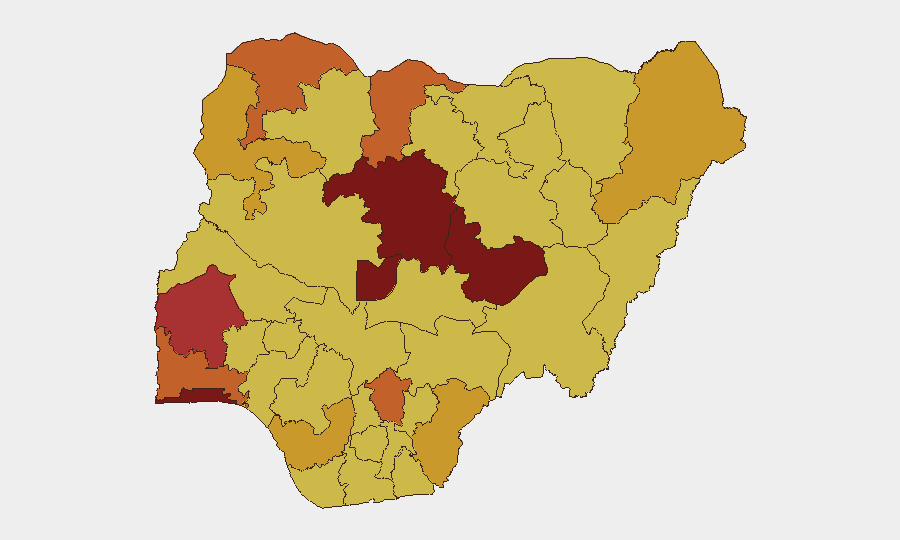
Situation Summary
Nigeria remains at acute risk of multi-theatre violence, ranked globally #5 for composite threat (score 97), driven primarily by active insurgency, banditry, and communal conflict across the northern and central belt. The past 48 hours have witnessed a sustained surge in civilian casualties from coordinated attacks in Kaduna, Benue, Sokoto, and Taraba states, alongside corresponding security force counter-operations that have yielded significant arrests and rescues but have not arrested the momentum of armed groups. The security picture shows both persistent threat activity and active state response, but civilian exposure remains very high in rural and peri-urban areas.
Key Developments
- Naridon village, Kauru LGA, Kaduna State (26 July, late evening): Armed gunmen stormed the community, killing at least 30 residents and burning houses in one of the deadliest single incidents in the region in recent weeks.
- Efeyi community, Otukpo LGA, Benue State (29 July, ~04:00): Suspected armed herdsmen attacked at dawn, killing no fewer than 14 people and injuring multiple victims in renewed violence across the Otukpo zone.
- Multiple attacks, Otukpo and Kwande LGAs, Benue State (28–29 July): At least 16 additional deaths reported across separate incursions, extending the casualty footprint across two local government areas.
- Maikujera village, Rabah LGA, Sokoto State (29 July): Bandits killed four residents; police subsequently rescued 32 kidnap victims in the same operation.
- Lau LGA, Taraba State (29 July): Suspected bandits attacked multiple communities, killing five, abducting a traditional ruler, and displacing hundreds of residents.
- Nationwide police operations (24–48 hours to 29 July): Nigeria Police conducted coordinated sweeps across Zamfara, Enugu, Benue, Bauchi, Ekiti, Imo, Katsina, and Delta states, rescuing multiple kidnapped persons and recovering illegal firearms.
- Nigerian Army multi-theatre operations (48 hours to 29 July): Army units neutralised 27 terrorists, arrested 10 suspected criminals, and rescued 8 kidnapped victims across ongoing counter-insurgency operations.
- Aboki community, Kaiama LGA, Kwara State (28 July, night): Security forces mounted rapid response to a kidnapping, neutralising three suspected bandits and recovering the abducted businessman.
Highest-Risk Areas
Kaduna State (97.8) and Lagos State (89.7) anchor the sub-national risk hierarchy, with Kaduna's ranking driven by sustained armed group activity, mass-casualty civilian attacks, and logistical vulnerability of rural settlements. The Federal Capital Territory (86.5), Plateau (83.4), and Oyo (79.2) round out the top five, reflecting both active conflict zones and urban security pressures. The concentration of risk in the northwest and north-central corridor—Kaduna, Sokoto, Katsina, Kebbi—reflects the operational footprint of both insurgent cells and bandit networks, while Benue, Plateau, and Taraba face acute herdsmen-farmer communal violence. Lagos and the FCT face distinct urban security challenges (crime, civil unrest, organised crime).
How GeoBit Would Assist
Security teams would deploy AOI (Area-of-Interest) Monitoring & Early Warning on high-risk states (especially Kaduna, Benue, Sokoto, Taraba) to detect emerging attack patterns and displacement events in near-real time. Intel Sweep and multi-language OSINT fusion (X, Telegram, local news, radio SIGINT) would provide situational awareness of bandit/insurgent messaging, mobilisation, and claimed operations ahead of mainstream reporting. GIS & Spatial Analysis would map attack clusters, displacement corridors, and safe routing for personnel and asset movement across affected regions.
7-Day Outlook
The northern and central belt will likely experience continued bandit and herdsmen activity, with sporadic mass-casualty attacks in rural areas. Security force counter-operations will persist but are unlikely to break the operational capacity of dispersed armed groups in the short term. Risk to corporate and expatriate presence remains elevated in Kaduna, the FCT, and parts of Benue and Plateau; travel into rural zones in these states should be assessed against duty-of-care and operational necessity thresholds.
Highest-Risk Areas — Ranked
| # | State / Region | Risk |
|---|---|---|
| 1 | Kaduna State | 97.8 |
| 2 | Lagos State | 89.7 |
| 3 | Federal Capital Territory | 86.5 |
| 4 | Plateau State | 83.4 |
| 5 | Oyo State | 79.2 |
| 6 | Enugu State | 75.1 |
| 7 | Ogun State | 74 |
| 8 | Sokoto State | 73.8 |
| 9 | Katsina State | 73.5 |
| 10 | Delta State | 72.9 |
| 11 | Cross River State | 72.2 |
| 12 | Kebbi State | 71.1 |
Sources
Previous Daily Briefs
A new Nigeria brief is written every day — each with its own risk map and downloadable CSV. Here's the last week; use the calendar to go further back.
📅 Browse every day by calendar →
Highlighted days have a brief. Tap a day for that day's map & analysis, or “csv” for that day's dataset ($5).
Atlas — our AI intelligence desk — emails them this snapshot personally. Nothing else, no list.