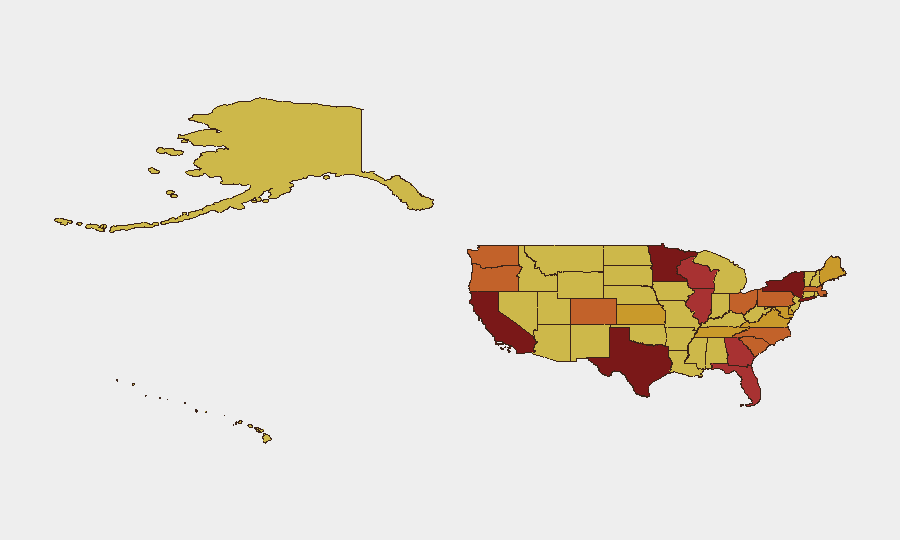
Situation Summary
The United States faces a composite threat score of 95 (rank #10 globally), driven by sustained Iranian-linked cyber operations against operational technology infrastructure, elevated terrorism risk around U.S. government facilities tied to ongoing Middle East escalation, and ongoing ransomware and data-compromise incidents affecting critical sectors. Travel disruptions and enhanced screening measures are in effect due to airspace closures in the Middle East and disease-screening protocols. The threat environment shows no immediate de-escalation; cyber targeting and force-protection posture elevations are expected to persist through early August.
Key Developments
- Nationwide – July 24–25, 2026: CISA, FBI, and NSA issued a joint advisory confirming active Iranian-affiliated cyber operations targeting internet-connected programmable logic controllers and operational technology devices across U.S. critical infrastructure (energy, manufacturing, water/utilities), with indicators of compromise and mitigation guidance distributed to sector operators.
- U.S. financial and energy sectors – July 24–25, 2026: Heightened threat hunting and monitoring activity detected in energy, finance, and transportation networks for suspected Iranian-aligned intrusion activity following consecutive nights of U.S.–Iran strikes; sector briefings highlight elevated business continuity and data-security risk.
- Major U.S. airports and airlines – July 23–24, 2026: State Department updated its Worldwide Caution warning that periodic airspace closures and flight cancellations are expected due to U.S.–Iran escalation, with disruptions affecting Middle East routes and onward connections to the United States.
- Designated U.S. arrival airports – July 23–24, 2026: CDC/DHS enhanced Ebola screening in effect for U.S. citizens arriving from Democratic Republic of Congo, Uganda, or South Sudan within 21 days of departure; mandatory routing through designated hubs and secondary inspection anticipated.
- U.S. diplomatic facilities and transportation hubs – July 23–24, 2026: State Department Worldwide Caution explicitly warns that groups supportive of Iran may attack U.S.-linked locations worldwide; elevated security postures and force-protection measures activated at U.S. government facilities and major transportation nodes.
- U.S. financial services sector – July 24–25, 2026: Operational impact ongoing from National Association of Insurance Commissioners cyberattack and credit-rating data compromise; insurers adjusting capital calculations and risk frameworks while rating agencies continue pausing data-sharing protocols.
- U.S. academic and municipal networks – July 24–25, 2026: Post-incident recovery continuing from recent ransomware attacks and data breaches affecting universities and local government systems; temporary suspension of non-emergency services and data-breach notifications in progress.
Highest-Risk Areas
New York, California, and Texas dominate the sub-national ranking (96.5, 95.9, and 93.5 respectively), reflecting concentration of critical infrastructure, financial services, and diplomatic presence in these states. Minnesota, Wisconsin, and Florida follow at 80, 79.8, and 79.2, indicating distributed cyber and physical threat activity. The elevated scores correlate with Iranian cyber targeting of OT infrastructure, heightened terrorism risk around federal facilities, and ongoing ransomware activity affecting municipal and institutional networks across multiple jurisdictions.
How GeoBit Would Assist
Security teams would deploy AOI Monitoring & Early Warning to track Iranian-linked cyber indicators, DNS sinkholes, and command-and-control infrastructure across assigned critical-infrastructure networks; Conflict & Military tracking to monitor U.S.–Iran escalation and corresponding force-protection posture changes; and Network & Actor Analysis to correlate newly disclosed indicators of compromise with existing intrusion activity and attribute threat campaigns to operational cells.
7-Day Outlook
Iranian cyber operations are expected to persist or intensify through early August as U.S.–Iran military tensions remain elevated. Airspace closures and travel disruptions will likely continue, with potential short-notice rerouting of long-haul flights. Enhanced security screening and heightened alert levels at U.S. government and symbolic sites are forecast to remain in effect pending de-escalation signals.
Highest-Risk Areas — Ranked
| # | State / Region | Risk |
|---|---|---|
| 1 | New York | 96.5 |
| 2 | California | 95.9 |
| 3 | Texas | 93.5 |
| 4 | Minnesota | 80 |
| 5 | Wisconsin | 79.8 |
| 6 | Florida | 79.2 |
| 7 | Illinois | 76.4 |
| 8 | Georgia | 76 |
| 9 | Washington | 75.6 |
| 10 | Colorado | 75.3 |
| 11 | Ohio | 74.6 |
| 12 | Pennsylvania | 74.2 |
Sources
Previous Daily Briefs
A new United States brief is written every day — each with its own risk map and downloadable CSV. Here's the last week; use the calendar to go further back.
📅 Browse every day by calendar →
Highlighted days have a brief. Tap a day for that day's map & analysis, or “csv” for that day's dataset ($5).
Atlas — our AI intelligence desk — emails them this snapshot personally. Nothing else, no list.