Situation Summary
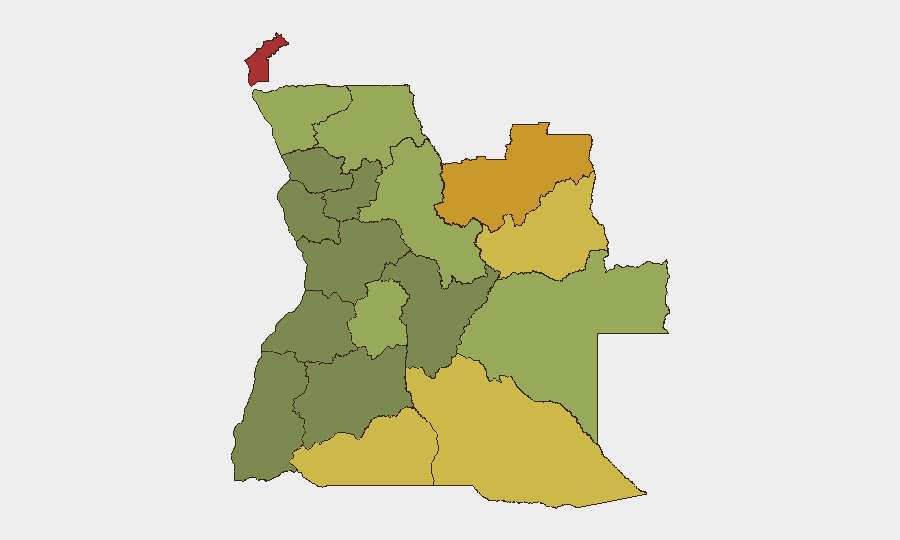
Angola remains a moderate-risk operating environment (rank #56 globally, composite score 32) with no tracked acute incidents in the past 24 hours and no nationally significant armed conflict or civil unrest. Security risks are concentrated in resource-rich frontier provinces—particularly Cabinda, Lunda Norte, and Lunda Sul—where informal armed groups, criminal networks, and smuggling operations create localized but persistent threats. Recent events indicate police operational tensions and isolated criminal incidents rather than systemic escalation; however, administrative and cyber vulnerabilities have demonstrated potential to disrupt essential services.
Key Developments
- Uíge Province, Uíge city (2026-08-09): Police dispersed a UNITA political gathering near the party's provincial headquarters. Police reported use of moderate, non-lethal force; UNITA alleged assault on party officials and claimed live rounds were deployed. At least one civilian and three police officers sustained minor injuries. Assessment: localized political friction without broader escalation signals.
- Luanda (2026-08-07): A scheduled migration of the Public Finance Management System caused temporary administrative service interruption. No evidence of cyberattack or infrastructure compromise; classified as routine maintenance disruption.
- Calomboloca Penitentiary (2026-08-05): Accidental firearm discharge killed one prison officer and injured another. Assessed as operational accident, not security breach or escape attempt.
- Mulenvos, Luanda (2026-08-07): Police detained an 18-year-old suspect in connection with homicide of a 45-year-old neighbor. Classified as localized violent crime without organized-crime indicators.
- National assessment (2026-08-08): Security briefing confirmed no armed conflict, civil unrest, or nationally significant incidents in preceding 24–48 hours, indicating stable baseline conditions outside high-risk provincial zones.
Note: The Unitel cyberattack (payment, digital-transfer, and internet services disruption across Luanda) began 2026-07-28 and recovery was reported by 2026-08-05/06, placing it outside the current 24–48-hour reporting window but flagged as a recent infrastructure vulnerability.
Highest-Risk Areas
Cabinda (risk 78), Lunda Norte (72), and Lunda Sul (68) provinces drive Angola's threat profile. These resource-extraction zones host competing armed factions, transnational smuggling networks, and weak state presence, creating environments conducive to informal conflict, criminal extortion, and supply-chain disruption. Cuando Cubango, Cunene, and Moxico (risk 64, 62, 58) present secondary but significant risks linked to border porosity and illicit cross-border activity. Luanda, while ranked lower in sub-national risk, remains operationally significant as the capital and primary hub for commercial activity; recent cyber and police incidents there underscore administrative and services-delivery vulnerabilities affecting corporate operations.
How GeoBit Would Assist
Security teams operating in Angola should deploy AOI Monitoring & Early Warning on high-risk provinces (Cabinda, Lunda Norte/Sul, Cuando Cubango) to track armed-group movements and criminal incidents in real time. Intel Sweep and multi-language OSINT (X, Telegram, local media) provide continuous detection of political tensions, police operations, and labor/supply-chain disruptions affecting Luanda and provincial logistics hubs. Routing & Network Analysis identifies secure and alternative transit corridors, and GIS & Spatial Analysis maps resource zones and criminal-activity clusters to inform duty-of-care and asset-protection planning.
7-Day Outlook
Angola's security trajectory remains stable at the national level, with risk concentrated in frontier provinces. Police-opposition political friction may recur around election cycles or party activities; localized crime and border smuggling will persist. Corporate operations in Luanda and provincial resource zones should maintain baseline security posture while monitoring political calendars and telecommunications infrastructure.
Highest-Risk Areas — Ranked
| # | State / Region | Risk |
|---|---|---|
| 1 | Cabinda Province | 78 |
| 2 | Lunda Norte Province | 72 |
| 3 | Lunda Sul Province | 68 |
| 4 | Cuando Cubango Province | 64 |
| 5 | Cunene Province | 62 |
| 6 | Moxico Province | 58 |
| 7 | Zaire Province | 54 |
| 8 | Huambo Province | 50 |
| 9 | Uíge Province | 48 |
| 10 | Malanje Province | 42 |
| 11 | Bié Province | 35 |
| 12 | Huíla Province | 32 |
Sources
Previous Daily Briefs
A new Angola brief is written every day — each with its own risk map and downloadable CSV. Here's the last week; use the calendar to go further back.
📅 Browse every day by calendar →
Highlighted days have a brief. Tap a day for that day's map & analysis, or “csv” for that day's dataset ($5).
Atlas — our AI intelligence desk — emails them this snapshot personally. Nothing else, no list.