Situation Summary
Bolivia remains in a state of heightened political and institutional instability, with the composite threat score of 34 positioning it at #52 globally. Over the past 48 hours, a cluster of arrest, occupation, and investigative actions—concentrated in La Paz and involving judicial, security, and financial actors—signals either an intensifying internal power struggle or enforcement action tied to the ongoing state of emergency declared 20 June 2026. The convergence of military intelligence activity, central bank occupation, and multi-sector arrests suggests fragmentation of state authority and elevated risk of further institutional disruption.
Key Developments
- 2026-07-26 · La Paz (inferred) · Firefighter Demonstration vs. Hospital: Public sector labor action against a health facility; consistent with broader May–ongoing protest cycle across public services and amplifying institutional strain.
- 2026-07-25 · La Paz (inferred) · Central Bank Occupation: Non-state actors or competing state organs occupied the Central Bank, indicating loss of monopoly control over critical financial infrastructure and potential asset-freezing or policy disruption.
- 2026-07-25 · Judicial Arrest/Detention: A judge was arrested or detained; suggests either purge of the bench, politically motivated justice system action, or criminal investigation within the judiciary itself—materially raising rule-of-law risk.
- 2026-07-25 · Multi-Sector Arrests (Bolivia-wide): Broad detention sweep by state forces; pattern unclear (security threat response vs. political crackdown) but indicates state coercive capacity is being mobilized at scale.
- 2026-07-25 · Agricultural Investigation: Ministry investigation into farmers; consistent with May–ongoing land-use and resource-access disputes in rural regions, particularly risk in Cochabamba and Santa Cruz provinces.
- 2026-07-24 · Senatorial Public Statement: High-level political messaging; indicates divisions within legislative branch or public signaling of institutional challenge.
- 2026-07-24 · Police Detention Action vs. Bolivia: Police arrested or detained individuals linked to the state itself; intra-security-force friction or rogue law enforcement.
- 2026-07-24 · Intelligence/Military Force Activity in La Paz: Military intelligence conducted conventional force operation in capital; suggests either counter-coup/counterinsurgency readiness or enforcement of state control over security apparatus.
Highest-Risk Areas
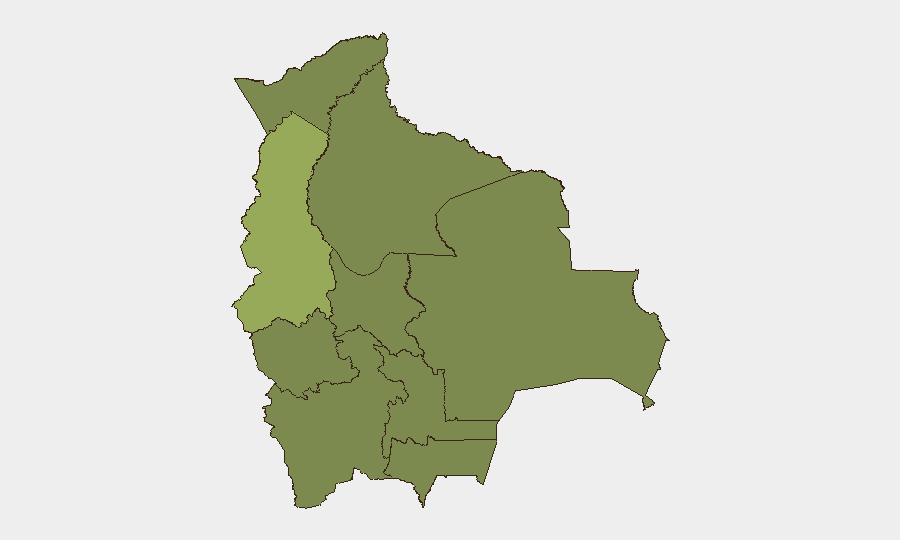
La Paz (risk 53.8) accounts for the majority of detected events and is the primary locus of state institutional volatility—arrests of judges, central bank occupation, military intelligence operations, and legislative statements all concentrate there. Tarija (33.5) represents a secondary risk cluster of unknown character; investigation is warranted. The remaining departments (Santa Cruz, Chuquisaca, Potosí, Pando, Beni, Oruro, Cochabamba, each 23.8–25.1) show elevated but more diffuse risk, driven primarily by agrarian disputes, labor action, and continuation of May–ongoing protest cycles rather than acute institutional collapse.
How GeoBit Would Assist
Entity and Network Analysis applied to arrest/detention patterns would clarify whether arrests target political opponents, security rivals, or criminal networks—critical to distinguishing state purge from criminal enforcement. AOI Monitoring & Early Warning deployed on La Paz government quarter, Central Bank, and judiciary buildings would provide real-time alerts to occupation, protest, or force deployment. OSINT fusion (X, Telegram, local media, radio SIGINT) would disambiguate official vs. competing narratives on arrests and military movement, enabling duty-of-care teams to distinguish routine enforcement from institutional breakdown.
7-Day Outlook
Absent further acute triggering events (e.g., renewed mass protest, military standoff), institutional tensions are likely to simmer at current elevated levels, with episodic arrests and public statements signaling ongoing factional friction. If central bank occupation persists or expands to other critical infrastructure (airports, utilities, border posts), risk of supply-chain disruption and capital flight rises materially. International mediation or security-force realignment could stabilize the situation; escalation of investigative actions or detentions of senior officials would signal further decay.
Highest-Risk Areas — Ranked
| # | State / Region | Risk |
|---|---|---|
| 1 | La Paz | 53.8 |
| 2 | Tarija | 33.5 |
| 3 | Santa Cruz | 25.1 |
| 4 | Chuquisaca | 24.4 |
| 5 | Potosí | 23.8 |
| 6 | Pando | 23.8 |
| 7 | Beni | 23.8 |
| 8 | Oruro | 23.8 |
| 9 | Cochabamba | 23.8 |
Previous Daily Briefs
A new Bolivia brief is written every day — each with its own risk map and downloadable CSV. Here's the last week; use the calendar to go further back.
📅 Browse every day by calendar →
Highlighted days have a brief. Tap a day for that day's map & analysis, or “csv” for that day's dataset ($5).
Atlas — our AI intelligence desk — emails them this snapshot personally. Nothing else, no list.